The short answer to "is there free reconciliation software?" is yes. The longer answer is more interesting. In Türkiye, "e-mutabakat" (e-reconciliation) is an established software category built around sending balance confirmation letters to trading partners electronically and collecting their replies — and several vendors in it do offer genuinely free tiers in 2026. But almost all of them make the same narrow task free: sending the balance notice and logging the answer. The part of reconciliation that actually consumes hours — finding which line item causes the gap when two balances disagree — sits outside nearly every free tier.
This article separates the three commercial models hiding under the word "free," lists the verified allowances with their sources, gives you a two-minute formula for deciding whether free is enough at your volume, and opens up the limits that never appear on a pricing page.
A transparency note: every allowance, plan, and price below comes from the vendors' own published pages — lists published as of August 2026, accessed on 9 August 2026 — and can change at any time; verify against the source before deciding. The goal is not to call anyone inadequate, but to show precisely what each tool is good at and what it does not do.
"Free reconciliation software" means three different things
In the market, one word covers three distinct commercial models, and comparing them without naming the model is hopeless:
- 1. A permanent free tier (freemium). No time limit, a volume limit instead. You get a monthly allowance of sends or rows; when it runs out, you either wait for the next month or move to a paid plan.
- 2. Reconciliation bundled into a product. The module carries no separate charge, but it arrives inside another subscription — the condition for "free" is being that vendor's customer.
- 3. A time-limited free trial. Full function, short clock. Excellent for evaluation, not a plan for continuity.
There is a fourth option, and most small businesses actually run on it: a spreadsheet plus a letter template. We will come back to where that breaks.
Türkiye's permanent free tiers in 2026: who gives what
Based on lists published as of August 2026, these are the verified options with a permanent free tier:
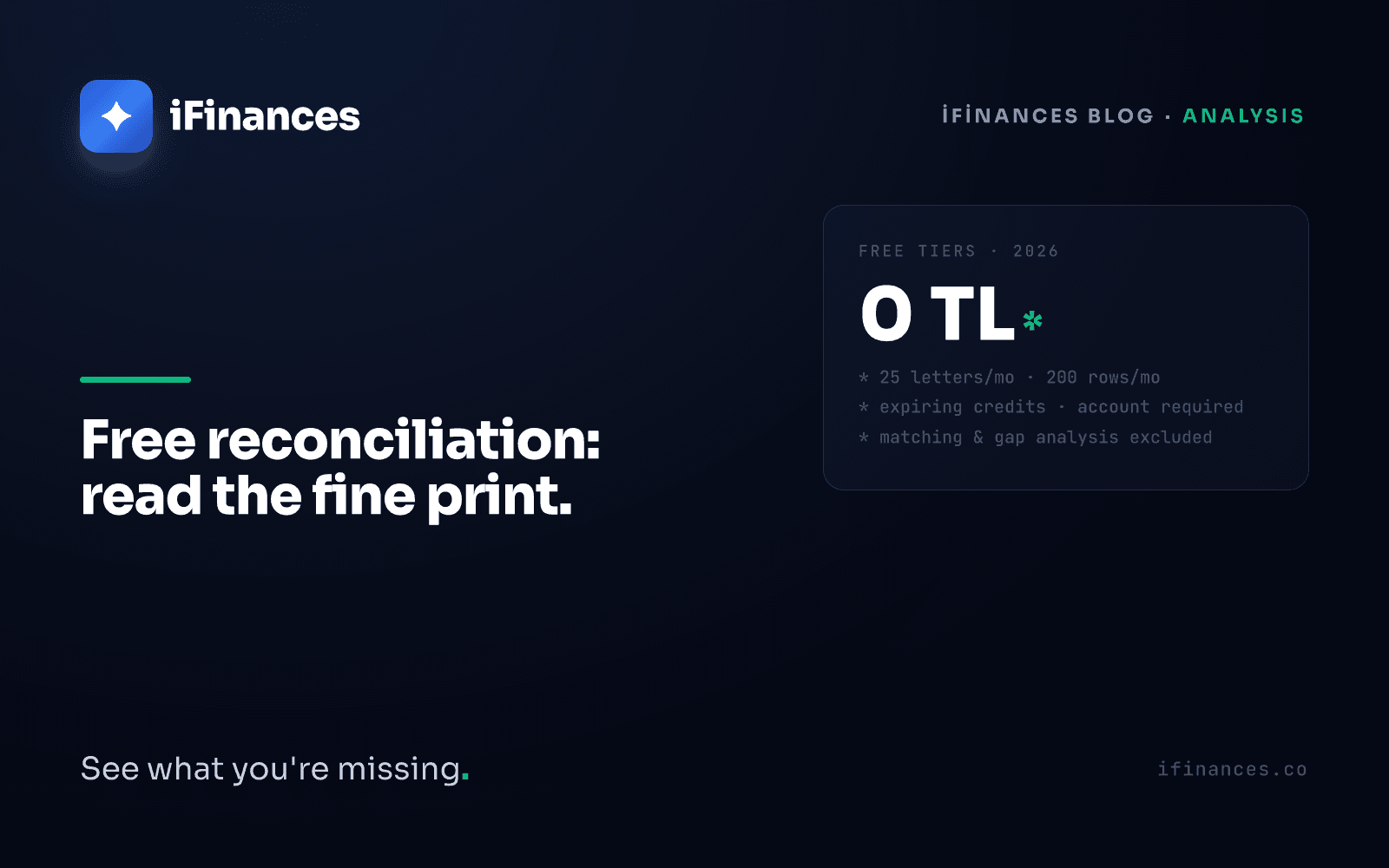
- Kolaymutabakat — Free package. Its pricing page offers 25 reconciliation sends per month (current-account and Ba/Bs), with unused allowance not rolling over to the next month. The first paid step is TL 28,450 + VAT for 1,500 reconciliations — so the jump beyond free is not a small one.
- Akıllı Mutabakat — Starter plan. The product site advertises a Starter plan at TL 0: 200 rows per month, one user. Above it sit Professional at TL 499 (2,000 rows, three users) and Business at TL 1,499 (10,000 rows, ten users). Note the unit: rows, not letters — because this product is positioned on the matching side, not the sending side.
- e-BABS — free account. Its pricing page states that each reconciliation burns one credit and that credits must be used within a year (the free package excepted). Its reconciliation letter sample page offers an interactive builder, but downloading a PDF or sending by e-mail requires an account — a free account comes with 25 credits a month.
- Mikro e-Mutabakat — bundled. According to its product page, e-reconciliation is included in Mikro's commercial accounting products at no extra cost, covering Ba/Bs, current-account reconciliation, and bank statement comparison, and the counterparty does not need to be a Mikro user. Here "free" is an entitlement that comes with being a customer.
A free trial is not a free product
The second group looks free in search results but runs on a clock. TAM Mutabakat works through a 14-day free trial plus a demo request and publishes no public price list. E-Mutabakat Bilişim advertises a 30-day free trial, calculates pricing from your monthly reconciliation count rather than a static list, and describes a success-based model summed up as "don't pay for reconciliations that get no reply." On the pre-accounting side, Paraşüt gives a 14-day trial with no commitment and no card details.
There is also a discount layer that is easily mistaken for free. e-BABS states a 10% discount on all packages for Paraşüt subscribers; Paraşüt's own guide routes current-account, Ba-Bs, and cross-border reconciliations to the third-party Kolaymutabakat integration and mentions a 25% discount exclusive to Paraşüt customers. Discounts are good news — but they mean "cheaper alongside another bill," not "no bill."
One more question worth closing here: there is no free government-run e-reconciliation service. The applications listed on the Turkish Revenue Administration's official e-document portal — e-Invoice, e-Archive, e-Waybill, e-SMM, e-Müstahsil, e-Ticket and others — do not include an "e-Mutabakat" application, and reconciling electronically has never been mandatory. E-reconciliation is the name of a commercial software category, not a tax authority application.
Is free enough for you? A two-minute calculation
One formula settles it:
Annual sends = number of accounts you reconcile × how many periods per year you send
Then compare that number to the free allowance. Three examples:
- 40 accounts, once a year at year-end: 40 sends. A 25-per-month allowance won't cover it in a single month, so you split the batch across December and January. Technically free still works — but your close calendar stretches.
- 120 accounts, quarterly: 480 sends a year, about 40 a month. The allowance runs out in the first week of every quarter; free no longer works in practice.
- 1,000 accounts, quarterly: 4,000 sends a year. At this volume the choice of pricing model matters more than any single price; we ran the annual cost of all three models through this exact scenario in our 2026 e-reconciliation pricing analysis.
Row-based free plans change the unit of the calculation: 200 rows a month is roughly the monthly transaction count of a single active account. Counting one month of statement rows, once, tells you within minutes whether such a plan fits.
Then there is seasonality. Reconciliation is not evenly spread across the year: under article 94 of the Turkish Commercial Code, if the parties have no agreement or commercial custom on the accounting period, the last day of each calendar year counts as the closing day — so the workload piles into December and January. Monthly allowances do not match that curve.
The fine print: five invisible limits of a free tier
- 1. Allowances that don't roll over. Kolaymutabakat's free package does not carry unused monthly sends forward. The allowance you skip during ten quiet months will not be there in the two months you actually need it.
- 2. Credit expiry and overage charges. On e-BABS, credits must be used within a year (free package excepted); the same page notes that for İzibiz, package overage is billed at the credit unit price and exceeding a 250 KB data limit is charged per MB. The day you move from free to paid, those rules become your rules.
- 3. The ecosystem condition. Mikro bundles reconciliation into its products, but the condition is being a Mikro user; the e-BABS 10% discount depends on a Paraşüt subscription, and the 25% discount in Paraşüt's guide depends on being a Paraşüt customer. Whenever "free" hangs on a subscription, the real question is: would I switch my accounting software for this tool?
- 4. Evidence and archiving. A reconciliation is not correspondence; it is a chain of evidence. Article 94 of the Turkish Commercial Code gives the party receiving a balance statement one month to object — through a notary, registered letter, telegram, or a document bearing a secure electronic signature — and article 82 requires commercial books and records to be retained for ten years. We covered what silence actually means in no reply to a reconciliation letter. On a free tier, ask up front how long the send record is retained and whether it can be exported; archiving is a line item paid lists highlight separately.
- 5. Part of the allowance may be obsolete. Most free packages define the allowance as "current-account plus Ba/Bs." But the Ba and Bs forms — the monthly purchase and sales cross-reports Turkish taxpayers used to file — were abolished by General Communiqué No. 565 published in the Official Gazette on 25 September 2024, starting with the September 2024 period. Ba/Bs comparison can still be a useful cross-check, but it no longer rests on a filing obligation; we examined what that changed in Türkiye abolished the Ba-Bs forms.
The real limit isn't volume — it's function
Every limit so far is countable: 25 sends, 200 rows, 14 days. The real limit of free tiers sits on the uncountable side.
What free tiers do is clear: deliver a balance to the counterparty, collect the reply, record "agreed" or "not agreed." What they don't do is just as clear:
- row-level matching — partial payments, FIFO clearing, one receipt spread across several invoices
- root-cause attribution for a difference — a missing invoice, a duplicate entry, a payment posted to the wrong account, a period shift
- cross-checking bank movements, e-invoices, and ledger records against one another
- isolating foreign-exchange differences, detecting anomalies, and showing an explainable rationale for every match
One honest qualification: the category is not entirely unrepresented. Akıllı Mutabakat's TL 0 plan sits on the matching side rather than the sending side — with free capacity of 200 rows a month and one user. We unpack the difference between the two categories — sending letters versus actually matching — in the first question about reconciliation software; if you want to see products side by side, our 2026 e-reconciliation software comparison is the better starting point.
The genuinely free option: a template and a spreadsheet
You can reconcile without buying software at all, and at low volume that is usually the sensible route. We published a Word letter template and an Excel reconciliation form — no sign-up, no e-mail required — in our reconciliation letter template guide; for the bank side, the step-by-step bank reconciliation guide pairs the process with a worksheet.
What breaks a spreadsheet is not volume but complexity. The file works well as long as it lives on one desk in one version. It breaks when three things arrive together: foreign-currency invoices (how FX movement hits the balance), partial and lump-sum payments (which invoices a single receipt actually cleared), and comparison across more than one source (bank, e-invoice, ledger). Past that point, what happens in the spreadsheet stops being reconciliation and becomes manual matching — and manual matching is costed in hours, not license fees.
Three signals that it's time to pay
The decision to leave the free tier is triggered by signals, not by volume:
- 1. Finding differences takes longer than sending letters. If you send in an hour and then chase gaps for three days, sending is not the thing worth paying for.
- 2. The same difference returns every period. A recurring gap is a data problem, not a correspondence problem; solving it again each period is wasted effort.
- 3. You carry FX transactions, partial payments, and returns. That trio produces exactly the kinds of differences a confirmation-collection tool is not designed to resolve.
If none of these apply to you, stay on the free tier with a clear conscience: for a business with few counterparties, low volume, and mostly local-currency trade, a free sending tool plus a decent template is more than enough. When the signals appear, the issue is not budget — it is changing category.
iFinances sits in that second category: it doesn't replace your accounting software or ERP, it sits on top of them. It takes in your Excel/CSV statements and bank movements, matches rows automatically, shows an explainable rationale for every match, isolates FX differences and anomalies, and at the end of the process produces the reconciliation letter and archives the signed copy.
If you'd like to work out where your own counterparty volume puts you against this threshold, get in touch — we'll run the formula above through your numbers together.
Frequently Asked Questions
Is there a completely free reconciliation program?
Permanent free tiers exist, but every one of them is capped by volume or by function. Based on lists published as of August 2026, Kolaymutabakat offers 25 reconciliation sends per month (unused allowance does not roll over), Akıllı Mutabakat's Starter plan is TL 0 with 200 rows per month and one user, and Mikro bundles e-reconciliation into its commercial accounting products. No unlimited, fully featured free reconciliation software exists.
What do free reconciliation packages not include?
Every free tier focuses on sending balance confirmations and collecting replies. Row-level matching, partial-payment and FIFO clearing logic, root-cause attribution for a difference, cross-checking bank records against e-invoices and the ledger, and anomaly detection all sit outside these packages. Non-rolling allowances, credit expiry, and integration fees are also details you find in the terms rather than on the price tag.
Is a spreadsheet enough for reconciliation?
At low volume and mostly single-currency trade, yes — a good template and a disciplined calendar usually suffice. A spreadsheet breaks when foreign-currency invoices, partial or lump-sum payments, and multi-source comparison arrive together. Past that point the work stops being reconciliation and becomes manual matching, which is costed in hours rather than license fees.
What is the difference between a free trial and a free plan?
A free plan has no end date but a capped volume; a free trial is fully featured but expires. As of August 2026, TAM Mutabakat offers 14 days, E-Mutabakat Bilişim 30 days, and Paraşüt a 14-day pre-accounting trial with no card details required. A trial is an evaluation instrument, not a plan for continuity.
Does the Turkish tax authority offer a free e-reconciliation service?
No. The applications listed on the Revenue Administration's official e-document portal — e-Invoice, e-Archive, e-Waybill, e-SMM and others — do not include an 'e-Mutabakat' application, and reconciling electronically has never been mandatory in Türkiye. E-reconciliation is a commercial software category, not a tax authority application.