The year-end close is done, the balance statements have been cut, and the reconciliation letters have gone out. Three weeks later, the picture looks familiar to every finance team in Türkiye: some counterparties wrote back "agreed", a few reported a different balance, and a sizeable group never answered at all. Which raises the question every controller eventually asks: what happens when there is no reply to a reconciliation letter? Is silence legally treated as acceptance — or does it mean nothing at all?
The answer sits in Article 94 of the Turkish Commercial Code (Türk Ticaret Kanunu, or TTK — Law No. 6102, the statute governing commercial relationships in Türkiye). But most of the summaries circulating online skip a critical precondition of that article. In this guide we walk through the one-month objection window, the channels that count as a valid objection, the specific conditions under which silence amounts to accepting a balance, and the surprising weight an unchallenged statement can carry in debt-enforcement proceedings.
If you first want the full picture of how reconciliation works in Türkiye — current accounts, bank, e-invoice — start with our complete reconciliation guide. This article zooms in on one question: nobody answered, now what?
TTK Article 94: how the one-month objection window works
The current-account relationship is governed by Articles 89 to 101 of the Turkish Commercial Code. Article 94 builds a two-part mechanism:
- The account period. If the parties have not fixed an account period by contract or trade custom, the last day of each calendar year — 31 December — is deemed the closing date. That is the legal anchor behind Türkiye's year-end reconciliation season, which our week-by-week year-end calendar turns into an operating plan.
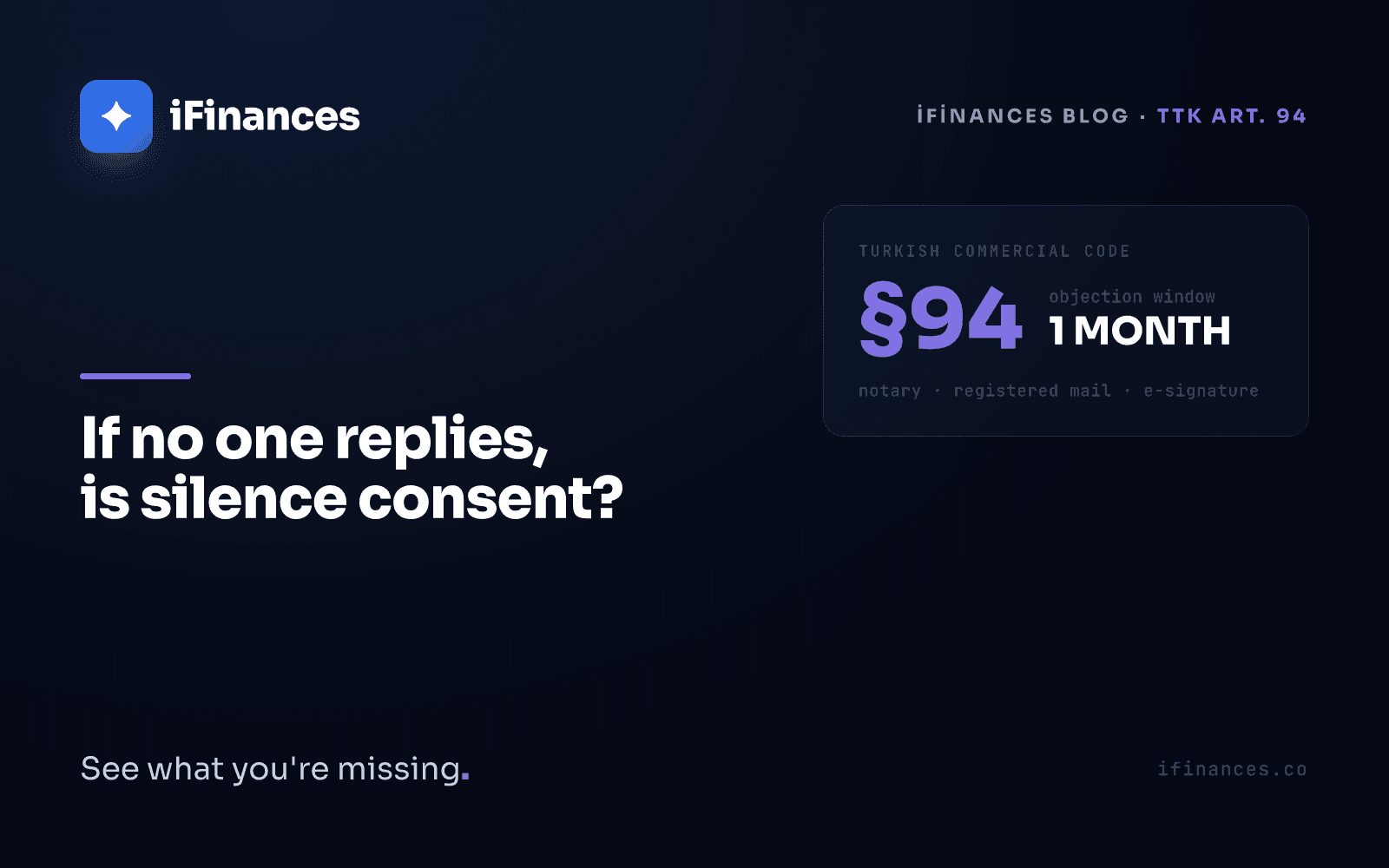
- The objection window. The party that receives the statement showing the closing balance is deemed to have accepted it unless they object within one month of receiving it.
Note that the clock starts on receipt, not on dispatch. That makes proof of delivery at least as important as the content of the letter itself.
Only a handful of objection channels count
The law also prescribes the form of a valid objection: through a notary, by registered mail, by telegram, or in a written document bearing a secure electronic signature. Plain e-mail, a phone call, or a WhatsApp message is not on that list. When the counterparty's accountant fires back an ordinary e-mail saying "our records show a different balance", that is a valuable practical signal — but it is not a form-compliant objection within the meaning of Article 94. We come back to how to object properly below.
The nuance most summaries miss: silence is not always acceptance
Here is the precondition that tends to get lost. Under Article 89 of the TTK, a current-account agreement is not valid unless made in writing — written form is a condition of validity. And the practice of the Court of Cassation (Yargıtay, Türkiye's highest court for civil and commercial matters) ties Article 94's silence-equals-acceptance rule to the existence of such a written current-account agreement: where no written agreement exists, simply staying silent on a reconciliation letter may not, by itself, amount to accepting the balance.
A large share of commercial relationships in Türkiye, however, run on invoice-and-payment flows without any written current-account agreement. That reality cuts both ways:
- If you sent the letter: you cannot build a collection strategy on "they stayed silent for a month, therefore they accepted" alone; silence gains meaning only alongside other evidence.
- If you received it: "there is no agreement anyway, so we can ignore it" is a risky comfort too — as the next section shows, unchallenged statements can turn into powerful documents in evidence and enforcement law.
This distinction is a matter of case-law nuance. In any live dispute, current Court of Cassation rulings should be reviewed together with a lawyer.
The weight of an unchallenged balance: conclusive evidence and the five-year clock
Debt enforcement is where the price of silence shows most clearly. Turkish legal literature treats a balance statement that was not challenged in time as capable of qualifying as conclusive evidence under Article 68/b of the Enforcement and Bankruptcy Law (İcra ve İflas Kanunu, or İİK — the statute governing debt collection in Türkiye), and Court of Cassation decisions have examined the evidentiary value of reconciliation letters in current-account claims. In plain terms: the letter that looks like routine paperwork today can be the strongest exhibit on the table in tomorrow's enforcement hearing.
There is a time dimension as well. Under TTK Article 101, claims relating to the liquidation of the current account, the accepted balance, interest, and accounting errors become time-barred five years after the agreement ends. A statement left unanswered today can resurface in a case file years later.
How binding is "you will be deemed to agree unless you reply within 7 days"?
Most template letters in circulation carry a version of the same sentence: "Unless you respond within 7 days, you will be deemed to have agreed with this balance." Does that clause actually deliver what it threatens?
The statutory objection window is one month, and the silence mechanism is conditional on the framework described above. A shorter deadline written unilaterally into a letter does not, on its own, create a binding legal consequence for the recipient — nobody becomes "reconciled" automatically because a number of days was printed on a letter they received.
That does not make the clause useless. Stating a response deadline builds process discipline, prompts the counterparty to act, and creates an evidentiary record that weakens a later "we received it but were still reviewing" defence. The right framing is to treat the deadline as an operating standard, not a legal threat. For a properly structured letter — with positive, negative, and open-balance variants — see our reconciliation letter template guide.
Is reconciliation mandatory in Türkiye?
Short answer: no — there is no general statutory duty to perform current-account reconciliation. E-reconciliation does not appear among the applications listed on the e-document portal of the Turkish Revenue Administration (GİB): it is an optional commercial service, not a mandated e-document application. Even the Ba-Bs forms — the old monthly purchase and sales listings that once forced a de facto monthly cross-check between companies — were abolished starting with the September 2024 period by VUK General Communiqué No. 565 (Official Gazette 25.09.2024, No. 32673).
But "not mandatory" is very different from "not needed":
- Independent audit. Under BDS 505 "External Confirmations" — Türkiye's auditing standard on external confirmations — the auditor keeps control of confirmation requests and must perform alternative audit procedures for every confirmation that goes unanswered. Non-responses slow the audit down; see our guide to staying audit-ready year-round.
- Evidence and risk management. The TTK 94 and İİK 68/b mechanics described above.
- Commercial hygiene. An unanswered balance usually hides a difference, and a difference usually means a missing invoice, a duplicate entry, or a posting to the wrong account.
When there is no reply to a reconciliation letter: a practical playbook
That is the legal frame — here is the operational one:
1. Set a reminder cadence. Follow the first letter with staged reminders around day 7 and day 15. Our five reconciliation email templates cover first contact, reminders, and escalation.
2. Switch channels. An accounting department that ignores two e-mails is often unlocked by a single phone call. For material amounts, move to registered mail or to a securely e-signed document delivered over KEP, Türkiye's registered electronic mail system.
3. Hunt the difference on your side too. Sometimes silence is neglect; sometimes it means the counterparty cannot tie your balance to their own ledger. Scan your records against the nine classic causes of balance mismatches.
4. Leave a trail. Dispatch dates, delivery confirmations, reminders, and every response belong in one archive. Remember that the one-month window runs from receipt — without proof of delivery, you lose the argument about when it started. Merchants are in any case required to retain commercial books and records for ten years under TTK Article 82.
5. Escalate significant balances to formal channels. If a large, ageing balance stays unanswered, a notarised balance notification signals seriousness and strengthens your evidence file.
If you are the party that disagrees: how to object properly
The other side of the coin: if the statement you received does not match your books, silence is the worst available option.
- Do not miss the window: one month from the day you received the statement.
- Use a valid channel: a notary, registered mail, telegram, or a document with a secure electronic signature. What satisfies the statutory form is the secure electronic signature itself; KEP, Türkiye's registered e-mail system, is only a delivery channel. Sending a securely e-signed document over KEP is a practical combination because it also leaves a delivery record — but for material balances a notary or registered mail remains the safest route.
- Make the objection concrete: "we disagree" is not enough — state which amount you dispute, the balance in your own records, and the supporting documents, and request an itemised statement.
- Keep the practical channel open in parallel: the formal objection protects your position, but the difference itself only gets resolved when both sides compare the accounts line by line.
Turn silence into a signal
The TTK Article 94 framework fits in three sentences. In relationships backed by a written current-account agreement, silence can ripen into acceptance one month after receipt. Without such an agreement there is no automatic acceptance — but an unchallenged statement can still become powerful evidence in enforcement proceedings. In either scenario, the party that documents the process wins.
That is exactly where iFinances helps: it generates reconciliation letters from your balance data, lets you track deliveries and responses in one place, and archives the signed copies of confirmed reconciliations — so unanswered letters land on your follow-up list instead of in a forgotten folder. Book a demo or get in touch to see the workflow, and use our week-by-week year-end calendar to plan the season.
This article is for general information only and does not constitute legal advice. For any specific dispute, review the current case law together with your lawyer and financial advisor.
Frequently Asked Questions
How long do you have to object to a reconciliation letter in Türkiye?
Under Article 94 of the Turkish Commercial Code, the recipient of a balance statement must object within one month of receiving it. That silence-equals-acceptance outcome applies in the context of a written current-account agreement (Article 89 requires written form for validity); without one, silence alone may not amount to acceptance. The clock runs from receipt, not dispatch, and shorter deadlines printed on the letter, such as "7 days", do not change the statutory period.
How do you validly object to a reconciliation balance?
The law recognises objections made through a notary, by registered mail, by telegram, or in a document bearing a secure electronic signature. A valid objection should state the disputed amount, your own recorded balance, and the supporting documents, and should request an itemised statement from the counterparty.
Is an objection sent by ordinary e-mail or WhatsApp valid?
It does not meet the formal channels listed in TTK Article 94. It remains a useful practical signal for resolving the difference, but for material balances you should object through a notary, by registered mail, or in a document bearing a secure electronic signature. It is the secure electronic signature that satisfies the statutory form; KEP, Türkiye's registered e-mail system, only carries such a document.
Is account reconciliation mandatory in Türkiye?
There is no general legal obligation to reconcile, and e-reconciliation is an optional service rather than a government-mandated e-document application. In practice, external confirmations in independent audits (BDS 505), evidentiary considerations, and receivable-risk management make regular reconciliation indispensable.