Search for e-reconciliation pricing in Türkiye and you won't find a comparison — you'll find a shelf of brochures. Every vendor explains its own model on its own page; some numbers sit in PDF price lists, others behind a "request a quote" button. As of 2026, there is virtually no independent piece that puts the market's three pricing models — credits, per-count packages, and subscriptions — side by side with published list prices.
That is the gap this article fills. First, a quick primer for readers new to the market: in Türkiye, "e-mutabakat" (e-reconciliation) is an established software category built around sending balance confirmation letters to your trading counterparties electronically — by e-mail, SMS, or even fax — and collecting their confirmations at scale. And a transparency note before the numbers: every figure below comes from the vendors' own published price lists (accessed 9 August 2026), excludes VAT (KDV, the Turkish value-added tax) unless stated otherwise, and can change at any time. Verify against the source page before deciding. The goal is not to declare anyone cheap or expensive, but to show how the models work, how to compute an annual cost for a sample company, and which line items never appear on the price tag.
One more frame up front: almost all of these prices buy the sending of a reconciliation letter and the collection of replies. Finding which line item causes the gap when two balances disagree — the part of reconciliation that actually consumes the hours — is mostly outside the scope of these lists. We'll return to that at the end.
Three e-reconciliation pricing models: credits, packages, subscriptions
The Turkish e-reconciliation market prices itself in three patterns:
- The credit (kontör) model: every send burns one prepaid credit, and you buy credits in packs. eLogo, Bay-t, DİA, and e-BABS work this way.
- The per-count package model: you buy an allowance of reconciliations instead of credits; this is Kolaymutabakat's approach.
- The subscription model: a flat monthly fee, with capacity defined by rows or users rather than credits. Akıllı Mutabakat sits here.
There are two notable exceptions. Mikro bundles e-reconciliation into its commercial accounting products at no extra cost, and the counterparty does not need to be a Mikro user. Sovos and TAM Mutabakat publish no public price list at all — you learn the price in a demo or sales conversation. That is a common enterprise-sales choice, not a criticism; but if you are budgeting, "the price is revealed in the meeting" is itself a data point.
The credit model: a balance that melts with every send
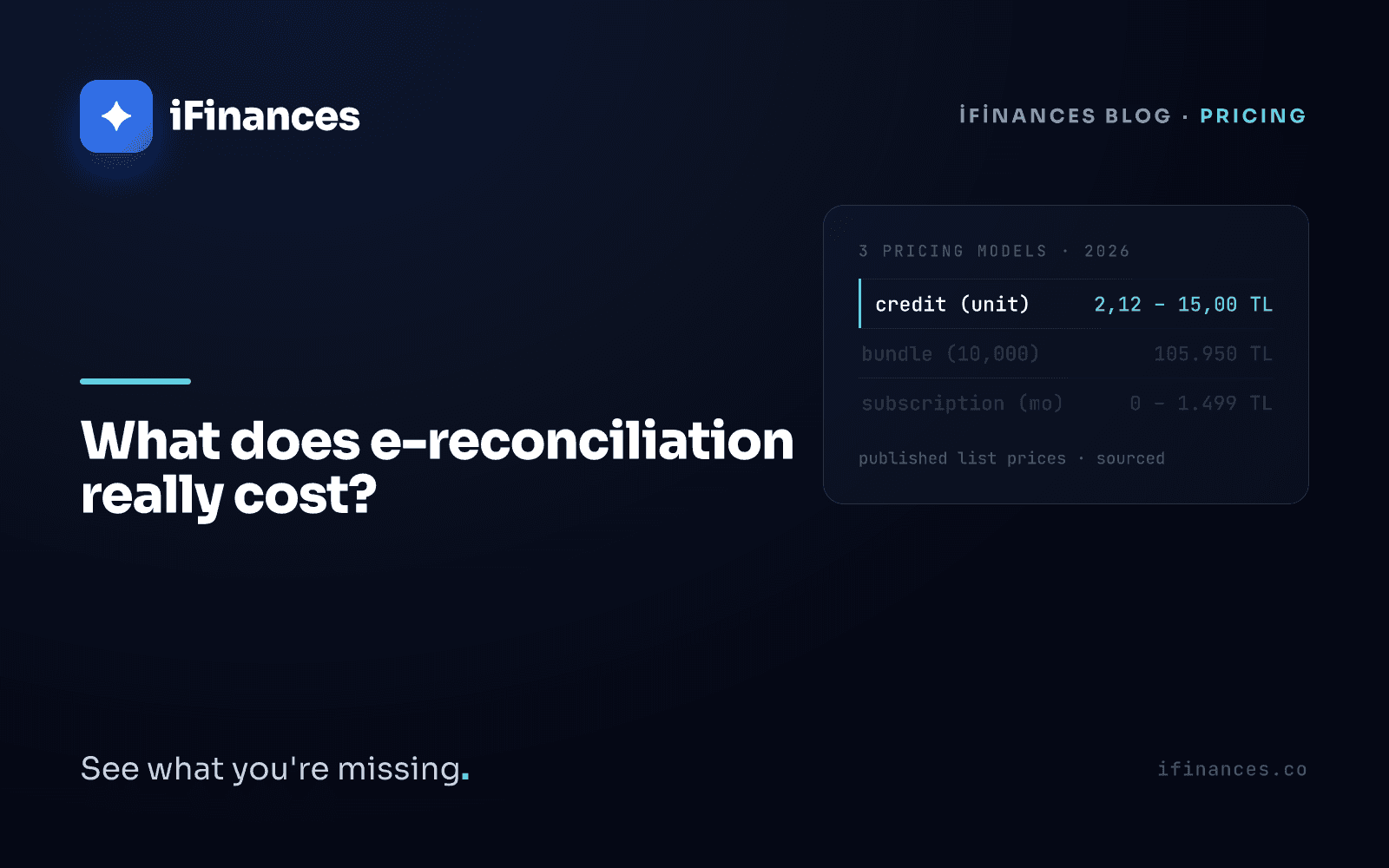
The clearest example is eLogo. Under its recommended price list effective 8 July 2026, every e-reconciliation letter sent — via e-mail, SMS, or fax — consumes one credit, with archiving included. The packs (excl. VAT):
- 150 credits: TL 2,250 (TL 15.00 per credit)
- 1,000 credits: TL 10,900 (TL 10.90)
- 10,000 credits: TL 66,100 (TL 6.61)
- 1,000,000 credits: TL 2,120,000 (TL 2.12)
The unit-price gap between the smallest and the largest pack is close to sevenfold. Credit pricing rewards scale: the small business that sends the least pays the most per send.
Bay-t layers a license under the credits: buying the software costs TL 10,950 (Capital) or TL 7,460 (Boss), renting it TL 4,928 and TL 3,357 respectively (excl. 20% VAT). Credits are sold separately and appear on the price list under the heading "iş takibi" (work-tracking) credit packs — 100 for TL 425, 1,000 for TL 2,990, 10,000 for TL 17,550 — and each e-document sent burns one credit. Confirm in writing whether those packs cover reconciliation sends.
On e-BABS the rule is the same — one reconciliation, one credit — with a critical detail: credits must be used within one year (free tier excepted). Paraşüt subscribers get a 10% discount on all packs. DİA's e-reconciliation also runs on credits, integrates with its receivables module, and covers five reconciliation types, from current-account balances (including foreign-currency and due-date variants) to the legacy Ba-Bs tax forms.
Per-count packages: pricing by reconciliation volume
Kolaymutabakat ties the price to a reconciliation count instead of credits: a free tier with 25 reconciliations per month (current-account and Ba-Bs; unused allowance does not roll over); a Small package at TL 28,450 + VAT for 1,500 reconciliations; an Economy package at TL 61,990 + VAT for 4,000; and a Large Business package at TL 105,950 + VAT for 10,000. Billing is applied "per reconciled company," and you don't pay unless a new reconciliation actually happens.
The strength of this model is predictability: if you know your counterparty count and your cadence in January, you know your bill. The weakness is the same coin's other face — if you don't fill the package, the unused allowance pushes your effective unit cost up.
Subscriptions — and the vendors that don't publish prices
Akıllı Mutabakat sells monthly subscriptions: a Starter plan at TL 0 (200 rows per month, one user), Professional at TL 499 (2,000 rows, three users), Business at TL 1,499 (10,000 rows, ten users), and custom Enterprise pricing. Note the unit: rows, not letters. That's because Akıllı Mutabakat is not a sender but an AI-assisted matching tool for current-account reconciliation — it does a different job from the other products on this page, a category difference we'll come back to.
E-Mutabakat Bilişim advertises a success-based model — "don't pay for reconciliations that get no reply" — with pricing custom-calculated via a slider (200 to 1,700 reconciliations per month) rather than a static list, a two-months-free annual option, and a 30-day free trial.
A meaningful share of the market publishes no prices at all: Sovos and TAM Mutabakat (a 14-day trial plus demo flow) quote only through sales conversations. The questions worth asking in those conversations are in the hidden-items section below.
Note: the validity period of these packages — monthly or annual — is not stated on the vendors' published price pages; only the free tier is explicitly described as "25 per month". Confirm the period in writing when you compare quotes.
A sample calculation: the annual cost for a company with 1,000 counterparties
The honest way to compare the models is to run the same scenario through all of them. Assumption: 1,000 active counterparty accounts, reconciled quarterly — 4,000 sends per year.
- eLogo (credits): four 1,000-credit packs = TL 43,600 + VAT. The 10,000-credit pack (TL 66,100) is cheaper per unit but means locking up two and a half years of stock at this volume.
- Bay-t (license + credits): a Boss license at TL 7,460 plus four 1,000-credit packs at TL 11,960 ≈ TL 19,420 + VAT in year one; only the credit cost recurs afterwards. Because those packs are listed under the "iş takibi" heading, this figure assumes they cover reconciliation sends — confirm that in the quote.
- Kolaymutabakat (per-count package): the 4,000-reconciliation Economy package at TL 61,990 + VAT (confirm the package's validity period in the quote).
- Akıllı Mutabakat (subscription): the Business plan runs 12 × TL 1,499 ≈ TL 17,988 per year — but a direct comparison misleads, because the unit is rows, not letters; a thousand counterparties can easily exceed 10,000 statement rows a month, and the product's job is matching, not sending.
For the same job, and subject to the caveats above, the annual bill ranges from roughly TL 19,000 to TL 62,000 — more than a threefold spread. The lesson is plain: the choice of model matters more than any single price list. Your own formula is simple: counterparties × reconciliation periods per year = sends; then look up the smallest package that covers that count in each model.
The hidden line items e-reconciliation pricing doesn't show
The list price is not the whole cost. When comparing quotes, always ask about these five items:
- 1. Credit expiry. On e-BABS, credits must be used within a year. A big pack's cheap unit price can evaporate along with the credits you fail to consume in time.
- 2. The scale penalty. On eLogo's list the unit price falls from TL 15.00 to TL 2.12. At low volume you pay the most expensive tier per send; renegotiate your pack tier as your volume grows.
- 3. The license-plus-credits double layer. As in the Bay-t example, some products add a software license or rental on top of the per-send cost. Sum both layers when computing an annual figure.
- 4. Non-rollover allowances and overage fees. Kolaymutabakat's free tier of 25 monthly sends doesn't roll over; on İzibiz, package overage is billed at the credit unit price and exceeding a 250 KB data limit is charged per MB. We examined the real limits of free tiers in is there really free reconciliation software?
- 5. Integration fees. At mutabakat.com, ERP integration is priced separately. Get "is integration included?" answered in the written quote.
A note for accounting firms: rather than buying a small package per client, calculating the firm-wide total send volume usually produces a better outcome — the credit model's scale discount only works that way. For managing the tool budget holistically, see our guide to SaaS cost optimization for accounting firms.
What are all these prices actually paying for?
Back to the frame we opened with. Nearly every figure above — credits, per-count packages, even the success-based model — is the price of sending a balance notification and collecting replies. The process ends when the counterparty says "we agree." But what happens when they say "we don't"?
That is when the real work begins: comparing two statements line by line, finding the missing invoice, the duplicate entry, the payment posted to the wrong account, the exchange-rate difference. That work — row-level matching and difference analysis — belongs to a different category from letter-sending tools. We unpack the two categories in does it send letters, or does it actually match?, and if you're in a selection process, read the seven critical criteria guide together with our 2026 e-reconciliation software comparison.
iFinances sits in that second category: it doesn't replace your accounting software or ERP — it sits on top of them. It takes in your Excel/CSV statements and bank transactions, matches rows automatically, shows an explainable rationale for every match, reports the differences, and at the end of the process generates the reconciliation letter and archives the signed copy. In other words, it automates the labor that comes before and after the letter you pay credits to send.
If you'd like to run a cost calculation with your own counterparty volume, get in touch — we'll work the formula above through your numbers together.
Frequently Asked Questions
How much does e-reconciliation software cost in Türkiye in 2026?
It depends on the model: in credit-based pricing, the unit price on eLogo's July 2026 list ranges from TL 2.12 to TL 15.00 per send depending on pack size; per-count packages start at TL 28,450 + VAT for 1,500 reconciliations (Kolaymutabakat); subscriptions range from TL 0 to TL 1,499 per month (Akıllı Mutabakat). All figures are published list prices accessed on 9 August 2026 and can change.
How does credit-based (kontör) pricing work?
Every reconciliation you send — by e-mail, SMS, or fax — burns one prepaid credit, and you buy credits in packs up front. Larger packs carry sharply lower unit prices; on eLogo's list the gap between the smallest and largest pack is close to sevenfold. Watch for expiry rules: on e-BABS, credits must be used within one year.
Is there free e-reconciliation software?
There are limited free tiers: Kolaymutabakat offers 25 reconciliations per month (unused allowance doesn't roll over), Akıllı Mutabakat has a TL 0 plan capped at 200 rows per month and one user, and Mikro bundles e-reconciliation into its commercial accounting products. Every free tier is limited by volume or by function.
Do these prices include line-level matching?
Mostly no. Credit and package prices cover sending balance confirmation letters and collecting replies. The work of finding which line item causes a mismatch — row-level matching and difference analysis — belongs to a separate software category and sits outside these price lists.