The supplier statement arrives on the third working day of the month. Someone opens it, compares the closing figure with the ledger, sees the same number, writes "agreed" across the top and files it. Nobody reads the forty lines underneath. In a great many finance teams that is the whole of statement reconciliation — and it is the part of the job that proves the least.
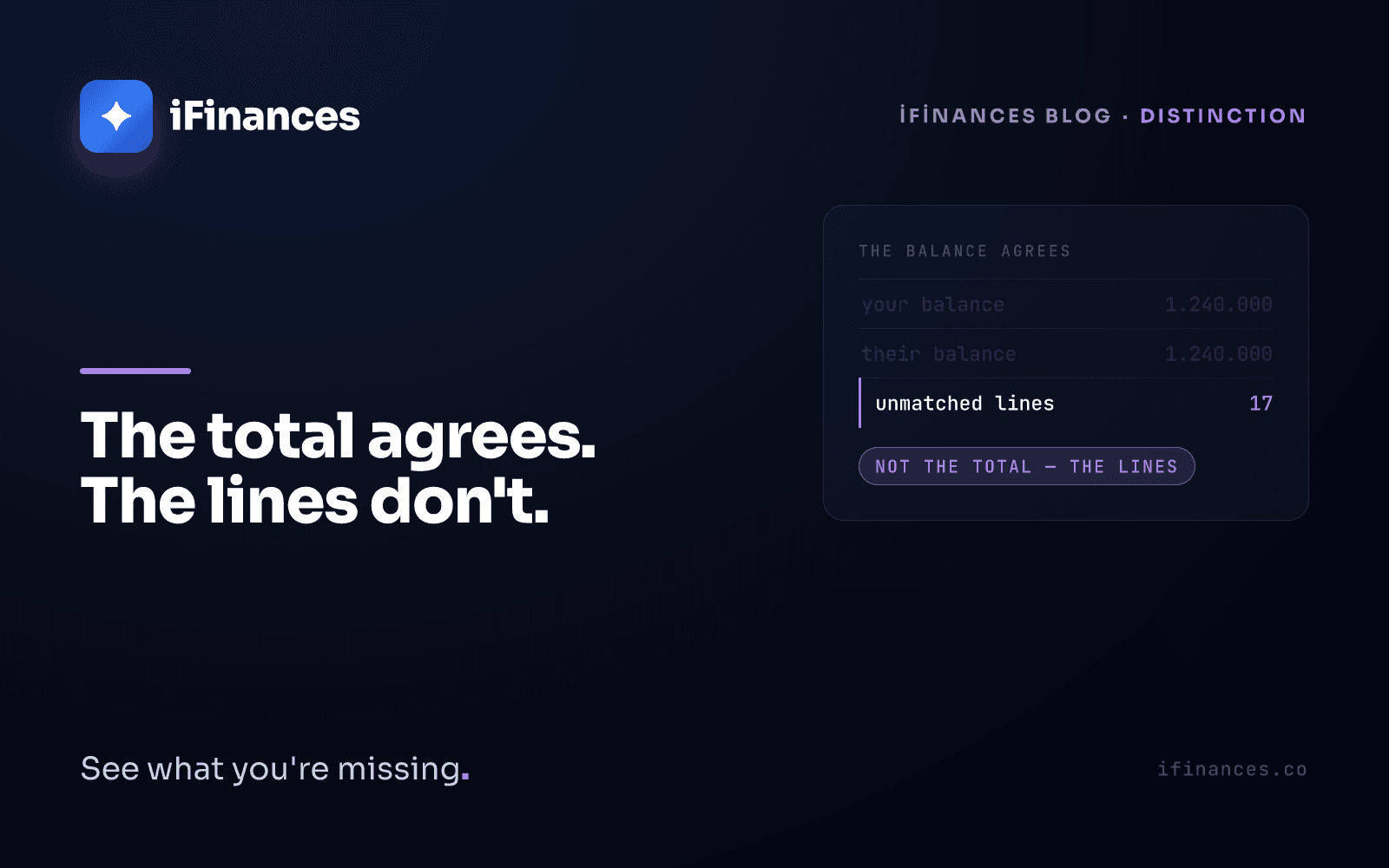
A balance is a sum, and two sums being equal says nothing about the lines that produced them. Two ledgers can reach the same figure by different routes, including by way of two errors that push the balance in opposite directions and meet in the middle. Agreement is not proof. It is a candidate for proof. This article is about the point at which the candidate becomes the real thing.
A total is lossy compression
Collapse a year of movements into one closing figure and the operation cannot be reversed. The number on the screen tells you nothing about the combination that produced it. Countless sets of movements yield the same total; yours is only one of them.
The accounting consequence is blunt. An invoice that never reached the ledger understates the account. A receipt of the same amount that never reached the ledger overstates it by exactly as much. Put both on the same account and the balance comes out correct to the cent, both sides relax, and two separate errors carry on sitting in the books — one of which will surface in collections and the other in the audit.
The profession calls these compensating errors. They have a name because they are common.
Statement agreement and open item clearing are two different jobs
The vocabulary hides the problem. Statement reconciliation, as most teams practise it, is an agreement exercise: two closing figures, one tick, one signature. Open item clearing is a matching exercise: every invoice on the account is either cleared against a specific payment, credit note or offset, or it stays open with a documented reason. The first produces a number that agrees. The second produces a list you can defend.
Only the second one is auditable. An agreed statement tells an auditor that two parties wrote down the same figure on the same day. An open item list tells them which document settled which invoice, on what date and for how much. When a chaser reaches a customer or a dispute reaches a lawyer, only the second survives contact.
The practical test is simple. Ask what happens to your reconciliation file if one invoice on the account is later found to be fraudulent. If the answer is "the balance changes", you had an agreement. If the answer is "one line is unwound and everything it was cleared against becomes visible", you had a reconciliation.
Four patterns where the errors cancel
Paired sign errors. An amount posted to the wrong side of the account moves the balance by twice the document value. If a second sign error runs the other way in the same period, the two offset exactly and the balance agrees. Neither posting is right; the pair is merely quiet.
Duplicate invoice with duplicate credit. The same invoice is posted twice and, in the same period, the same receipt or credit note is also posted twice. One inflates the account, the other deflates it. Identical amounts leave no residue at all. The mirror version is just as common: an invoice that was never posted alongside a receipt of the same amount that was never posted either.
Group and branch confusion. The amount is right but the account is wrong — two legal entities in the same group, or two branches of the same customer. The sum across the accounts is correct while each account is individually wrong. The counterparty, looking at a single account, sees nothing to query.
FX and rounding noise. When the two sides use different rate dates on foreign-currency items, every line carries a small deviation. Some are positive, some negative. Across hundreds of lines they largely neutralise one another: the balance looks plausible and not a single line is right.
None of the four is visible in a balance comparison. All four appear the moment two transaction lists are placed side by side.
A worked scenario: the credit note nobody posted
A customer account agreed to the cent at year end, so the file was closed. Four months later a collections chaser went out for an invoice the customer insisted had been credited long ago. The line-level comparison that finally got run turned up two items rather than one: a credit note raised in the billing system that had never been posted to the ledger, and a sales invoice of the same value that had never been posted either.
Work the directions through. The unposted credit note left the receivable overstated. The unposted invoice left it understated by exactly the same amount. Net effect on the balance: zero. The customer's own ledger carried both documents, which is precisely why the two closing figures agreed while the two line lists differed by two documents.
The awkward part was not the balance. It was that one sale had been recognised and the other had not, in a period already closed and reported, and that a credit the customer had been promised existed nowhere in the accounting record. A balance comparison cannot raise either question, because a balance comparison never looks at a document.
A balance that disagrees can still be a finished reconciliation
The other side of the coin is rarely discussed. A difference does not mean the reconciliation failed. Cheques not yet presented, a month-end invoice the two ledgers assign to different periods, a credit note still in transit — all legitimate reconciling items. There is a gap, and there is an explanation for it.
The test is not the size of the difference but whether it is explained. A large difference in which every cent is tied to a named item is a healthier picture than a small unexplained one. A small unexplained difference is very often two large errors that have partly netted off.
So balance agreement and reconciliation are not the same thing. One is an outcome, the other a process. We laid out the underlying concepts in our complete guide to reconciliation.
Three conditions for calling it finished
One: a transaction list. The comparison must be between two lists of movements, not two balances. Date, document number, amount, currency, direction. The balance is the output of that list, not the input. If all you received from the counterparty was a figure, what you hold is a statement, not a reconciliation.
Two: traceable identity and a recorded match. Every line needs an identifier, and which line was matched to which must be written down. "The payments cover the invoices" is not a reconciliation. Which payment cleared which invoice, and for how much, is. Partial payments, single transfers settling a bundle of invoices, and FIFO clearing all make this record mandatory — we worked through the mechanics in why payment-to-invoice matching is hard.
Three: evidence and an owner for every open item. Each unmatched line needs three things: why it is unmatched (the supporting document), who is responsible, and when it will clear. A difference with no owner and no date is not a reconciling item. It is a note postponing the problem.
Without all three, saying "we agree" means the balances are equal. It does not mean the reconciliation is done.
Right amount, wrong transaction: two lessons
In August 2020 Citibank intended to make a 7.8 million dollar interest payment on the Revlon loan and instead wired roughly 900 million dollars of principal to the lenders. The detail that matters: the amount sent was not random. It was the loan principal itself, so it would have passed a test asking "does this amount tie to a line in the ledger?" What was wrong was not the number but the transaction. We covered the approval chain and the interface design of that case in our piece on the Citibank–Revlon wire.
The second lesson is harsher. In June 2020 it emerged that the 1.9 billion euros Wirecard claimed to hold in escrow accounts at two Philippine banks had never existed. There too a balance existed — a balance confirmed on paper. What was missing were the movements that should have produced it.
If what you verified was a figure, what you verified was not a transaction.
Why manual comparison cannot run this test
A balance comparison reads two figures. A line comparison reads thousands. Change the scale and you have to change the tool.
Field audits of operational spreadsheets have found at least one error in roughly 94% of the spreadsheets examined. (The widely repeated claim that "88% of spreadsheets contain errors" is a misreading; 88 was the number of spreadsheets audited.) In Gartner research published in July 2023 with 497 respondents, 18% of accountants reported making errors every day and 33% several times a week.
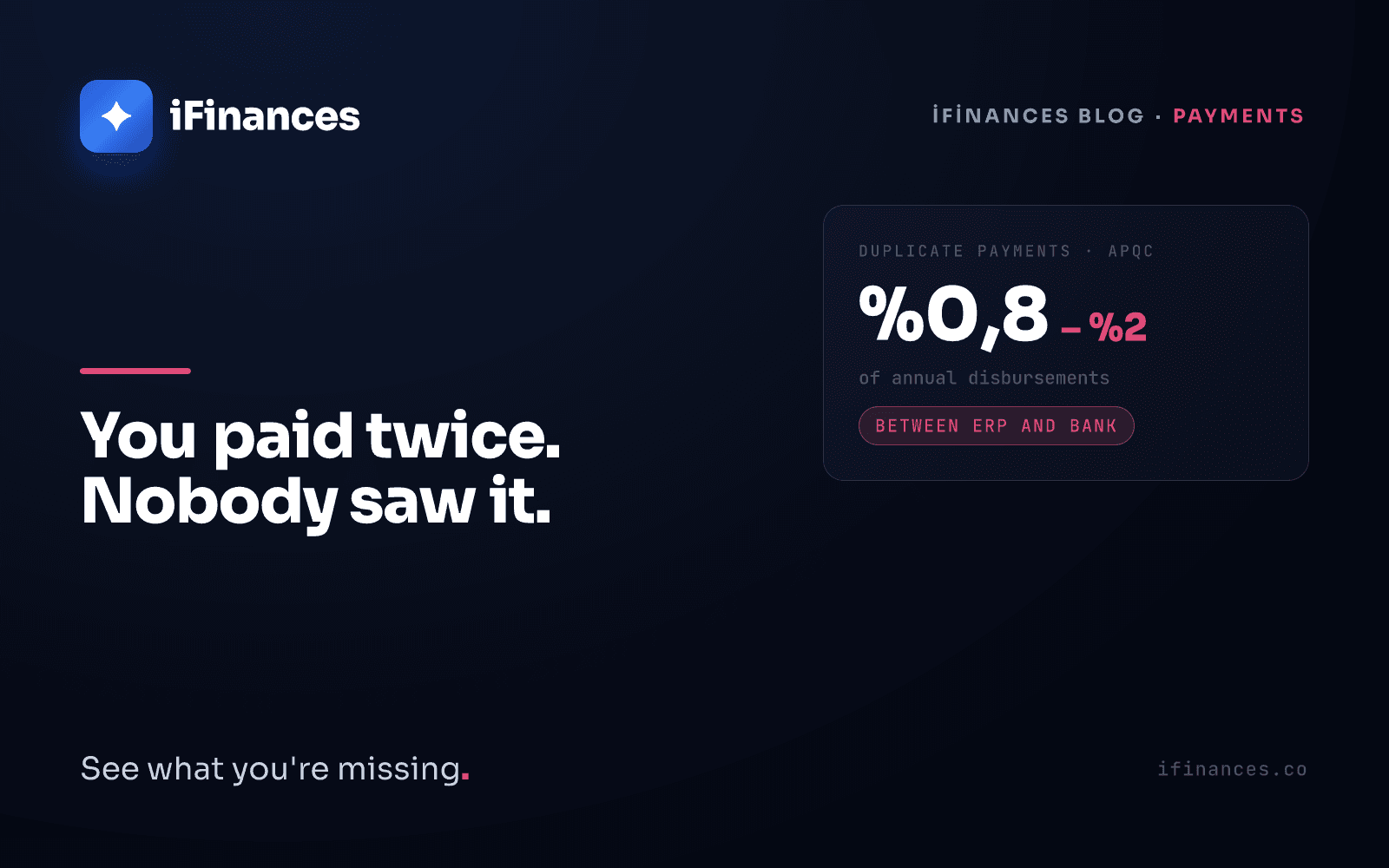
The same blind spot carries a price on the payables side. APQC benchmarks put duplicate or erroneous payments at 0.8% of annual payments for top-quartile organisations and 2% for the bottom quartile. What separates the quartiles is not how careful the accountant is; it is whether each payment is tied to the document it settles.
Then there is the limit of the tool itself. A lookup formula matches on amount and stops at the first hit, so two invoices of the same value defeat it immediately. It cannot split a partial payment, allocate one transfer across six invoices, or turn a cent tolerance into a rule. Which means most spreadsheet reconciliation is not line matching at all. It is total verification — precisely the thing this article is questioning.
Where iFinances fits
iFinances is not a tool for getting balances confirmed. It is a matching engine. It brings ledger and ERP records, bank statements and e-invoice data into one table, then matches at line level using FIFO and invoice-specific clearing, partial-payment splitting, bulk-payment allocation, cent tolerance and cross-currency logic based on the official Turkish central bank rate. Every match carries a written rationale beside it: the amount ties, the date fits, the reference points to this invoice. Missing invoices, duplicate postings and out-of-pattern amounts are flagged as anomalies — which is where the individual halves of a compensating pair show up, one at a time. Recognising that two of those flags cancel each other out, and calling the pair a compensating error, is still the job of the person reading the line comparison.
The limits are equally explicit. iFinances does not keep your books, does not create entries, and never clears a line on its own. For the fuzzy resemblance between a bank narrative and a company name it produces suggestions; the decision stays with a person. Data comes in from plain Excel or CSV, and from the ERP systems that dominate the Turkish market — Logo, SAP, Mikro, Netsis, Luca, Zirve — because that is where our customers' ledgers actually sit; the matching logic itself does not care which system wrote the file. You can also have the counterparty upload their own statement through a secure link, without needing any software themselves. Reconciliation letters, PDFs and a signed-copy archive are part of the same flow. More detail is on our supplier statement reconciliation page.
Closing
An agreed balance is good news. It is not the finish line. A reconciliation ends when every line is tied either to a counterpart or to an owned, dated explanation — not at the moment two numbers happen to be equal. That distinction decides what the phone call four months from now will be about.
Frequently Asked Questions
If the balance matches, is the reconciliation complete?
No. A balance is the sum of movements, and a sum hides information. Two errors that push the balance in opposite directions — an invoice that never reached the ledger and a receipt of the same amount that never reached it either — cancel out and produce a balance that is correct to the cent. To call a reconciliation complete you need two transaction lists compared, the matches recorded line by line, and every unmatched item tied to supporting evidence.
If the balance does not match, has the reconciliation failed?
Not necessarily. Cheques not yet presented, a month-end invoice booked in different periods by the two ledgers, and credit notes in transit are all legitimate reconciling items. The test is not the size of the difference but whether it is explained: a large difference in which every cent is tied to a named item is healthier than a small unexplained one. Small unexplained differences are often two large errors that have partly netted off.
How do you find errors that cancel each other out?
Not by looking at the balance. You have to compare the line lists. In practice the fastest route is to place both sides' movements side by side with date, document number, amount, currency and direction, isolate the lines that do not match, then eliminate duplicates, sign errors, wrong-account postings and period shifts one at a time. Two postings of the same amount, and a deviation equal to exactly one document value, are the quickest clues.
What records should I keep to treat a reconciliation as finished?
Three things: the two transaction lists the comparison was based on, a match record showing which line was cleared against which and for what amount, and for every open item the supporting document, the responsible person and the target clearing date. These are also the records that serve you in an external audit or a commercial dispute, and they are very hard to reconstruct after the fact.
✦ iFinances — See what you're missing.