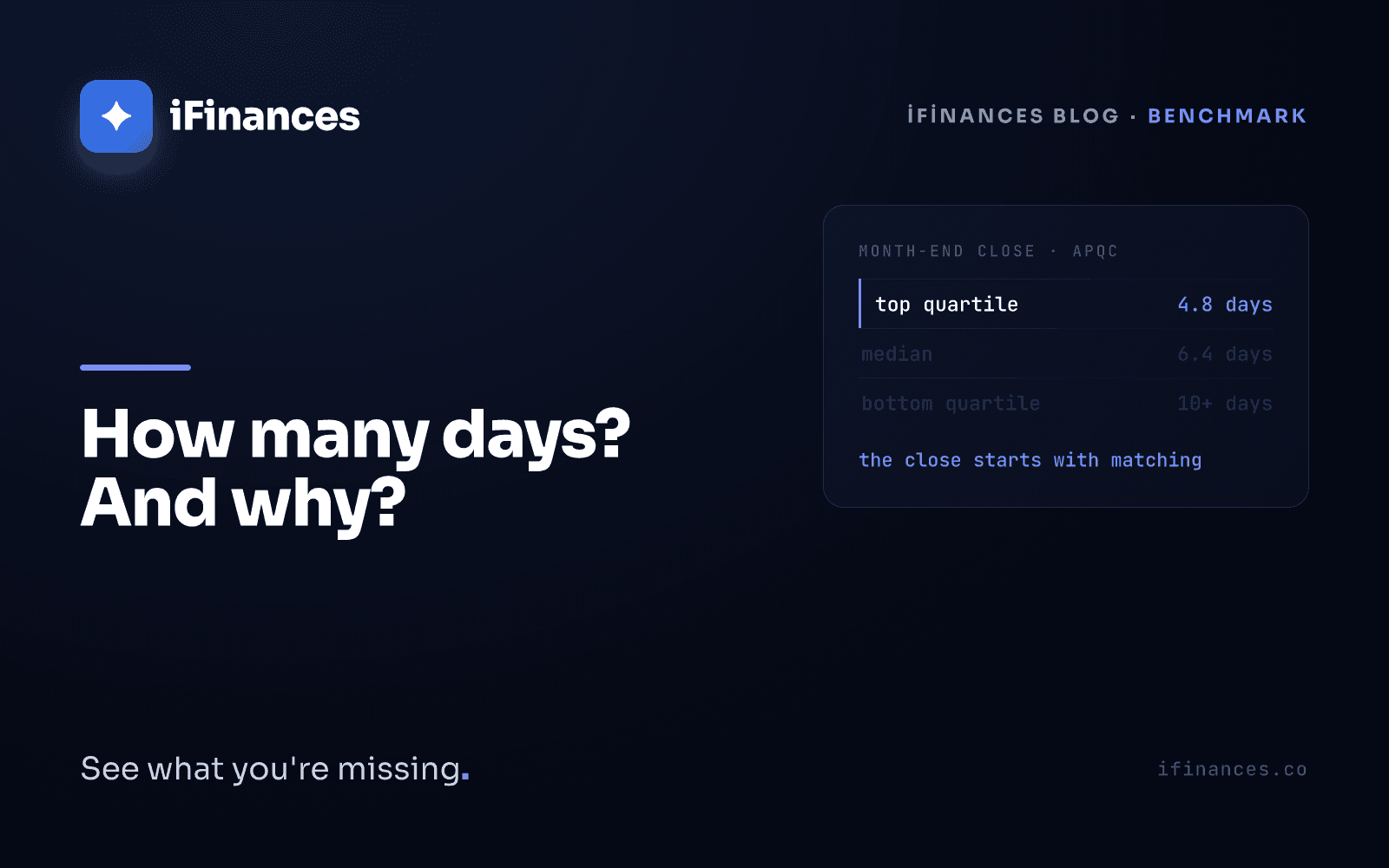
Ask a finance team how long the month-end close takes and you usually get a defence rather than a number: "It is not on us, the data arrives late." Often true. But benchmark data shows that companies living with the same delays close in very different amounts of time. In APQC's general accounting benchmarks, top-quartile organizations complete the monthly close in 4.8 days or fewer, the median sits at 6.4 days, and the bottom quartile takes more than 10. The slowest group needs more than twice as long as the fastest. The gap is not talent. It is sequence.
This article answers two questions: where your close sits against the benchmark, and where the lost days go. A note on scope: it is written from the Turkish market, and if you operate in Türkiye one item on the list behaves differently. Your ledger, the bank statement and the e-invoice records held by the tax authority sit in three separate systems, at a document volume that rules out checking by eye — and that is where a large share of the lost days hide.
The benchmark line: 4.8 / 6.4 / 10+
APQC's three thresholds are clear enough to plan against. They come from a global benchmark spanning organizations of every size and geography — a yardstick, not a standard — and a company operating in Türkiye carries an extra load on top of them: e-invoice and e-archive documents that have to be reconciled against the ledger every month, at the volume described later in this article. Top quartile: 4.8 days or fewer. Median: 6.4 days. Bottom quartile: 10 and up. These cover closing the books; reporting and consolidation sit on top.
Ventana Research's 2023 study adds a second angle: 58% of organizations close the month within six business days, while only 31% have automated most or all of their reconciliations. How far those two groups overlap is not visible in the data, which raises a question rather than settling one: how do companies that have not automated reconciliation still close fast? Three answers are common in the field — deferring the reconciliation to the following month, settling for a sample, parking the difference in a suspense account. That is not a conclusion drawn from the numbers, only a reminder that the same result can be reached by different routes. Low transaction volume, few counterparties, or disciplined work spread across the month can produce the same day count.
That distinction matters. A short close is not good news on its own. The good news is a short close that is defensible — when the books shut, you can say in writing what each balance rests on.
Where the lost days actually go
Few controllers say journal entries are what stretch the close. What stretches it is waiting and searching. A typical distribution:
- Waiting for data. Bank and card statements, e-invoice extracts, inventory counts, payroll output. Most are ready on day one; some slip to day three.
- Matching. Working out which invoice, which payment and which counterparty each bank line belongs to — the quietest and longest item in the close.
- Chasing differences. Why an item did not match: partial payment, lump-sum transfer covering several invoices, FX movement, bank charge — or a genuinely missing invoice.
- Correspondence. Emailing a supplier or customer for their statement and waiting. Measured in days, not hours.
- Corrections and postings. Turning findings into entries — usually the fast part.
- Reporting and review. Trial balance, draft financials, management commentary.
The critical path almost always runs through items two, three and four. The vast majority of a month's transactions match without hesitation. What delays the close is the small remainder — and it is not randomly distributed. It tends to cluster in the largest counterparties, in multi-currency activity, in lump-sum settlements and credit-note chains.
Why reconciliation sits on the critical path
Reconciliation resists speed-up for one reason: it is the only step in the close that depends on someone outside your company. Posting an entry is within your control; a supplier sending their statement is not.
The second reason gets discussed less. In most companies reconciliation happens at the end of the close. Entries go in, the trial balance is pulled, and only then does someone say "these accounts don't agree" and send letters. That places the externally dependent step at the narrowest point in the calendar. The close waits for replies; when replies do not come, the difference rolls into next month. By December those differences have compounded, and managing year-end reconciliation workload becomes a project of its own.
The sequence can be inverted. The bank statement is available on day one, e-invoice data is already in the system, and most ledger entries went in during the month. Match on days one and two and by the end of day two you hold a list of genuinely unexplained items. Start the correspondence then and replies arrive in the middle of the close rather than at the end. Reconciliation should be the first step of the close, not the last.
An illustrative example: what changes when the sequence changes
The figures below are illustrative, not a measured customer result. The point is not a promised saving but the effect of the order in which the steps are taken.
Picture a mid-sized manufacturer operating in Türkiye: 9,000 bank lines a month, 1,400 purchase invoices, 600 sales invoices, 180 active counterparties, with e-invoice records to be reconciled alongside the ledger. The close takes 11 business days.
Map the time. Days one and two: gathering data. Days three to six: bank-to-ledger matching in Excel plus counterparty checks. Day seven: emails to the accounts that do not agree. Days eight to ten: waiting for replies and comparing the statements that come back. Day eleven: corrections and trial balance.
The location of the lost days becomes visible: the days spent matching and the days spent waiting for outside replies form the largest block of the close.
Change the sequence and the flow shifts. Day one: statement, e-invoice data and ledger land in one table; the engine runs and leaves an exception list behind. Day two: part of that list is resolved internally — partial payments split, lump-sum transfers allocated, FX differences and bank charges identified. Questions go out only for what remains, and the correspondence starts at the end of day two. Replies land in the middle of the close, and corrections and the trial balance follow them.
Nothing magical happens. Waiting moves from the end of the close to the beginning, and matching moves from human hours to machine hours.
Error rates: what a faster close must not cost
The classic risk of compressing the close is that controls loosen. In a Gartner survey of 497 accountants conducted in July 2023 (n=497), 18% reported making errors every day, 33% a few times a week and 59% a few times a month. That is the natural error rate of a manual process, not a statement about capability.
Then there are spreadsheets. In the field audits compiled by Raymond R. Panko in "What We Know About Spreadsheet Errors", roughly 94% of the operational spreadsheets examined contained at least one error. One note: the widely repeated line that "88% of spreadsheets contain errors" is wrong — 88 is the number audited. The correct reading is that nearly all spreadsheets in real operational use hold at least one error.
A close-acceleration effort that still runs matching in Excel raises the error rate. One that hands matching to a rules-based engine and points people at exceptions lowers it.
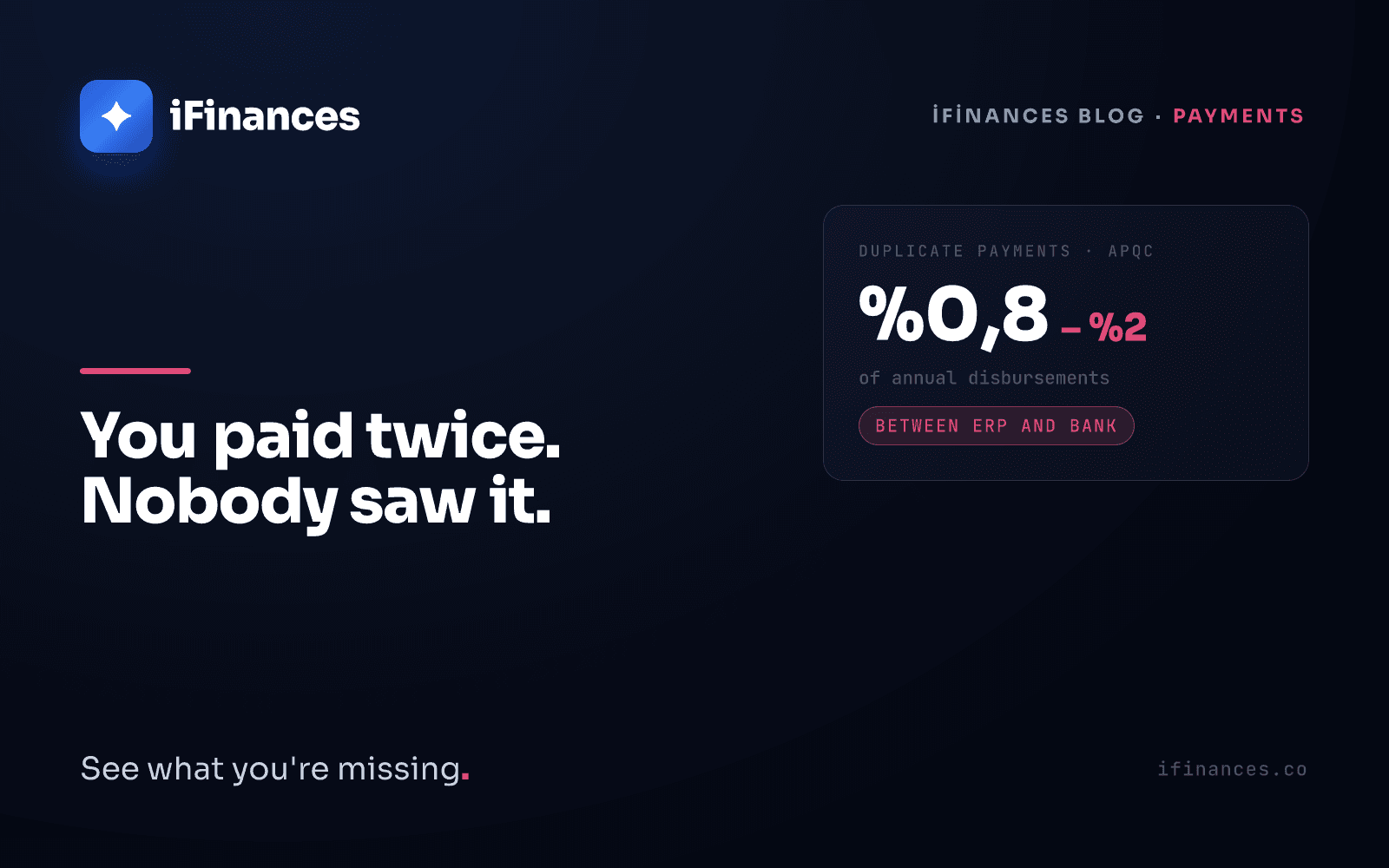
One side benefit is worth naming. APQC puts duplicate or erroneous payments at 0.8% of annual disbursements in the top quartile and 2% in the bottom. Early bank-to-ledger matching is the one point where a duplicate can be caught before the month closes; found later, it stops being an accounting task and becomes a collection task.
You cannot shorten what you do not measure
Most close-acceleration projects start without measuring the close. Four metrics are enough, and none need new software.
First: days to close. Business days from month-end to a finalised trial balance.
Second: exception count. Number and value of items still unmatched at month-end. If it does not fall, the speed gain is not real.
Third: externally dependent days. Time from asking a counterparty a question to their answer arriving — the most invisible line in the close.
Fourth: suspense balance. The amount parked with "we'll look at it later" attached. It should be near zero; if it grows, the close did not get faster, it got deferred.
Track those four for three months and the location of the lost days stops being a matter of opinion. A year-end reconciliation calendar and checklist is best built on these measurements rather than on intuition.
An ERP alone will not deliver a fast close
"We run SAP — why is the close still ten days?" comes up constantly. An ERP keeps the ledger, records transactions and locks periods. But the entry inside the ERP, the line on the bank statement and the e-invoice record held by the tax authority live in three separate worlds. Bringing them into one table and comparing them is not the ERP's job.
Scale makes it harder. Turkey's Revenue Administration reported roughly 1 billion e-invoices and 11 billion e-archive documents in 2024, with 1,565,603 registered e-invoice taxpayers. At that volume, eyeballing incoming invoices against the ledger stopped being feasible long ago. Three-way reconciliation across bank, e-invoice and ledger exists precisely to close that gap.
Where iFinances fits
To be plain: iFinances does not keep your books, create entries, or clear any line on its own. It shortens the one step sitting on the critical path.
Your ledger or ERP records, bank statements and e-invoice data come into a single table. The matching engine works with FIFO and invoice-specific clearing, splits partial payments, allocates lump-sum payments across invoices, applies a tolerance for rounding differences, and uses the Turkish central bank's official rate for cross-currency comparison. It matches the name in a bank narrative against a company name using accent-folded Turkish similarity — but that is a suggestion, and a person decides. Every match carries a written rationale: amounts agree, dates align, the reference points to this invoice. Missing invoices, duplicates and out-of-pattern amounts are flagged. Reconciliation letters are generated, exported to PDF and archived as signed copies — an archive that carries weight because Article 94 of the Turkish Commercial Code treats a balance statement left unchallenged for a month as accepted where a written current-account agreement exists; you can send the other side a secure link to upload their own statement, so they need no software. Intake is ERP-independent: Logo, SAP, Mikro, Netsis, Luca, Zirve or plain Excel.
In close-calendar terms: pull matching to day one, start the correspondence on day two instead of day seven. How that is set up is described on the bank reconciliation page.
Frequently Asked Questions
How many days should a month-end close take?
In APQC's general accounting benchmarks, top-quartile organizations finish the monthly close in 4.8 days or fewer, the median is 6.4 days, and the bottom quartile exceeds 10 days. Ventana Research's 2023 data found 58% of organizations close within six business days. A realistic first target is to get under the median. Sustaining under four days generally requires reconciliation to be automated, not merely compressed.
What is the first step to speeding up the close?
Measure the close in segments. For one month, record how many days go to data collection, matching, difference investigation, external correspondence, posting and reporting. In most companies the bulk of the lost time lands in matching and in waiting for replies. Any acceleration attempt made before those two are identified just asks the team to work later.
We run SAP — why is our close still long?
An ERP maintains the ledger and locks the period, but comparing the bank's statement and the tax authority's e-invoice records line by line against your ledger is not its core function. The items that stretch a close — lump-sum transfers spread across invoices, partial payments, FX differences, bank charges, a balance the counterparty sees differently — sit at the intersection of three sources, and an ERP does not produce that intersection on its own.
Does a faster close increase the risk of errors?
If you keep the process and simply compress the calendar, yes. In Gartner's July 2023 study (n=497), 18% of accountants reported daily errors and 59% errors a few times a month; Panko's compiled field audits found at least one error in roughly 94% of the operational spreadsheets examined. But if the speed comes from handing matching to a rules-based engine and directing people only at exceptions, error risk falls rather than rises. What matters is not the shorter calendar but the smaller volume of manual work.
Do reconciliation letters make the close faster?
A letter is an outcome, not a method. Sent before you have narrowed the difference on your own side, it asks the counterparty to do the analysis and adds their response time to your close. The right order is to finish matching in the first days of the month and send letters only for genuinely unexplained items. Under Turkish commercial law a balance statement left unchallenged for a month can be treated as accepted — but that consequence operates in the context of a written current-account agreement; without one, silence may not by itself constitute acceptance.
✦ iFinances — See what you're missing.