For close to twenty years, the Ba-Bs forms were a monthly ritual for finance teams in Türkiye. Form Ba reported what a company purchased; Form Bs reported what it sold. Both went to the Revenue Administration (GİB — Gelir İdaresi Başkanlığı, Türkiye's tax authority), which cross-matched the two sides of every trade. If your supplier reported a sale that never appeared among your purchases, questions followed. Month-ends came with threshold arithmetic — transactions of 5,000 TL and above, excluding VAT, had to be reported — and with phone calls to counterparties about who declared what.
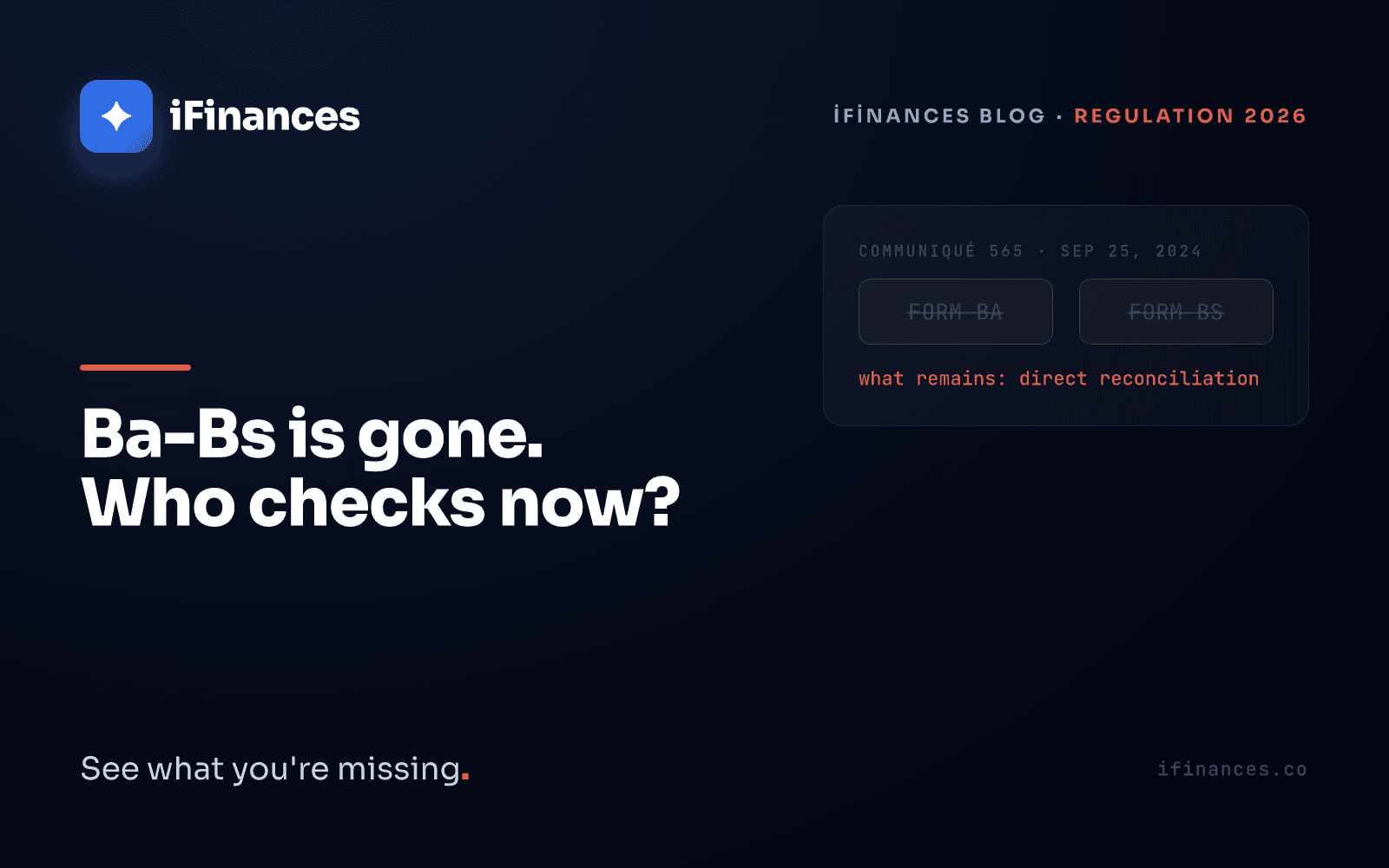
Türkiye abolished the Ba-Bs forms in September 2024, and that ritual formally ended. General Communiqué No. 565 under the Tax Procedure Law (VUK — Vergi Usul Kanunu), published in the Official Gazette on 25 September 2024, ended the filings starting with the September 2024 period. The news cycle noted the abolition and moved on. For finance teams, the more interesting question was born that very day: what replaced the cross-checking discipline — crude as it was — that Ba-Bs imposed between companies?
The answer has two layers. On the state's side, nothing is missing: the administration already receives the same information at document level, through e-invoice and e-archive data. Between companies, though, an invisible gap opened: no mandatory filing surfaces the difference between two firms' ledgers anymore. This guide walks through the communiqué itself, the twenty-year phase-out that led to it, and how reconciliation actually works in Türkiye in 2026.
What Communiqué No. 565 actually says
Published in the Official Gazette of 25 September 2024, Communiqué No. 565 settled three things:
- The filings ended. Form Ba and Form Bs submissions were discontinued starting with the September 2024 period; the communiqué entered into force on 1 October 2024.
- The legal basis was repealed. Communiqués No. 362, 381, and 396 — the foundations of the Ba-Bs regime — were removed from effect.
- Past periods are preserved. Filings and corrections relating to periods before September 2024 continue to follow the old provisions.
The rationale, as relayed in TÜRMOB's regulatory circular (TÜRMOB is the union of Turkish chambers of certified public accountants), is equally clear: with e-document applications now widespread, electronic records easy to access, and data sharing between public institutions effective, the goal was reducing taxpayers' compliance costs. In other words, the administration acknowledged that making taxpayers re-type information it already held had become pointless.
From 2005 to 2024: a phase-out in four steps
Ba-Bs did not disappear overnight. As Türkiye's e-document ecosystem grew, the forms were hollowed out step by step:
- Communiqué No. 350 (2005) — the start. Companies keeping books on the balance-sheet basis began reporting their monthly purchases and sales of 5,000 TL and above (excluding VAT).
- Communiqué No. 523 (January 2021) — e-documents excluded. Under the communiqué published in the Official Gazette on 25 January 2021, invoices issued as electronic documents were left out of Ba-Bs from the July 2021 period onward. As e-invoicing spread, the forms emptied fast.
- Communiqué No. 543 (December 2022) — no more empty forms. Taxpayers whose transactions all fell under the threshold, or consisted entirely of e-documents, were removed from the filing obligation; the era of submitting blank forms ended.
- Communiqué No. 565 (September 2024) — full stop. The practice was discontinued entirely.
The penalty regime became history too: in 2024, the final year of the regime, the special irregularity fine for failing to file on time was 11,800 TL. For periods from September 2024 onward there is nothing left to file — and nothing left to fine.
Why the state let go: it already holds the same data
Ba-Bs existed for one reason — information: who sold what to whom, in which month, for how much. E-invoice and e-archive systems now carry that information to the administration at document level; every e-document a seller issues already contains the buyer, the amount, and the date. Asking two taxpayers to re-declare the same trade as monthly totals had been reduced to summarizing data the system could already see. The communiqué's rationale, quoted above, points in the same direction.
The critical nuance that gets overlooked: what got digitized is the state's access to the data, not your control. E-document data flows to GİB; it does not post itself into your books. Whether every inbound e-invoice actually landed in your ledger, which invoices sit in which status, and how your outbound invoices look from the counterparty's side — those remain your questions to answer. We cover that layer in detail in our e-invoice reconciliation guide.
Reconciliation after Ba-Bs was abolished: what's gone, what remains in 2026
In practice, "reconciliation" is not one procedure but a family. Here is the family portrait as of 2026:
- Gone — Ba-Bs reconciliation. With the underlying filing abolished, the practice of comparing forms ended with it. Yet in the examples we have run into, a corporate guide updated as late as December 2025 can still describe Ba-Bs reconciliation as current practice — it pays to check the regulatory date on whatever you read.
- Still here — counterparty (cari) reconciliation. Two companies comparing the receivable-payable balances and transactions each holds for the other. Required by no communiqué; required by commercial trust, healthy balance sheets, and audit readiness.
- Still here — bank reconciliation. Comparing the bank movements in your ledger against the bank statement; fees, value-date differences, and in-transit items get caught here.
- Still here — cash, inventory, and dealer reconciliations. The types that check physical counts against records, and dealer networks against head office, continue as business needs.
The key distinction: none of the surviving types is a tax filing. They are all instruments a business uses to protect its own financial truth. We walk through the whole family in our complete reconciliation guide.
With Ba-Bs gone, who finds the difference between two ledgers?
Ba-Bs was never a precise control. It compared VAT-exclusive totals, per month, above a threshold; it showed nothing at line level. But it had an indirect function: because both parties reported the same trade to the state, large breaks — an unreported invoice, a duplicate entry, a wrong period — eventually came back as a mismatch query. Without anyone framing it that way, the state was enforcing inter-company data discipline.
In 2026 that external enforcer is gone. A gap between two companies' ledgers — a missed invoice, a duplicated record, a payment posted to the wrong account, an FX asymmetry, a one-sided credit note — only surfaces if one side sits down and compares line by line. We collected the nine typical causes and the tactics for hunting them down in a dedicated field guide. The behavioral consequence matters most: with the obligation gone, many businesses now postpone mutual checks to year-end. A difference discovered in December means tracing eleven months back — and the older the gap, the deeper its roots.
Is e-reconciliation mandatory in Türkiye? No — and it never was
The answer is short. Among the applications listed on GİB's official e-document portal — e-Fatura (e-invoice), e-Arşiv, e-İrsaliye (e-waybill), and others — there is no application called "e-Mutabakat" (e-reconciliation). The e-reconciliation tools on the Turkish market are private-sector products that digitize the sending of reconciliation letters; using one is a commercial choice, not a legal requirement. For the concept's history and its relationship to the Ba-Bs regime, see our e-reconciliation guide.
This clarity matters because the abolition of Ba-Bs is sometimes framed in marketing copy as "now you must switch to e-reconciliation." The accurate statement is: no reconciliation application is mandatory. What businesses need — whatever tool they choose — is a regular, line-level habit of checking.
Building counterparty discipline after Ba-Bs: a practical framework
With the externally imposed calendar gone, the discipline has to be built from within. We suggest a four-part framework:
- 1. Set your own rhythm. Monthly reconciliation with high-volume counterparties, quarterly with mid-volume ones, at least annually with the rest. Rather than piling everything into December, plan week by week with our year-end reconciliation calendar.
- 2. Compare lines, not balances. "Our balances match" can hide two errors cancelling each other out. Real assurance is transactions matching item by item; balance confirmation is the outcome of the process, not the process itself.
- 3. Cross-check three sources. Your ledger, your bank statements, and your e-invoice data are three photographs of the same commercial reality. Compared together, they reveal differences that any single source conceals.
- 4. Keep watching the rulebook. Ba-Bs is gone, but 2026 is not a quiet year for regulation in Türkiye; we round up the changes that matter to finance teams in our 2026 tax changes overview.
iFinances was built precisely for this gap. It does not replace your accounting or pre-accounting software; it sits on top of it. It takes in your Excel/CSV statements and e-invoice data; matches counterparty, bank, and e-invoice records automatically at line level; handles partial payments and FIFO settlement logic; shows the explicit reasoning behind every match; flags anomalies such as missing invoices and duplicate entries; and generates reconciliation letters, archiving the signed copies. To talk through how to rebuild the discipline Ba-Bs left behind in your own company, get in touch — or continue with our essay on the category difference between letter-sending tools and matching engines.
Frequently Asked Questions
When did Türkiye abolish the Ba-Bs forms?
With General Communiqué No. 565 under the Tax Procedure Law (VUK), published in the Official Gazette on 25 September 2024 (issue 32673). The obligation ended starting with the September 2024 reporting period, and the communiqué took effect on 1 October 2024. Earlier periods remain subject to the old rules.
What replaced the Ba-Bs forms?
No new filing replaced them. The Turkish tax administration already receives the same transaction data through e-invoices and other e-documents, and the communiqué's rationale rests on that plus lower compliance costs, so a separate monthly report became redundant. Between companies, however, nothing mandatory remains — regular counterparty reconciliation is the only safeguard left.
Is Ba-Bs reconciliation still performed in 2026?
No. Since the filing itself no longer exists for periods from September 2024 onward, there are no forms left to compare. Only corrections relating to earlier periods still follow the old provisions. Commercial reconciliation types — counterparty, bank, cash, inventory — continue as normal business practice.
Is e-reconciliation mandatory in Türkiye?
No. E-reconciliation is not among the official e-document applications listed on the Turkish Revenue Administration's portal, and it has never been compulsory. Tools sold under that name are optional private-sector services that digitize the sending of reconciliation letters.