A finance manager shopping for reconciliation software in Türkiye faces dozens of products that all sound alike: e-reconciliation platforms, ERP add-ons, credit bundles, one-click promises. Look closer and you will find two fundamentally different categories living under a single name — and you often discover which one you bought only when the first serious discrepancy appears.
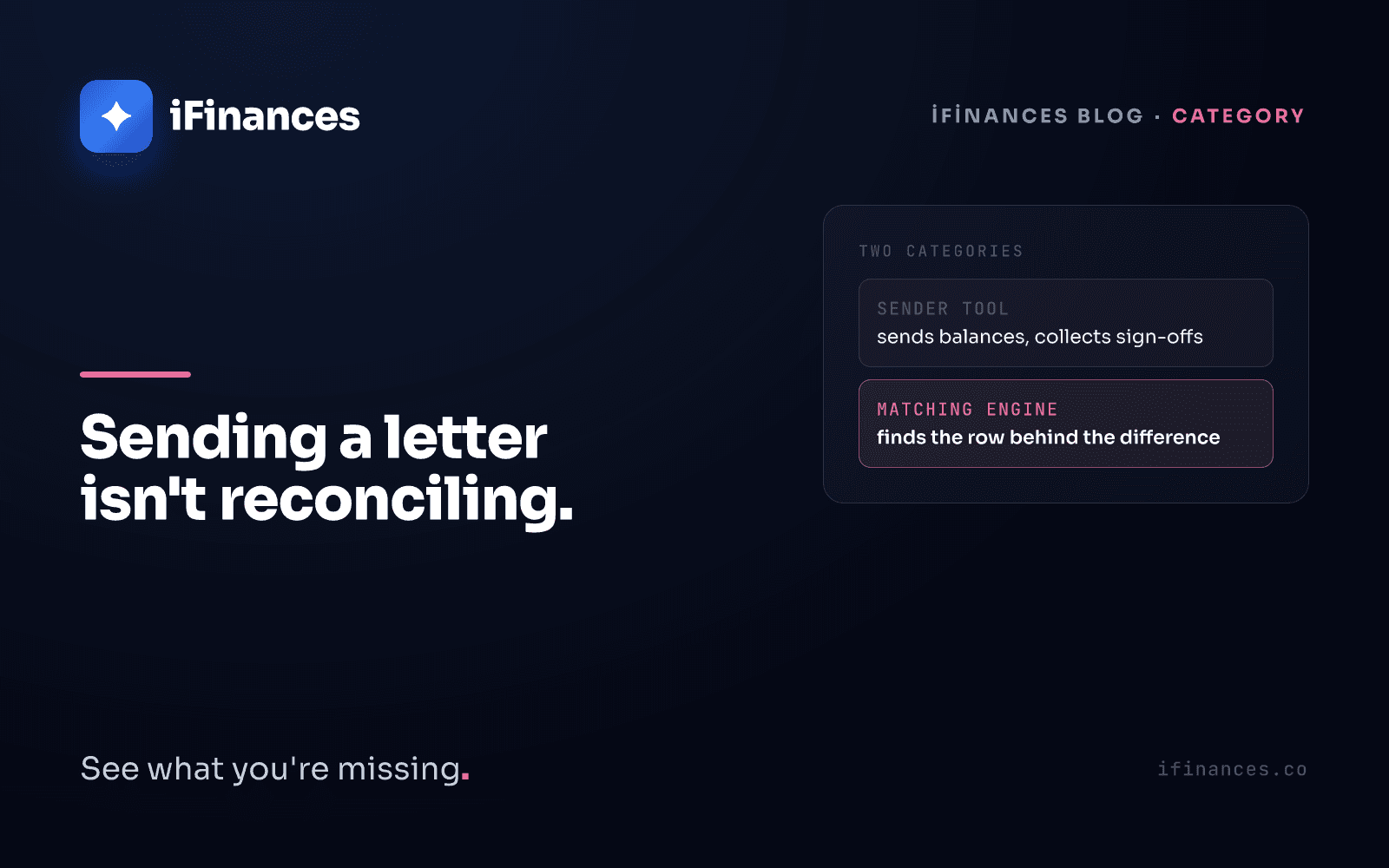
The first category sends letters: it takes your list of customer and supplier accounts with balances, delivers balance statements to counterparties, and collects the "agreed / not agreed" replies in one panel. The second category matches: it compares both sides' transaction data row by row and finds which invoice is missing from the other ledger, which payment was applied to the wrong invoice, and exactly which items add up to the difference.
This is not a technical footnote. It determines everything from the pricing model to how your team spends month-end, from audit readiness to the tone of your customer relationships. This article unpacks the first question worth asking in any sales call: does this tool send letters, or does it actually match?
What "reconciliation software" means in Türkiye today
In the Turkish market, the category has largely formed around automating reconciliation letters — the balance-confirmation notices that companies exchange, locally known as "e-mutabakat" tools. The workflow is familiar: upload the account list and balances, send the letters in bulk by e-mail, SMS, or fax, collect the replies automatically, and pull an "agreed / objected / no reply" report at period end.
The vendors' own product pages describe exactly this frame. According to eLogo's published price list, every e-reconciliation letter sent consumes one credit and goes out via e-mail, SMS, or fax. Mikro's e-reconciliation comes bundled with its commercial software, covers account reconciliation and bank-statement comparison, and does not require the counterparty to be a Mikro user. DİA's credit-based module manages five reconciliation types, including foreign-currency and due-date balances, with bulk-send filters; Uyumsoft's product page highlights preparing data in Excel and sending thousands of reconciliations in a single step. Kolaymutabakat charges per reconciled company on a pay-as-you-go basis.
Let's be fair: these tools solve a real problem. Preparing letters for hundreds of counterparties by hand is serious operational work, and bulk sending, reply tracking, and a documented trail genuinely matter — especially given Article 94 of the Türk Ticaret Kanunu (TTK), Türkiye's Commercial Code, under which a balance statement received in a written current-account relationship counts as accepted if no formal objection is raised within one month. Accounting packages and ERPs bundle reconciliation modules built on the same paradigm; we examined that layer in detail in can your accounting software do reconciliation?.
The hidden assumption behind letter-sending tools
The process design of a sender tool leans on a quiet assumption: the overwhelming majority of replies will come back "agreed." In that scenario the system works beautifully — letter out, confirmation in, archive updated, dashboard green.
The real work starts with "not agreed." If your ledger shows a balance of 1,350,000 TL and your counterparty says 1,280,000 TL, all the letter tool can tell you is that a difference exists — not where it lives. From that moment the process leaves the software: both sides export their statements to Excel, rows get read out over the phone, and the "do you see this invoice on your side?" marathon begins.
The key conceptual point: a balance confirmation is the outcome of reconciliation, not the reconciliation itself. The real labor is finding and resolving the difference item by item once it appears. We catalogued the nine most common causes in the balances don't match: 9 causes of reconciliation differences — and not one of them can be found by sending a letter.
The second category: the matching engine
A matching engine works with the rows themselves, not the balance summary: it takes the transaction data of both sides — three sources, if needed — and links it item by item. Its capability list looks nothing like the letter category's:
- Row-level matching. Links invoices, payments, and returns through document numbers, amounts, dates, and references; isolates whatever fails to match as open items.
- FIFO and partial-payment resolution. Handles real-world traffic where one payment closes several invoices and advance leftovers float around — we wrote about why this is genuinely hard.
- FX separation. On foreign-currency items, splits true disagreements from exchange-rate effects.
- Anomaly detection. Flags duplicates, missing invoices, and unusual amounts on its own.
- Multi-source cross-checking. Verifies the ledger not only against the counterparty's statement but against bank and e-invoice data in a three-way check.
- Explainable matches. Shows the reasoning behind every match in plain language — see black box vs. reason chain for why that is non-negotiable.
In the Turkish market this second category is so under-represented that it barely has an established name; users reach for it through roundabout searches like "statement comparison program." Some sender tools have begun adding comparison features — Sovos, for instance, promotes a comparison engine on its product page that it says finds unmatched transactions within seconds. Still, the category's center of gravity today remains sending balance notices.
The same discrepancy, two very different outputs
Let's make it concrete. Suppose there is a 70,000 TL disagreement on a supplier balance.
The letter tool's output: "Objected." The counterparty's objection note, perhaps with their statement attached. The next step is yours: open the two statements side by side and hunt for the difference by hand.
The matching engine's output: an itemized difference report — say, 209 of 214 transactions matched; two invoices missing entirely from the counterparty's ledger; one payment applied to a different invoice on their side; one FX item and one rounding item. The itemized total: exactly 70,000 TL.
The first leaves you a to-do list; the second arrives as an explained answer. On your closing calendar, those two are not the same week.
Which reconciliation software is enough for you?
The honest answer: not every company needs a matching engine.
A sender tool may be enough if:
- you have few counterparties and low transaction volume,
- transactions are mostly in lira and FX differences are not on your agenda,
- differences are rare and resolve within a few rows when they appear,
- what you mainly need is periodic balance confirmation and a documented trail.
You need a matching engine if:
- you have hundreds of counterparties and thousands of monthly transactions,
- foreign-currency invoices, partial payments, advances, and returns are heavy,
- some accounts come back "not agreed" every period and burn days in Excel,
- audits or tax cross-examinations demand documented explanations of differences.
Costs behave differently too. Sender tools mostly price by credit, and unit prices vary sharply with bundle size: on eLogo's list dated July 8, 2026, a 150-credit pack costs 2,250 TL (15.00 TL per credit) while a 1,000,000-credit pack costs 2,120,000 TL (2.12 TL per credit) — a nearly sevenfold unit-price gap between the smallest and largest packs (published list prices excluding VAT; subject to change). For the full breakdown of credit, package, and subscription models, see e-reconciliation pricing in Türkiye (2026).
The deciding question is simple: when a difference appears, who finds it? If the answer is "we do, in Excel" — and that answer gets a little more expensive every month — it is time to look at the second category.
Letters and engines: not rivals but a sequence
In truth, the two categories are not alternatives; in a well-designed process they are sequential steps. Rows are matched first and the difference is resolved; the letter comes last, as documentation of a balance both sides already agree on. A process that starts with the letter falls back to Excel the moment a difference appears; a process that starts with matching turns the letter into a formality.
iFinances is the AI-assisted representative of that second category — and it is not accounting software. It sits on top of the ERP or accounting system you already use: it ingests your Excel, CSV, and statement exports; matches receivables, bank, and e-invoice data at row level; explains the reasoning behind every match; flags anomalies; and generates and archives the reconciliation letter, signed copy included, at the end of the process. So yes, there is a letter here too — at the earned end of the process, not the start. The full picture is in what is iFinances?.
If you are still evaluating, two more resources will help: the reconciliation software selection guide, which walks through the criteria one by one, and a small pilot with your own data. To see a live difference report built from your own statements, get in touch — your own rows always give the clearest answer.
Frequently Asked Questions
What does reconciliation software actually do?
In Türkiye the term covers two different jobs. Letter-sending tools deliver balance statements to your counterparties in bulk and collect the agree/disagree replies; matching engines compare both sides' transactions line by line and show exactly where a difference comes from. Deciding which job you need automated is the first step of any selection.
What is the difference between an e-reconciliation tool and a matching engine?
An e-reconciliation tool automates sending balance notices by e-mail, SMS, or fax and tracks the responses; when a counterparty disagrees, the analysis is left to you. A matching engine works on row-level data, links invoices to payments — including FIFO order and partial payments — and produces an itemized explanation of the difference.
Is fully automatic reconciliation possible?
Sending letters and tracking replies is already largely automated. Difference analysis can be automated too, by engines that work with transaction rows and handle FIFO allocation, partial payments, and FX effects; they typically resolve most items on their own and leave a short exception list for humans. The realistic goal is not full autonomy but explainable automation.
Is a letter-sending tool enough for a small business?
Often yes: with few counterparties, mostly lira-denominated transactions, and rare differences, periodic confirmation plus a documented trail may be all you need. As the number of accounts, foreign-currency invoices, and partial payments grows, finding the differences becomes the real cost — and that is when a matching engine starts paying for itself.