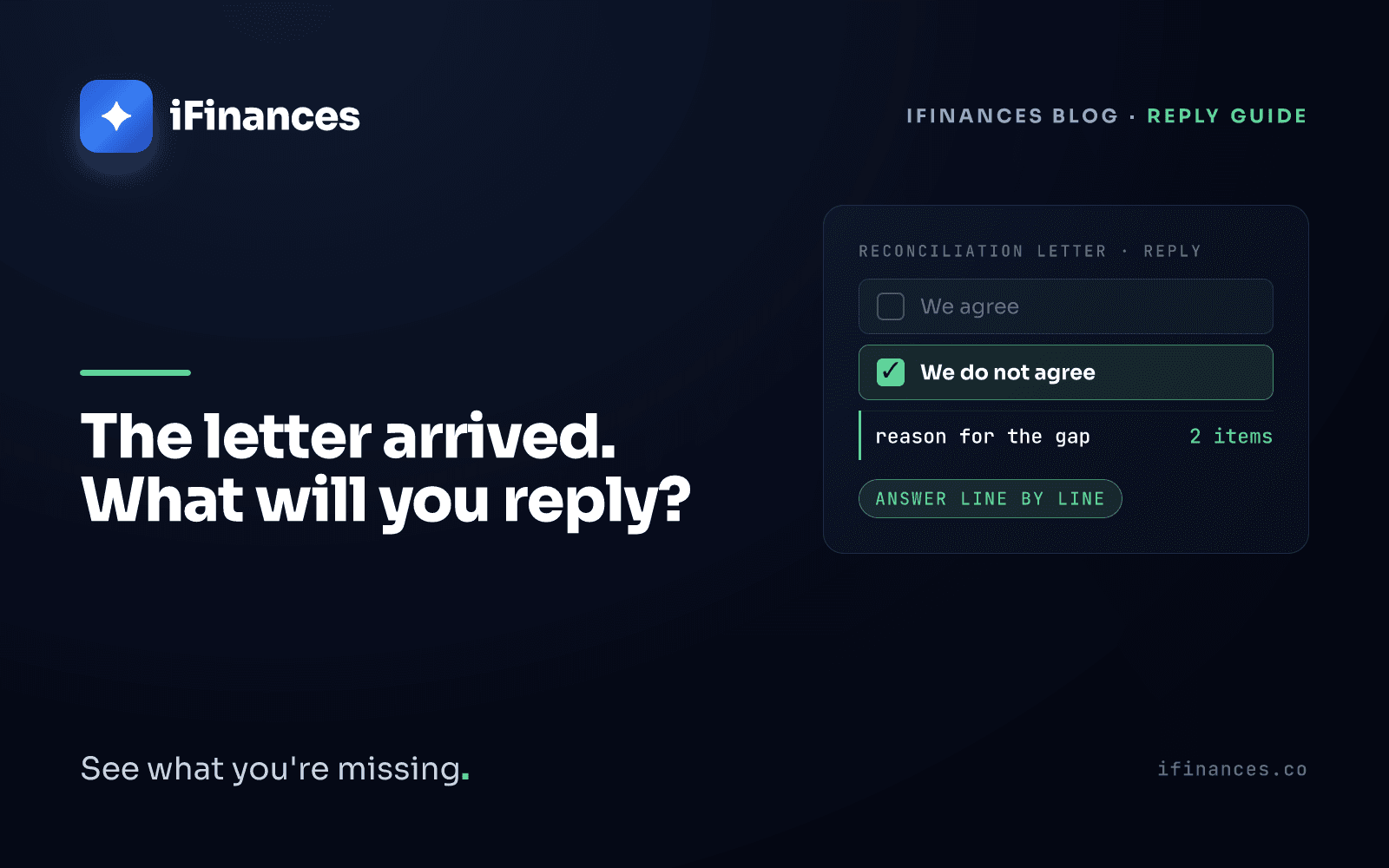
It is month-end and a reconciliation letter from a supplier lands in your inbox: a single figure and two boxes, we agree or we do not agree. So how do you respond to a reconciliation letter? In short: check the cut-off date, the currency and the account first; pull your own statement for the same cut-off; look at the lines even if the balance agrees; and if it does not, send a reasoned disagree reply that states your balance, the difference and every item that explains it by document number. Have an authorised person sign it, and keep it on file.
Most Turkish-language guides to reconciliation letters (also called balance confirmation letters) speak to the sender. This guide is for the other side of the desk: the accountant, finance manager or outside adviser who receives the letter in Türkiye, where the Turkish Commercial Code (TTK) shapes what a reply, or silence, can mean. The tick box is an outcome; the real answer is a written record of two ledgers compared.
Saying "we do not agree" means stating that the balance the counterparty reported does not match your records. It is not a confrontation but an invitation to compare, and a well-written reply is the shortest route to resolving the difference.
Before you reply: cut-off date, currency, account and your own statement
Before you look at the figure, read three things:
- Cut-off date. Which day does "as at …" refer to? Comparing a 31 March balance with a listing that runs to 15 April will usually produce a difference.
- Currency. For foreign-currency accounts the balance is confirmed per currency. Compare a euro balance with its lira equivalent in your books and exchange-rate drift looks like a real difference; compare like with like: euro against euro.
- Account and legal entity. Which company name, tax number and branch does the letter refer to? With group companies, or a counterparty that is both customer and supplier, make sure you have opened the right account.
Check the type of letter too (the distinction comes from audit confirmation practice): a positive letter expects a reply in every case, a negative letter only if you disagree, and a blank letter asks you to fill in the balance yourself. For a short definition see our confirmation letter glossary entry. A clause in a negative letter saying silence means agreement does not by itself trigger TTK Article 94; see the section on Article 94 below.
If the letter is an audit confirmation request (it may carry the audited company's authorisation and ask you to reply to its auditor), a separate process applies: under both positive and negative requests the reply goes directly to the auditor, so send it to the auditor's address shown on the letter. Our guide to external confirmation letters covers this process and how the three request types work in an audit.
Then pull your own statement for the same cut-off, opening balance included. Remember the mirror rule: a debit balance in the counterparty's ledger is a credit balance of the same amount in yours. Our guide to reading an account statement explains the debit and credit markers; the glossary has the short definition.
If the balance agrees: check the lines before you confirm
Both balances match, and ticking the box is tempting. But a balance is a total, and a total hides the lines behind it. An invoice that never reached the ledger and a payment of the same amount that never reached it either cancel out, leaving a balance that is correct to the cent. We cover this trap in the balance matches, the lines don't.
A practical approach: for high-volume accounts, at least match the significant documents and the movements close to the cut-off date against the counterparty's listing before you confirm. If the counterparty sent only a figure, asking for the transaction listing is a reasonable request.
Confirmation is not a formality. Where the relationship rests on a written current account agreement, TTK Article 90 provides that the balance recognised at the end of an account period is carried into the next period as an item. Even without such an agreement, a signed confirmation may come back to you as evidence in a later dispute.
Confirming: what to fill in on the form
If the lines agree too, fill in the form completely:
- Cut-off date and currency: confirm they match the letter.
- Confirmed balance and direction: write the amount and the debit (B, borç) or credit (A, alacak) direction after checking against your own statement, and note whose ledger the form's direction refers to. On a blank letter you fill in the figure yourself.
- Note, if any: if you want to flag an item alongside your confirmation, such as a document dated close to the cut-off, give its document number.
- Signature block: name, title, date, company stamp and authorised signature.
How to respond to a reconciliation letter when the balance doesn't agree: a sample reply
Most printed forms leave the recipient a single line: "According to our records the balance is ……" That line reports a difference but does not resolve it; the reasoning does. You can use the outline below as an email, a letter on company letterhead or an electronically signed document:
- Subject: Your reconciliation letter dated … (cut-off date: …, currency: …)
- Statement: We do not agree with the balance you reported as at the cut-off date stated.
- Balance in our records: … amount, currency and direction (debit / credit).
- Difference: the gap between the balance you reported and the balance in our records.
- Items explaining the difference: for each item, document number, document date, amount, currency and status: "in our books, not visible in yours", "in your books, not visible in ours", "amount differs" or "in transit".
- Unexplained remainder: … (if any). Please send us your transaction listing for the period so we can trace this amount.
- Request: Please review the items and send your updated balance to this address.
- Signature: name, title, date.
For the same outline as a ready-to-send email, see the objection template for differing balances in our reconciliation email templates.
An illustrative example: the supplier reports that, according to its ledger, you owe TRY 184,600; your ledger shows TRY 152,100. The difference is TRY 32,500. Your reply lists two items: a TRY 20,000 transfer that left your bank on the cut-off date and reached the supplier the next day (in transit), and a TRY 12,500 return invoice you issued for goods sent back, recorded in your books but not yet in the supplier's. Together they explain the entire difference.
If the difference does not break down that easily, use our nine causes of account balances that don't match as a checklist.
Timing difference or real difference?
Not every difference is an error. A transfer that left you on the cut-off date and reached the counterparty the next day, an invoice they have not yet booked, a return invoice you issued that has not yet reached them: these are items the two ledgers will reconcile over time, known as timing differences or items in transit. Nobody needs to post a correcting entry; list them in your reply as reconciling items with document number and date, and they clear once the counterparty books them.
A real difference does not clear on its own: a missing or duplicate posting, a transaction booked to the wrong account, an amount or sign error. One party has to correct its records; the accounting side is covered in where reconciliation differences go in the books. A practical signal: timing differences sit close to the cut-off date. A document dated weeks earlier is unlikely to be "in transit".
Auditors draw the same line. BDS 505 External Confirmations, the Turkish adoption of ISA 505 published by Türkiye's Public Oversight, Accounting and Auditing Standards Authority (KGK), defines a response indicating a difference as an exception and accepts that some exceptions may not indicate misstatements, because differences can arise from timing. Separating timing differences from real ones in your reply shortens the work for the counterparty and for its auditor, if it has one.
Who signs a reconciliation letter reply, how to send it, how long to keep it
Signature. The reply is a declaration that may carry legal consequences, so check the signatory's authority against the company's specimen signature circular and internal delegation of authority. Remember that in a Turkish joint stock company, unless the articles of association provide otherwise, representation is exercised with two signatures (TTK Article 370). A company stamp alongside the authorised signature is common practice.
Channel. In day-to-day practice most replies go by email. Article 1525 of the Turkish Commercial Code allows objections and similar declarations to be made electronically, provided the parties have expressly agreed. A secure electronic signature has the same legal effect as a handwritten one under Article 5 of Electronic Signature Law No. 5070. According to the Turkish telecoms regulator BTK, sending through registered electronic mail (KEP) requires an electronic signature, and the system provides evidence that a message was sent, whether it reached the recipient and when. In short, the secure electronic signature supplies the form and KEP the delivery record.
Retention. The letter you received and a copy of your reply are commercial correspondence. Under TTK Article 82 a merchant keeps the commercial letters it receives and copies of those it sends for ten years, starting at the end of the calendar year in which the correspondence took place. File the reply together with the documents that explain the difference.
Silence and the form of objection: the limits of TTK Article 94
There is no general statutory deadline that applies to every reconciliation letter. The one-month objection period and deemed acceptance in TTK Article 94 apply within a current account agreement, which under Article 89 must be made in writing, and concern the balance statement sent at the end of an account period; in the practice of the Court of Cassation, without a written agreement the relationship is treated as an open account and the current account provisions do not apply. Deemed acceptance therefore does not apply automatically to every reconciliation letter, and a deadline printed on the letter, such as seven days, is the counterparty's request rather than a statutory period. Equally, assuming you can stay silent because there is no written agreement is risky: failing to report a difference in time can weaken your position in a dispute, and replying on time helps resolve it faster.
The practical consequence has two layers. An operational reply, by email or through the link the counterparty sent, is usually enough to resolve a difference. If the amount is significant, a written current account agreement exists, or the disagreement is escalating, make the objection separately in one of the forms the law lists (notary, registered letter, telegram or a document bearing a secure electronic signature). Deadlines, form and deemed acceptance are covered in detail in our TTK Article 94 guide and the TTK Article 94 glossary entry.
The points on signature, channel and objection form are general information, not legal advice. In a specific dispute, consult a lawyer.
If the request came through an iFinances link
If your counterparty runs its reconciliations on iFinances, the request reaches you as a secure link and you do not need to install any software. Through the link you can:
- Review the summary: calculated from the sender's records as at the cut-off date, per currency: opening balance, invoices, returns, collections, net balance and direction; foreign currencies are not converted to lira.
- Confirm or dispute: to dispute, declare the balance in your own records with amount, currency and direction, adding a separate row for each currency if there is more than one. List the items that explain the difference (document number, date) in the row description or the general note.
- Run your checks first: neither a confirmation nor a dispute can be changed through the link once sent.
- Letter and archive: confirmation generates a serial-numbered reconciliation letter that can be verified by QR code, and a signed copy can be added to the archive.
If the sender also opens a separate data request, you can upload your invoice, payment and return lists as Excel or CSV through a secure link, without installing software; the files are not imported into iFinances until the sender approves them.
Two limits should be clear. A dispute submitted through the link is not one of the objection forms listed in TTK Article 94. And iFinances does not write to the ledger, does not create entries and does not close a line on its own; every match carries a written rationale, uncertain matches arrive as suggestions, and the decision stays with a person. The structure of the letter is on our reconciliation letters page, and the full flow on the supplier statement reconciliation page.
On the reply side, what eats the time is not the figure but finding the items that explain the difference. If you want to run reconciliation at line level, get in touch.
Frequently Asked Questions
What should a disagree reply to a reconciliation letter include?
The date of the letter and its cut-off date, the balance and direction in your own records, the difference between the two balances, and every item that explains it: document number, document date, amount, currency and status (in our books not yours, in your books not ours, amount differs, in transit). If part of the difference remains unexplained, say so and ask for the counterparty's transaction listing for the period. An authorised person should sign the reply with name, title and date.
What if the reconciliation letter shows no balance?
A blank letter asks you to fill in the balance yourself. Pull your own statement for the same cut-off date, opening balance included, and write the balance with its currency and debit or credit direction; have an authorised person sign it. For foreign-currency accounts, give a separate balance for each currency. If the request is part of an audit, send the reply to the auditor's address shown on the letter.
How do I show a timing difference in my reply?
List the payment, invoice or return close to the cut-off date that the counterparty has not yet booked, with document number, date and amount, marked "in transit". A timing difference needs no correcting entry; it clears once the counterparty books it. A document dated weeks before the cut-off is unlikely to be in transit, so investigate it as a possible real difference.
Who should sign the reply to a reconciliation letter?
In practice, someone authorised to represent the company signs; check the specimen signature circular and internal delegation of authority. In a Turkish joint stock company, unless the articles of association provide otherwise or the board has a single member, representation belongs to the board of directors and is exercised with two signatures (TTK Article 370); the board may delegate it to executive members or managers. A company stamp alongside the authorised signature is common. Confirm the position for your case with your legal adviser.
We confirmed a reconciliation letter by mistake. What now?
As soon as you spot the error, notify the counterparty in writing with the document numbers that explain the difference and ask for a corrected balance. The confirmation you gave stays on file as a declaration, so keep your correction letter in the same file. If the amount is significant, consult a lawyer.
✦ iFinances — See what you're missing.