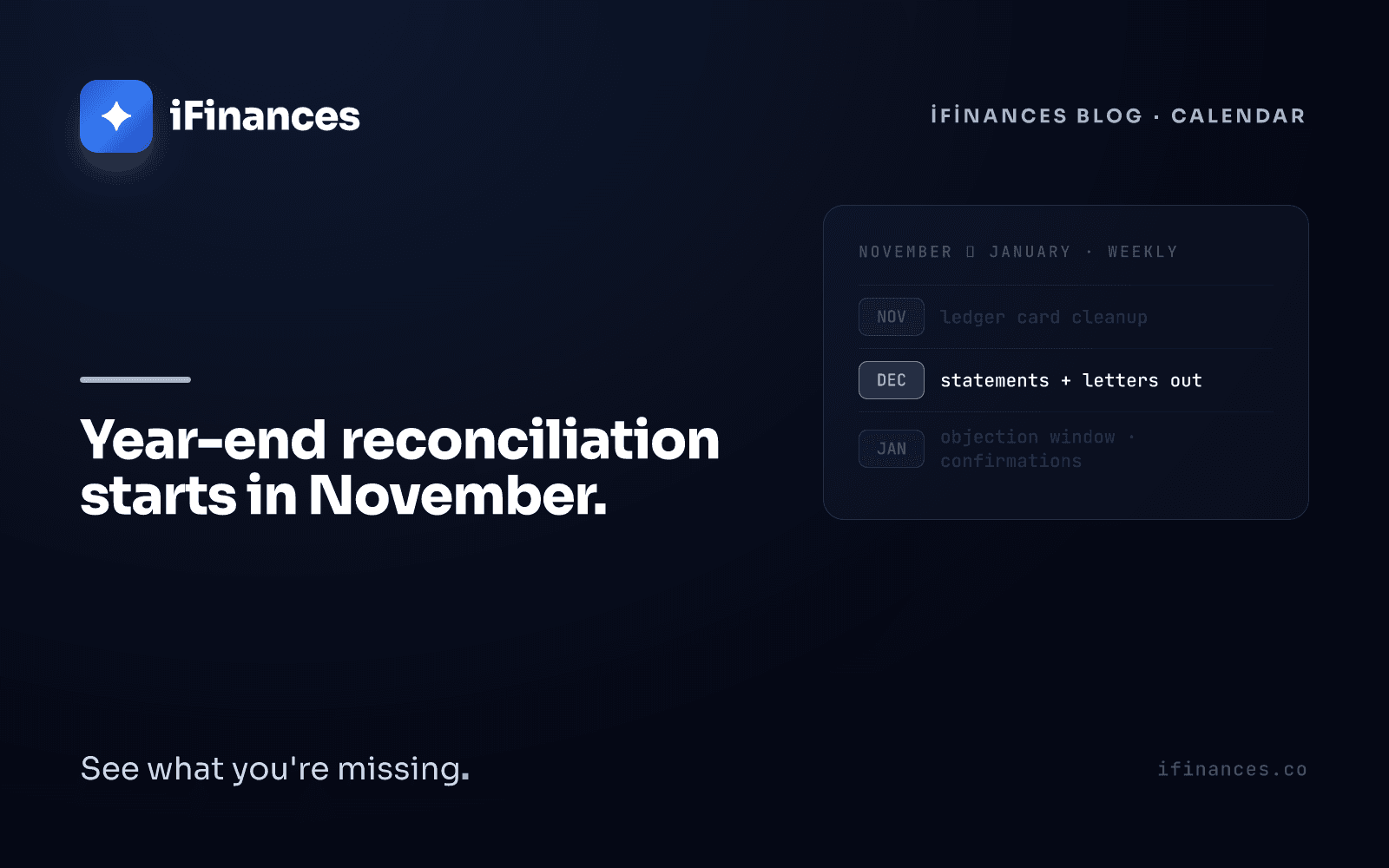
Year-end reconciliation in Türkiye has an unwritten tradition: balance statements are cut in a rush during the last days of December, replies are chased through January, and the unresolved differences that spill into February land right in the middle of audit and tax-filing season. Done properly, the year-end reconciliation effort is not a crisis week at all — it is a calm rhythm that starts in November, with a defined job for every week.
There is a legal anchor for that rhythm. Under Article 94 of the Turkish Commercial Code (TTK — the law governing commercial relationships in Türkiye), if the parties have not agreed on an account period by contract or trade custom, the last day of the calendar year counts as the closing day of the current account (TTK current account provisions). December 31 is the statutory cut-off — and the one-month objection window for the party receiving the balance statement starts on the day the statement reaches them. One caveat up front: that one-month period sits inside the TTK's current account provisions, and whether silence counts as acceptance of the balance turns on there being a written current account agreement between the parties — a point Turkish court practice treats as debatable. We come back to that distinction below.
In 2026 this calendar matters more than it used to. The Ba-Bs forms — Türkiye's monthly purchase and sales cross-reporting requirement — were abolished by Tax Procedure Law General Communiqué No. 565, effective from the September 2024 period. The mandatory monthly discipline that used to surface mismatches between two companies' books is gone. Whether your ledger and your counterparty's ledger still agree is now checked by exactly one thing: your own reconciliation calendar. The plan below builds that calendar, week by week, from November to January.
Why the Year-End Reconciliation Calendar Starts in November
Sending the letter is the end of the reconciliation process, not the beginning. If account cards are still messy when the statement is cut, reverse balances have not been scanned, and the gaps with your biggest counterparties are still open, every letter you send becomes an invitation to an objection. Plan backwards and the picture gets clear:
- The December 31 cut-off is fixed. If no account period has been agreed, the closing day is the last day of the calendar year. You cannot move the date — you can only be ready for it.
- Differences do not get resolved in December. Your counterparty's accounting team is in the same closing crunch; the last week of December is the worst week of the year for difference-hunting.
- The objection window spills into January and February. The one-month period under TTK Article 94 starts when the statement reaches the other side; letters that arrive in early January keep the window open well into February, and that needs managing.
- Audits and refund files lean on these balances. Independent audit confirmations, VAT refund files, and your accountant's checks are all built on top of your December 31 balances.
November: Clearing the Ground
November has a single purpose: making the ledger worth cutting a statement from.
Weeks 1–2: account card hygiene
Merge duplicate cards opened for the same company, complete missing or incorrect tax IDs, and process name changes. The most insidious source of differences is a single counterparty whose transactions are split across two cards; balances sent before this clean-up are wrong from the start.
Week 3: the reverse balance scan
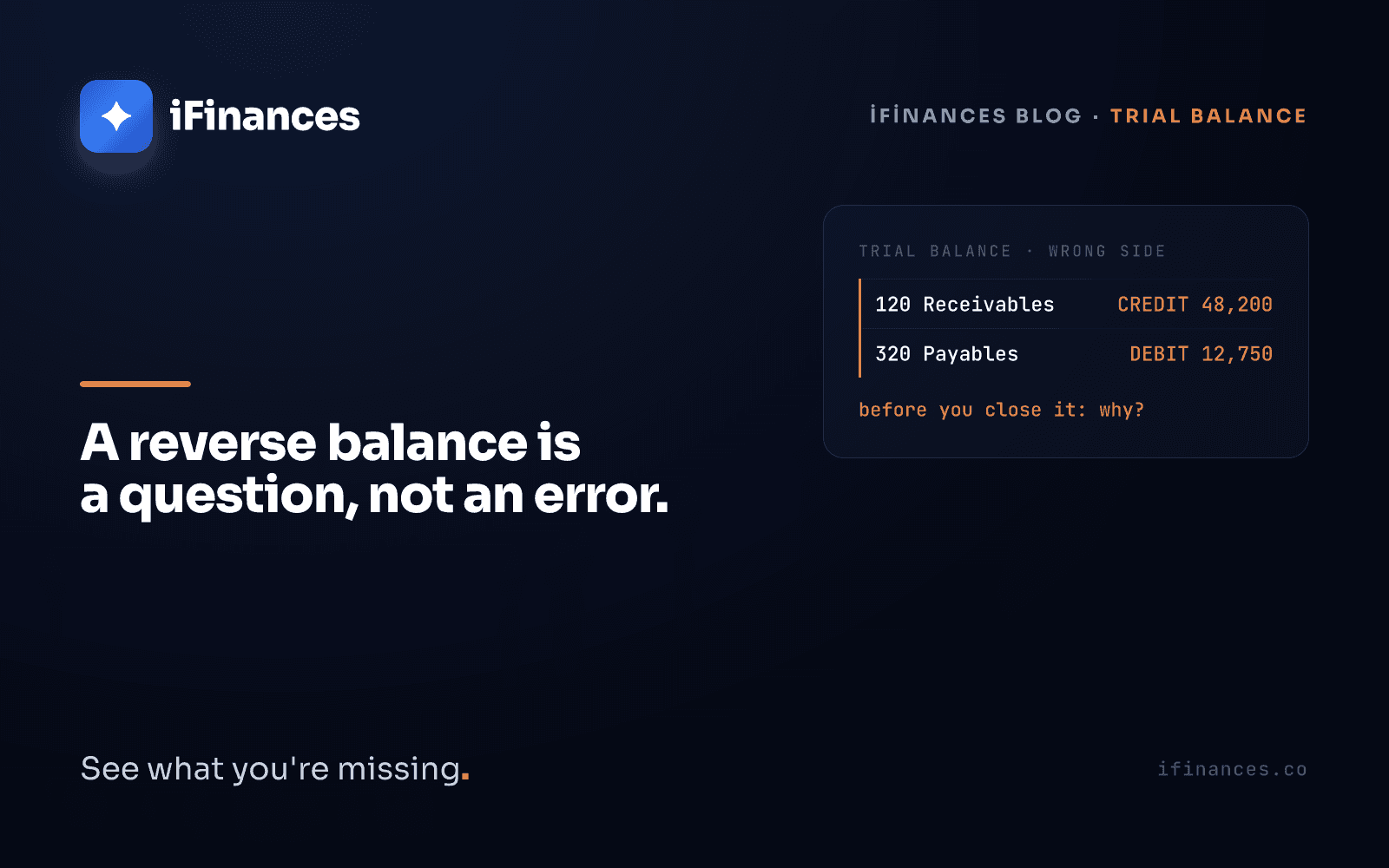
Receivable accounts showing credit balances and payable accounts showing debit balances are the classic period-end warning signs: an entry posted to the wrong counterparty, an advance still waiting for its invoice, or a return recorded on one side only. List the reverse balances now — each one is a question that should be answered before December.
Week 4: the missing document round
Invoices that never made it into the books, unprocessed returns and discounts, and bank slips left in limbo get collected this week. A large share of differences comes not from missing documents but from documents booked into different periods on each side; scan your own ledger against the nine typical causes of reconciliation differences.
Early December: the Pre-Reconciliation Round
The first two weeks of December are the most valuable reconciliation time of the year: everyone is still at their desk, and nobody is in closing panic yet.
Run a preliminary round with your highest-volume counterparties — in most businesses, the twenty or thirty companies that carry most of the total balance — using end-of-November balances. The goal here is not a formal statement but early diagnosis: if there is a gap, it gets resolved in December's calmer days, while both sides can still reach their records. A formal letter is not required for this round; the five ready-made reconciliation email templates cover the first contact and the reminder rhythm.
For counterparties with foreign-currency balances, this is also valuation prep: pin down now which balances are tracked in which currency and which rate each side books with. FX-driven differences take longer to resolve than amount differences and should not be left for the last week of December.
The Last Week of December: Cutting the Statement and Sending the Letters
Once the December 31 balance is final, the work turns into a well-constructed letter. Four fields should leave no room for debate: the balance date, the amount and currency, both parties' tax IDs, and the expected reply period. If you want a ready starting point, the Word and Excel reconciliation letter templates can be downloaded without registration.
Choose the delivery channel deliberately. Email is fast and practical; but where replies and objections need to leave a legally recognized trail, channels such as registered mail, notary, or secure electronic signature have a different standing under the TTK. For critical counterparties, pairing the fast channel with a recorded one is the healthiest practice.
One final planning note: the last week of December is for sending, not for investigating. For a team that has run the pre-reconciliation round, this week becomes largely mechanical — which is exactly the point.
January: Follow-Up, the Objection Window, and Audit Confirmations
January is the most neglected month of the calendar: the letters are out, everyone has dived into filing season, and the replies are left to fend for themselves.
- Put follow-up on a rhythm. A week is a reasonable gap before the first reminder; widening the audience on the second reminder (the finance manager, the counterparty's accountant) tends to help in practice.
- Manage the objection window. Under TTK Article 94, the party receiving the statement is deemed to have accepted the balance unless they object within one month via notary, registered mail, telegram, or secure electronic signature — but exactly when silence counts as acceptance is nuanced; we unpack it in what happens when nobody replies to a reconciliation letter.
- Resolve differences with a file, not a phone call. A "we do not agree" reply is a beginning, not an end: request the line-item list, scan forward from the last agreed date, and close each difference against its source document.
- Be ready for audit confirmations. For companies subject to independent audit, the auditor keeps control of the confirmation process under BDS 505, Türkiye's external-confirmations auditing standard, and asks for replies to be sent directly to the auditor; your reconciliation file is the raw material of that process. The thresholds were also updated: under Presidential Decree No. 11066, for fiscal periods starting on or after January 1, 2026, general (other) companies that exceed at least two of the three criteria — total assets of TRY 500 million, annual net sales of TRY 1 billion, 150 employees — in two consecutive fiscal periods become subject to mandatory audit from the following period (2026 audit thresholds). Regular reconciliation through the year is the shortest path to staying permanently audit-ready.
- Do not forget cross-examinations. Sworn-in CPA (YMM) cross-examination reports in Türkiye are drawn up electronically through the Digital Tax Office; electronic submission has been optional since 1 January 2026, and the mandate was deferred to 1 January 2027 by Communiqué Serial No. 2 (Official Gazette, 21 August 2026, No. 33347). The taxpayer on the receiving end of the request must reply within 30 days of notification; a clean receivables file turns that request into a routine task. See Türkiye's cross-examinations went digital for the details.
How Often Should You Reconcile? An Honest Frequency Matrix
The year-end reconciliation is a final exam; walk in without studying all year and the result will match. A sensible rhythm by volume looks like this:
- Low volume (a few mutual transactions per month): a full annual round, plus a half-year check with your few most critical counterparties, is usually enough.
- Medium volume (regular trading, single currency): a full quarterly round, with monthly balance checks for your ten largest counterparties.
- High volume (foreign currency, partial payments, multiple branches): a monthly reconciliation rhythm and, ideally, continuous line-level matching. For this profile the year-end round should not be a new project — it should be the final step of a rhythm that has been running for twelve months.
The more frequent the rhythm, the smaller the year-end burden: no differences left to resolve in December, letters that become a formality, and a January that is nothing more than reply management.
For Accounting Firms: One Calendar Across the Portfolio
Building this calendar for one company is easy; running it simultaneously across a portfolio of forty clients is an operation in its own right. Three principles help: build the calendar once as a portfolio-level template rather than client by client, fix each client's data-delivery dates (statements, bank exports, open-item lists) in the calendar as early as November, and entrust follow-up to a process rather than a person. We covered how to segment a portfolio and direct effort to the right clients in client portfolio management for accounting firms.
And one honest distinction: our piece on managing the year-end close workload is about damage control once the crisis arrives. This article is about the crisis never arriving: a rhythm that starts in November turns December's crunch from an exception into a manageable routine.
The two heaviest links in the year-end chain — matching thousands of line items and producing and chasing dozens of letters — can be automated today. iFinances matches the statements you upload as Excel or CSV line by line, shows which row every difference comes from with an explainable reason, and generates the reconciliation letter for confirmed balances, archiving the signed copy. If you want your calendar in place before November, get in touch — and to prepare the letter side, you can download the Word reconciliation letter template and the Excel reconciliation form directly.
Frequently Asked Questions
When should year-end reconciliation start?
Letters go out at the end of December, but the preparation should start in early November. Account card clean-up, reverse balance scans, and a preliminary round with your biggest counterparties all take time; a team that starts in November can spend the last week of December on nothing but cutting statements and sending them.
Should accounts be reconciled monthly?
Frequency depends on volume. For businesses with a few mutual transactions a month, one full annual round is usually enough; quarterly suits regular traders, while high volumes with foreign currency and partial payments call for a monthly rhythm. The more often you reconcile, the lighter year-end becomes.
What happens if the counterparty does not reply in December or January?
The one-month objection window under Article 94 of the Turkish Commercial Code starts on the day the balance statement reaches the other side, so letters sent in late December keep the window open into January and February. Whether silence actually counts as acceptance is a nuanced question tied to the existence of a written current account agreement — so keep following up rather than relying on it.
Why is December 31 the reconciliation cut-off in Türkiye?
Under Article 94 of the Turkish Commercial Code, if the parties have not set an account period by contract or trade custom, the last day of the calendar year counts as the account's closing day. That makes the December 31 balance the statutory anchor of year-end reconciliation.