One morning an email lands in your inbox: "Please find attached our account statement; we kindly ask you to review it for reconciliation." The attachment is a PDF — dates, document numbers, debit and credit columns, and a single balance at the bottom. For a business owner or a newly hired finance analyst reading a cari hesap ekstresi — the account statement that companies in Türkiye exchange with their trading partners — seriously for the first time, the table is more confusing than it looks. Is the figure in the debit column our debt or theirs? What does the letter printed next to the balance mean? And the sharpest question of all: why do our own books show a different number?
This guide takes the account statement apart line by line: what each column actually says, why debits and credits sit in mirror-opposite directions on the two sides of a trading relationship, how a "reverse balance" comes about, and where to start when two statements refuse to agree. The aim is to turn the statement from a document only accountants read into one the business itself can read.
What is an account statement?
In Turkish commercial practice, a cari hesap — a running account — is the ledger where the entire trading relationship between two companies is tracked in one place: invoices, payments, returns, foreign-exchange differences. Your books keep a separate account card for every customer and every supplier, and the statement is simply a dated extract of that card's movements. The concept even has a legal frame: the running account is a contract type regulated in Articles 89-101 of the Turkish Commercial Code (TTK), and the code requires it to be made in writing to be valid.
Don't confuse it with a bank statement. A bank statement shows cash moving between you and your bank; an account statement describes the whole commercial position with a trading partner — including invoices that have not been paid yet. One is a snapshot of cash flow, the other of commercial receivables and payables.
Before you read a single row, settle one question: who prepared this statement? The debit and credit columns are written from the preparer's ledger. The very same relationship, extracted from your own system, will show the columns flipped. That single sentence resolves half of the confusion people have with statements.
The anatomy of a statement: six columns
Software differs cosmetically, but a typical statement carries six pieces of information:
- Date: the document date the entry was booked under. When comparing, both sides must use the same period; extracts cut on different dates will never agree.
- Document number: the invoice number or payment reference. This — not the description text — is the most reliable key for matching two statements.
- Description: the transaction type: "sales invoice", "wire transfer", "return invoice", "FX difference". Helpful, but free text; the same event can carry different names in two companies.
- Debit: amounts that increase what the counterparty owes, from the preparer's point of view. On a seller's statement, issued invoices land here.
- Credit: amounts that reduce that debt. On a seller's statement, collections and returns appear here.
- Running balance: the net position after every row. The real "result" of the statement is this figure on the last line.
The letter next to the balance
Turkish systems usually print a B (borç, debit) or A (alacak, credit) next to the balance. On a statement a seller prepares for a customer, "3,000 TL (B)" reads: this customer owes us 3,000 TL. If the same statement shows (A), the relationship has flipped — the seller appears to owe the customer, which, as we will see shortly, is more often a signal than a fact.
The mirror rule: your receivable is their payable
Double-entry bookkeeping, applied across two companies, produces one consequence worth memorizing: the same trading relationship is recorded in opposite directions in the two ledgers. In Türkiye's uniform chart of accounts, a seller tracks its customer in account 120 (Trade Receivables), which normally carries a debit balance; the buyer tracks the same relationship in account 320 (Trade Payables), which normally carries a credit balance. A row sitting in the debit column of your statement sits in the credit column of theirs.
A three-line scenario makes it concrete. Say Aydın Metal sells to its customer Bora İnşaat during March. Aydın Metal's statement reads:
- March 1 — sales invoice A-1042: Debit 10,000 TL → Balance 10,000 TL (B)
- March 15 — wire transfer (collection): Credit 6,000 TL → Balance 4,000 TL (B)
- March 28 — return invoice: Credit 1,000 TL → Balance 3,000 TL (B)
The same three events in Bora İnşaat's ledger point the other way:
- March 1 — purchase invoice A-1042: Credit 10,000 TL → Balance 10,000 TL (A)
- March 15 — wire transfer (payment): Debit 6,000 TL → Balance 4,000 TL (A)
- March 28 — return invoice: Debit 1,000 TL → Balance 3,000 TL (A)
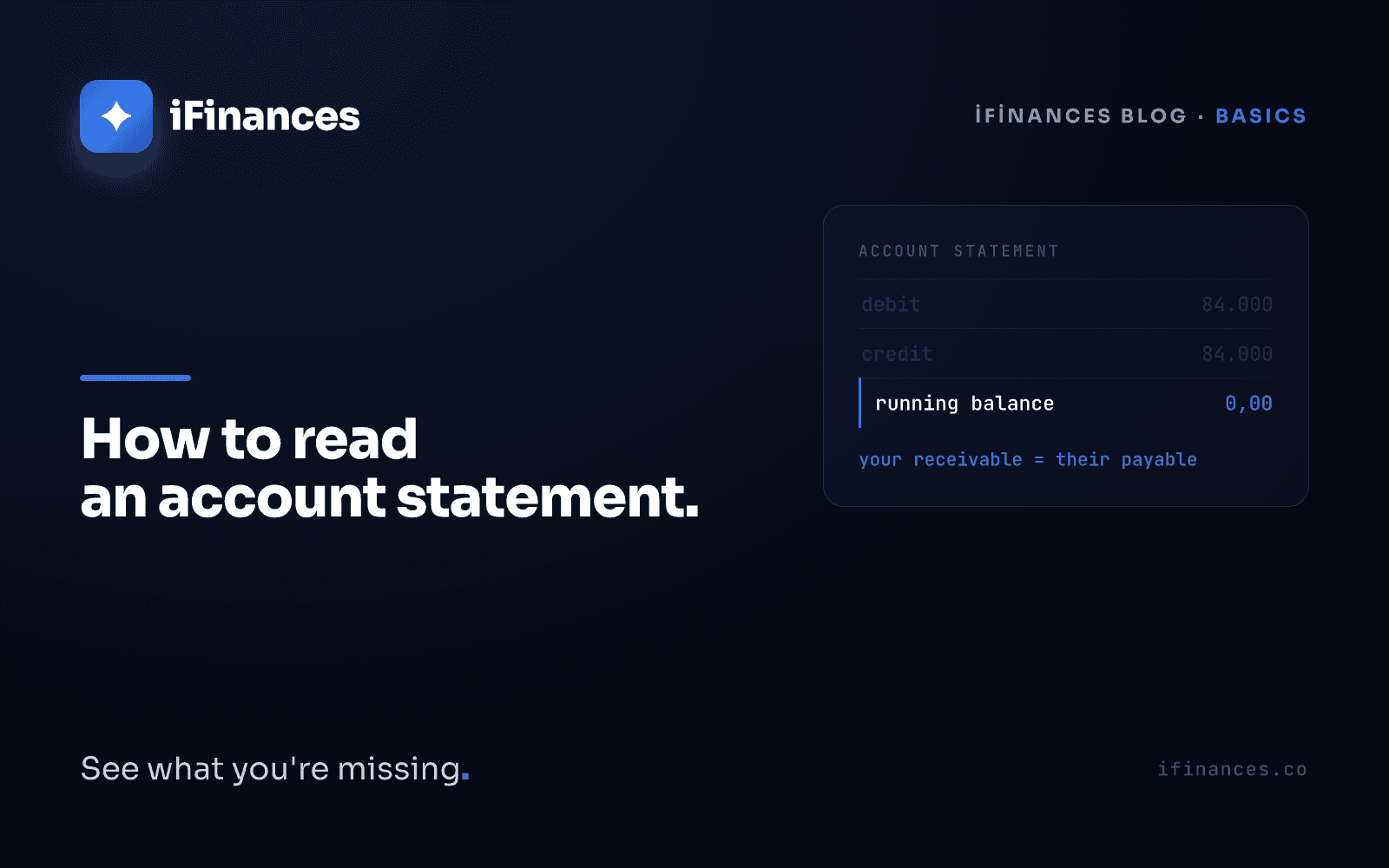
Both ledgers tell the same truth: Bora İnşaat owes Aydın Metal 3,000 TL. Identical amounts, mirrored directions. Reconciliation, at its core, is exactly this mirror check: your debit balance should meet the counterparty's credit balance of the same amount. Our complete guide to reconciliation walks through the account, bank, and e-invoice flavors of that check.
What is a reverse balance, and why does it happen?
A reverse balance is an account showing a balance against its "natural" direction: a customer card (120) with a credit balance, or a supplier card (320) with a debit balance. At first glance it reads as "we owe our customer, not the other way round" — sometimes that is genuinely the case, but more often it is the fingerprint of a bookkeeping issue.
The usual suspects:
- Advance payments: a customer pays up front for work not yet invoiced; the card flips temporarily and legitimately, and rights itself when the invoice is issued.
- Duplicate payment entries: the same wire booked twice can push a balance past zero.
- Postings to the wrong account card: another customer's payment recorded on this card flips one balance and overstates another.
- One-sided returns or discounts: a credit note recorded in one ledger but not the other pulls the balances apart.
- A skipped invoice: if an invoice exists in the counterparty's books but was never entered in yours, accumulated payments can flip the card.
Scanning for reverse balances is a well-known period-end routine in Turkish accounting; ERP documentation even defines dedicated reports for it — Logo Netsis, for instance, ships a "reverse balance control" report used at period end to check the direction of 120/320 accounts. One warning: closing a reverse balance or a reconciliation gap with a transfer entry before finding its source is dangerous — Turkish accounting literature explicitly flags such shortcuts as carrying tax-loss risk. Find the source document first, and confirm any correcting entry with your accountant.
When two statements disagree: the line-by-line method
"We sent the statement, and they came back with a different balance." That sentence is spoken thousands of times a month in Türkiye, and it calls for a systematic search rather than panic:
- 1. Equalize the period. Both extracts must cover the same start and end dates; different cut-off dates manufacture differences that are not real.
- 2. Find the last agreed date. Work backwards to the most recent date the balances matched; the difference was born after it, and your search space shrinks at once.
- 3. Match on document numbers. Line the rows up by invoice or payment reference, not by description, and eliminate every row present on both sides.
- 4. List the one-sided rows. Whatever survives elimination — rows in your books but not theirs, or in theirs but not yours — is your candidate list.
- 5. Run quick difference tests. A gap equal to exactly one invoice amount suggests a single skipped document; a round number suggests an unrecorded payment; two account cards whose gaps cancel out point to a wrong-card posting.
If the sweep still comes up empty, the difference may hide in a deeper pattern: invoices that look open although they were paid — "phantom debt" — or the question of which invoice a partial payment was applied to are the classic suspects. We collected the full taxonomy in our field guide to the nine causes of reconciliation differences.
There is also a legal layer worth knowing in Türkiye: staying silent about a balance summary you received is not neutral. Under Article 94 of the Turkish Commercial Code, the party receiving the balance statement can be deemed to have accepted it unless they object within one month through specific channels — a notary, registered mail, telegram, or a secure electronic signature. When and how that rule actually applies is the subject of our piece on what silence means under TTK 94.
From statement to reconciliation: should this stay manual?
A handful of partners and a few movements per card — at that scale the method above runs comfortably in Excel, and what mainstream Turkish pre-accounting tools offer is essentially the first step of it: producing the statement as a PDF and emailing it. We looked at how that workflow plays out in Paraşüt, and where it stops.
As volume grows, the equation changes: hundreds of partners, thousands of rows, partial payments, foreign-currency items, and two extracts kept in different formats. Matching rows by hand then costs both time and accuracy. iFinances works exactly at that layer: it does not replace your accounting software or ERP — it ingests both sides' Excel/CSV extracts, matches the rows automatically, shows every unmatched item with an explainable reason, and generates and archives the reconciliation letter. Reading the statement remains your job; shuttling between two PDFs at midnight to find the gap does not.
If you want your account statements to be readable — and comparable — on a regular rhythm, get in touch; and if you would rather start with the big picture, the complete reconciliation guide is a good first read.
Frequently Asked Questions
What is the difference between an account statement and reconciliation?
A statement is an extract from one side's ledger; reconciliation is the two-sided process of comparing both sets of records and confirming the balance with the counterparty. Sending a statement starts a reconciliation but does not finish it — reconciliation ends when the two extracts are shown to match line by line.
What does a debit balance on a statement mean?
It means that, according to the preparer's ledger, the counterparty owes them money. If a seller's customer statement shows 3,000 TL with a debit marker, the seller is claiming a 3,000 TL receivable. The same relationship appears as a credit balance of the same amount on the customer's own statement.
How do you fix a reverse balance?
Find the root cause first: an advance payment, a duplicate entry, a payment posted to the wrong account card, or a skipped invoice. Closing the balance with a transfer entry before confirming the source document can create tax risk in Türkiye. Always agree the correcting entry with your accountant or financial advisor.
How often should account statements be checked?
It depends on volume: monthly checks catch differences while they are small for high-activity partners, while a quarterly rhythm can be enough for low-volume ones. Year-end is critical in every case — under the Turkish Commercial Code, if the parties have not agreed otherwise, the last day of the calendar year counts as the account's closing date.