If you read a Turkish entity's year-end reconciliation file in English — as the group controller of a subsidiary in Istanbul, or on a Turkish finance team that reports upward in English — one line in it looks harmless and is not. It is the residual: the gap between two statements, closed in a single stroke on the last evening of the close.
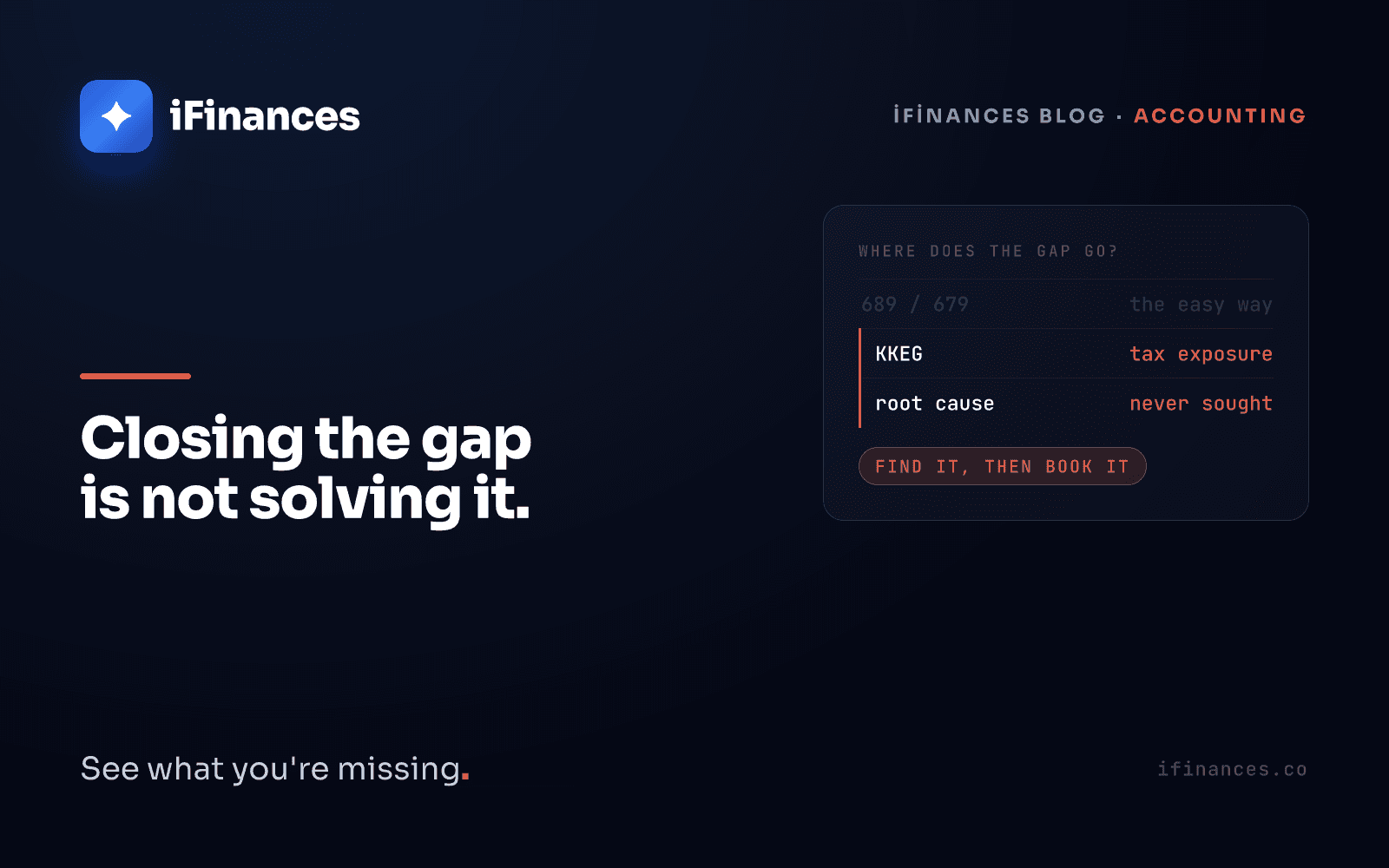
In Turkey that stroke usually has a name, KKEG, short for "kanunen kabul edilmeyen gider" — an expense that is recorded in the books but added back to the corporate tax base because the law does not allow its deduction. The category is legitimate and it has no exact equivalent in most group charts of accounts, which is precisely why it is a convenient place to put things. A difference booked there stops asking questions: the trial balance ties, nothing is deducted, and nobody feels exposed. The gap is closed; it is not solved.
"Which account does a reconciliation difference go to?" is a diagnostic question, not an accounting one. The same gap may need no entry at all, a document request to the counterparty, an invoice with VAT, or a genuine expense whose deductibility is assessed separately. You cannot choose the entry before you choose the cause.
What the shortcut costs
First, the difference comes back. If the root cause is untouched, the same drift accumulates in the next period. Four quarters of "small" write-offs become one unexplainable year-end number, and the group consolidation inherits it.
Second, the tax treatment is wrong. A gap that came from an unrecorded credit note produces the wrong result on both the VAT and the taxable-base side when it is expensed. The reverse happens too: a real expense parked in a customer account inflates receivables and the balance sheet with it.
Third, you lose the signal. In ACFE's 2024 Occupational Fraud: A Report to the Nations, account reconciliation is the initial detection method in 5% of cases, against 43% for tips and 14% for internal audit; the median loss is 145,000 dollars and the median duration 12 months. The conclusion is not that reconciliation solves fraud — it does not. It raises a flag, and a difference closed without explanation is a flag taken down. (Those figures are from the 2024 edition; ACFE's 14th edition was published in 2026.)
Nor is the underlying error rate unusual. In a Gartner survey of 497 accountants published in July 2023, 18% said they make errors every day, 33% a few times a week and 59% a few times a month. A difference appearing is not the anomaly. Not knowing where it came from is.
Five root causes, five different outcomes
Almost every gap falls into one of five buckets. Choosing the bucket correctly usually answers the journal-entry question by itself.
Documents: missing, duplicated or one-sided records
An invoice was never posted; the same invoice was posted twice; a credit note reached only one party's ledger. This is the bucket that looks most like a write-off candidate and is least likely to be one.
Accounting outcome: there is no "difference entry" here. What is needed is the original entry the document calls for, or the reversal of the duplicate. The gap was the symptom; the correction follows the document.
The expensive sub-case is duplicate payment. APQC's benchmark data puts duplicate or erroneous payments at 0.8% of annual disbursements for top-quartile organisations and 2% for bottom-quartile ones. That is not a difference to expense — it is money to recover from a supplier who already has it. The screening patterns are in financial anomaly detection.
Matching: the balance is fine, the open items are not
The sneakiest bucket, and the one that survives a signed confirmation letter. The total agrees, so both sides sign, but which payment cleared which invoice is wrong: a partial payment applied to a single invoice, a lump-sum transfer never allocated, a credit note matched to the wrong document.
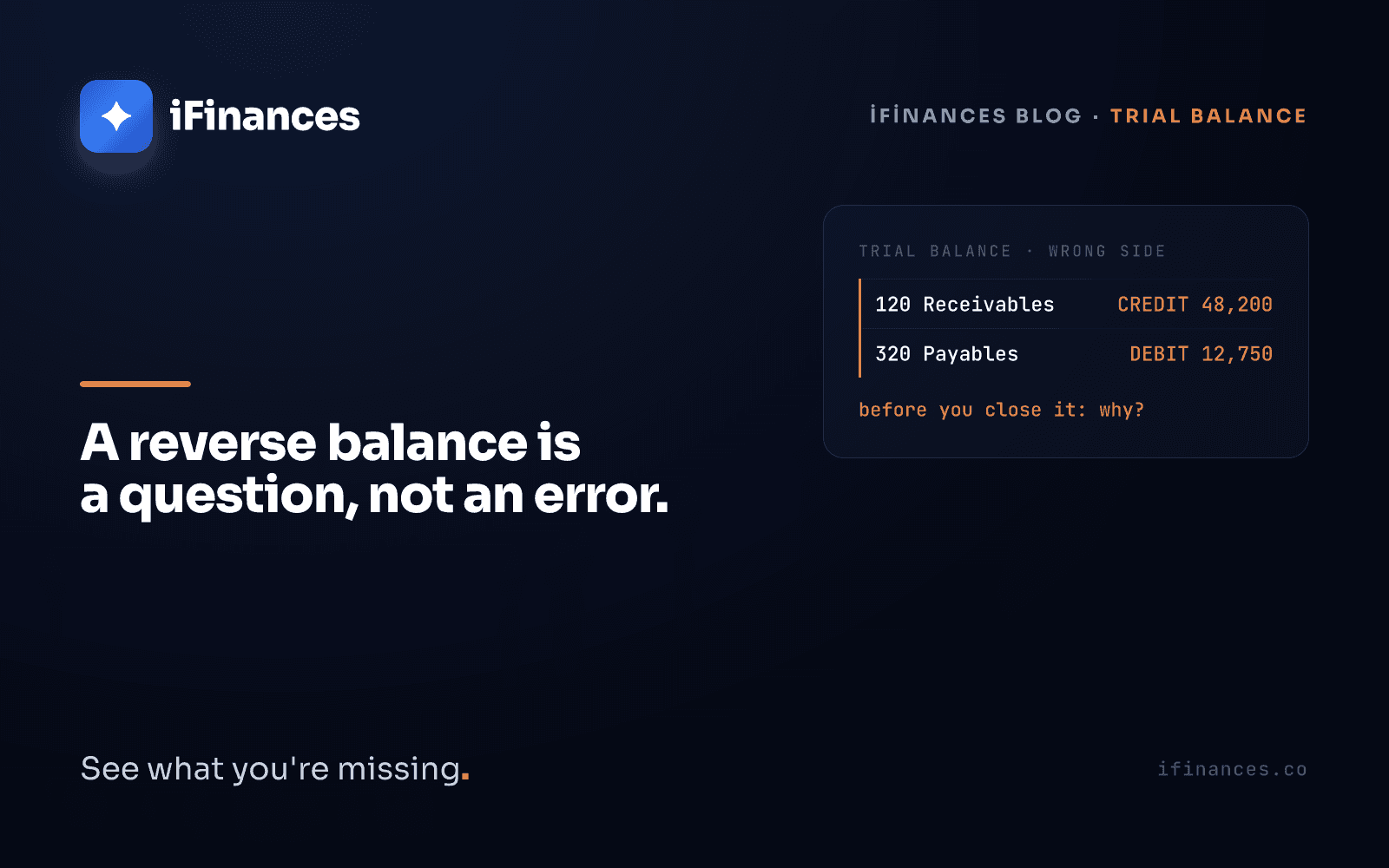
Accounting outcome: usually no amount entry is needed. The amounts are right and the clearing is wrong, so what has to be corrected is the open-item allocation. Why splitting partial payments and allocating lump sums goes wrong so often is the subject of payment-to-invoice matching. The visible symptom is often a reversed balance — a customer account in credit, a supplier account in debit — which is one of the causes collected in why account balances don't match.
Timing: an explanation, not an entry
The most common and most harmless cause. The invoice was recorded before the cut-off on one side and after it on the other; the delivery note and the invoice landed in different periods; the payment instruction left on the last day of the month and arrived in the next one.
Accounting outcome: no adjusting entry. List the items with dates and document numbers, attach the list to the reconciliation note and track them clearing in the next period. Expensing a timing difference imports a loss that does not exist. A quick test: if the dates of the offending items straddle the cut-off, stop looking for an entry.
Amounts: discounts, rebates, freight, retentions
Both sides hold the same invoice at different amounts, usually because of a retroactive discount, a volume rebate, a late-payment charge, a freight deduction or a progress-billing retention.
Accounting outcome: most of these require their own document, not an adjustment sized to the gap. Agree in writing which line opened it and issue what is required. For 2026 the Turkish invoicing threshold under Tax Procedure Law art. 232 is 12,000 TL, set by General Communiqué No. 588 (Official Gazette 31.12.2025, issue 33124, 5th repeated); below that amount an invoice must still be issued if the buyer asks for one.
FX: one invoice, two rates
The classic source for companies buying or selling in foreign currency, and the one a foreign parent notices first, because the subsidiary's TL books and the group's reporting currency disagree for reasons that have nothing to do with the supplier. The invoice was valued at one rate and the payment at another, or the two parties used different days or different rate types (buying, selling, effective).
Accounting outcome: this is a real exchange gain or loss and belongs in its own account, not in an "unexplained difference" bucket — provided both sides use the same official rate source. How the rate published by the Turkish central bank becomes that single reference is covered in FX differences and foreign-currency invoice reconciliation.
One local caveat worth knowing before someone in the group blames indexation: inflation accounting is not available as an explanation in these years. Under provisional article 37 of the Tax Procedure Law, inflation adjustment is suspended for the 2025, 2026 and 2027 accounting periods.
A rounding difference and a five-figure gap are not the same problem
The real defect in practice is treating 0.03 TL and a five-figure gap with the same reflex. Sharing a label does not entitle them to the same treatment.
A written tolerance policy draws the line, and it needs four elements: the threshold, per invoice and in total; the account that sub-threshold differences go to; who approves them; and what evidence is retained. Nothing above the threshold closes automatically. Set the threshold too low and the team chases cents while real differences hide in the noise; set it too high and the policy becomes the doorway for unexplained gaps. Both the amount and the account are accounting-policy decisions — set them with the Turkish accountant who signs the file.
What a wrong write-off costs
Three shortcuts are common in Turkish practice and all three carry exposure. In a piece published on MuhasebeTR on 8 September 2020, Koray Ateş lists them plainly: transferring a customer account with a credit balance to the shareholder-payable account, clearing that account through petty cash, and posting a direct cash outflow. According to the article these routes create tax-loss exposure on both the VAT and the income or corporate tax side; for reversed customer balances the correct treatment is an invoice with VAT issued using the internal-rate method.
The lesson is not one account code. It is that the way a difference is closed must reflect its economic nature: a sale gets an invoice, a collection gets a bank movement, a loss gets expensed with deductibility assessed separately. The entry should wear the shape of the event, not the reverse. And the consequence of any correction depends on the company, the document and the counterparty's status — this article is a diagnostic framework, not tax advice. Confirm the entry with your accountant before posting it.
A hypothetical example
The file below is not a customer case. It is invented, with representative figures, to show what the five buckets do to a single number. Assume the year-end gap with one supplier is 68,940 TL, and the reflex is a single write-off. Line-level matching breaks it down like this.
- 52,000 TL: two invoices issued around the cut-off, sitting in December on the supplier's side and in January on ours. Timing, no entry required.
- 9,400 TL: a supplier credit note that never entered our ledger. Documents, the original entry is made.
- 7,300 TL: a contractual freight deduction expensed on one side only. Amounts, the missing document is issued.
- 240 TL: the two parties valued the same payment at different daily rates. FX, booked to the exchange gain or loss account.
The four lines explain the whole gap and the unexplained residual is zero. Had the reflex won, 68,940 TL would have been added back as non-deductible expense, a 9,400 TL credit would have been lost, and the timing item would have reappeared with the opposite sign in the next period. That is the distance between closing a difference and solving it.
The file, and how long it has to survive
Closing a difference is a decision, and decisions need a file: both parties' line-level statements, the matching list, a root-cause label for each item, the reasoning, the approver and the document issued.
Two retention regimes run in parallel in Turkey. Tax Procedure Law art. 253 requires books and documents to be kept for five years starting from the calendar year following the one they relate to; Turkish Commercial Code art. 82 requires merchants to keep commercial books and records for ten years. Group retention schedules are frequently shorter than the local one, which is a problem worth catching before an inspection does.
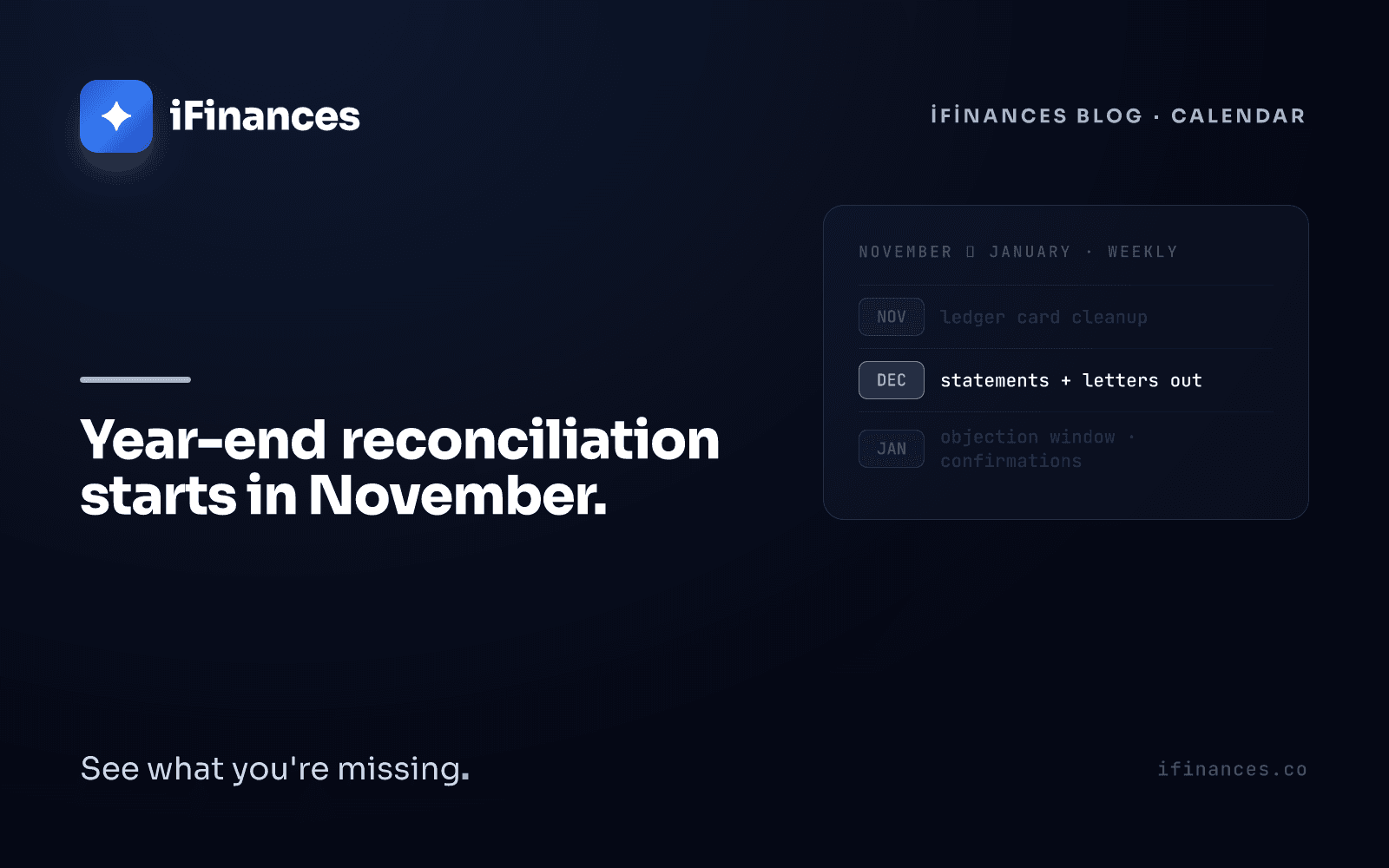
Do not rely on the counterparty's silence either. Under TCC art. 94, a party that receives the statement showing the balance at the end of an account period is deemed to have accepted it if no objection is raised within one month by notary, registered letter, telegram or secure electronic signature. The critical nuance: this operates in the context of a written current-account agreement, and TCC art. 89 makes written form a validity condition — without such an agreement, silence in response to a reconciliation letter may not by itself amount to acceptance. TCC art. 101 time-bars claims arising from a current account, including those about errors and miscalculations, five years after the agreement ends. Documenting a difference is an evidentiary question, not only a tax one.
Where iFinances fits
To be clear: iFinances does not keep your books, does not create entries and does not close a line on its own. You post the correction and choose the account with your accountant.
What it does is compress the preparation behind the hardest part of this article — breaking a gap into its underlying items, line by line — into minutes. Ledger and ERP records, bank statements and e-invoice data land in one table. The matching engine performs FIFO and invoice-specific clearing, splits partial payments, allocates lump-sum transfers, applies a cent-level tolerance and matches across currencies using the central bank's official rate. Every match carries a written reason: the amounts agree, the dates line up, the reference points to this invoice. Name similarity between a bank narrative and a company title is proposed through a Turkish-character-folding comparison, and a human decides. Missing invoices, duplicates and out-of-pattern amounts are flagged as anomalies.
Naming the bucket stays with your team: whether an item is a freight deduction or a rebate is a judgement that needs the document and a person. What changes is that the team can separate the items behind a gap in minutes, with the reason for every proposed match written next to it. The full flow is on our supplier statement reconciliation page, and the closing decision stays yours.
Frequently Asked Questions
Which account does a reconciliation difference go to?
There is no one correct account; it depends on the root cause. A timing difference needs no entry and clears next period. A missing or duplicated document is fixed by the entry it calls for, or by a reversal. Discounts, late-payment charges and freight deductions require their own documents. An FX difference belongs in the exchange gain or loss account. Only a genuinely unexplained residual below your tolerance threshold is a write-off candidate, and its deductibility must be assessed separately.
What exactly is KKEG, and can I book a reconciliation difference straight to it?
KKEG is the Turkish category for expenses recorded in the books but disallowed for tax, so they are added back to the corporate tax base. It is the conclusion of a diagnosis, not the diagnosis itself. Booking there without investigating the cause lets the cause repeat and can produce the wrong tax result — a gap that came from an unrecorded credit note leaves the VAT side incomplete when it is expensed. Match line by line first, then decide the treatment of the residual with your accountant.
What should we do about cent-level rounding differences?
Rounding and revaluation differences of a few cents are not economical to chase one by one. The answer is a written tolerance policy: a threshold per invoice and in total, the account sub-threshold differences go to, who approves them, and no automatic closing above the threshold. The threshold is an accounting-policy decision to set with your accountant.
Is clearing a reversed customer balance through petty cash acceptable?
According to Koray Ateş's article on MuhasebeTR dated 8 September 2020, transferring a customer account with a credit balance to the shareholder-payable account, clearing it through petty cash or posting a direct cash outflow are common errors carrying tax-loss exposure. The same article gives the correct treatment as an invoice with VAT issued using the internal-rate method. Confirm it for your file with your accountant.
How long do we have to keep the decision file?
Two regimes run together in Turkey. Tax Procedure Law art. 253 requires books and documents to be kept for five years from the calendar year following the one they relate to, and Turkish Commercial Code art. 82 requires merchants to keep commercial books for ten years. TCC art. 101 also time-bars current-account claims, including those about errors, five years after the agreement ends. Keep the difference file for evidentiary reasons, not only tax ones — and check that the group retention schedule is not shorter than the local requirement.
✦ iFinances — See what you're missing.