In theory, reconciliation in Türkiye runs on formal letters. In practice, it runs on email: the statement goes out as an attachment, the confirmation comes back as a reply, objections start in an inbox, and reminders are — of course — emails. Yet search for a reconciliation email sample and you will mostly find a single generic paragraph buried inside a long guide, with no sense of who it is written for or at which stage of the process it belongs.
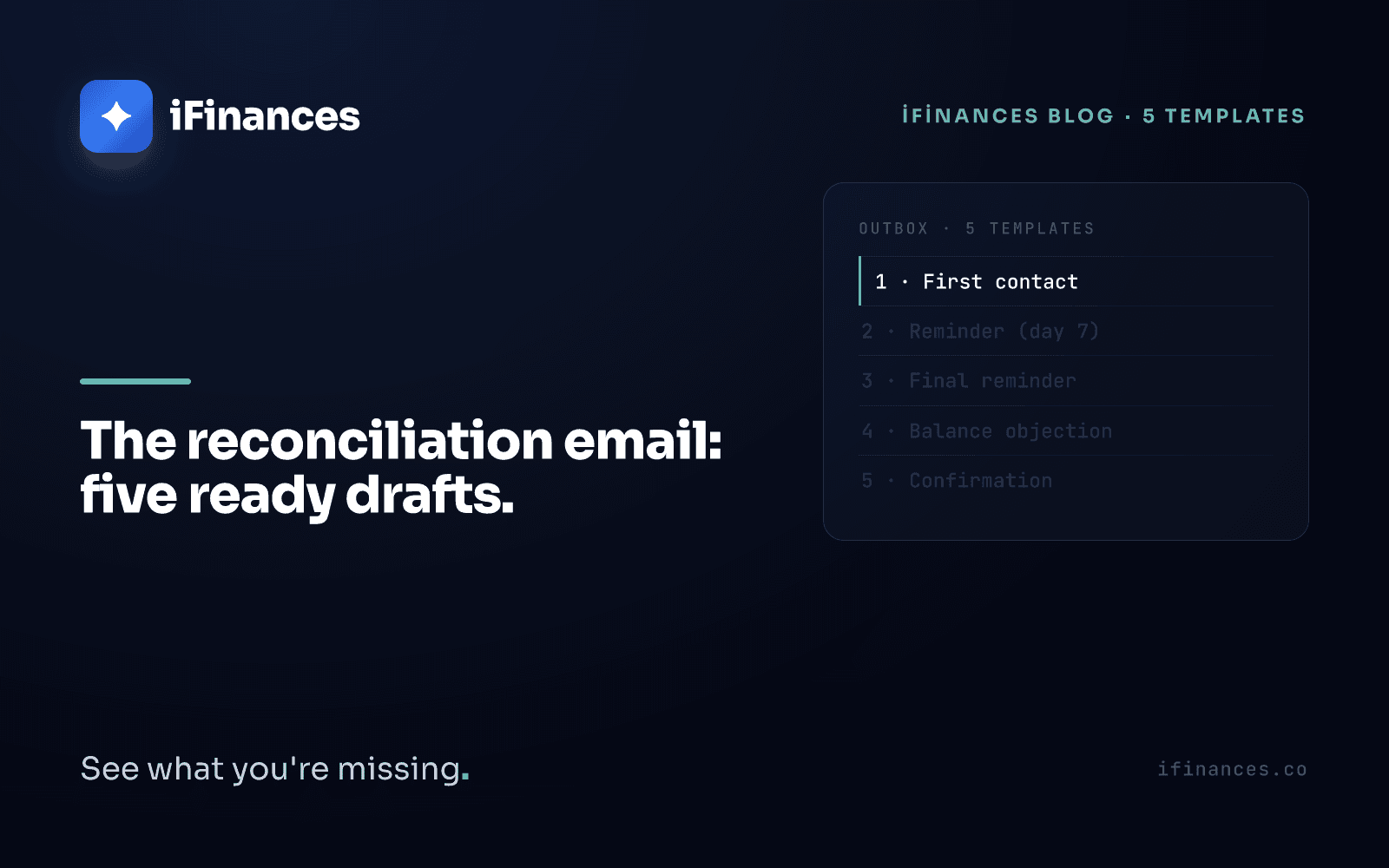
This guide gives you five ready-to-use templates covering the full cycle: first contact, a first reminder, an escalated final reminder, an objection when the balances differ, and the final confirmation. Each comes with a suggested subject line, and all of them use placeholders such as [Company], [Amount], and [Date] — copy, fill in the brackets, send.
Before the templates, two things are worth clarifying: how the reconciliation email relates to the formal reconciliation letter, and what to prepare before hitting send. Even a well-written email goes unanswered when it reaches the wrong person, arrives without the statement, or asks for three things at once.
What is a reconciliation email — and how does it differ from the letter?
A reconciliation email tells your counterparty the balance you see on their account as of a given date and asks them to confirm it or object. The reconciliation letter is the structured, archivable document version of the same request: it carries the tax ID, balance date, currency, and reply deadline in a standard format. In practice the two are complements, not alternatives — the letter carries the record, the email carries the conversation. For the wider picture of how account, bank, and e-invoice reconciliation fit together in Türkiye, start with our complete reconciliation guide.
The distinction matters legally as well. As we will see below, email is the fast, practical channel — but it is not one of the formal objection channels listed in the Turkish Commercial Code (Türk Ticaret Kanunu, or TTK). The templates work best when used inside that legal frame.
Before you send: three preparation rules
1. Find the right recipient. The reconciliation email should go to the counterparty's accounting or finance contact, not the company's general info@ inbox. If you don't know who that is, send the first email with a note asking that it be forwarded to the accounting department, request a named contact in the reply, and write directly to that person from then on.
2. Always attach the statement. Asking only "our records show X — do you agree?" forces the other side to compare their books against a list they cannot see. Attach your account statement with date, document number, and amount columns to every send. We covered how to read a statement — and how to compare two of them line by line — in this guide.
3. One date, one amount, one request. The balance date, the amount, and the currency should each appear once and unambiguously, and the request should be a single sentence: confirm if you agree, send your statement if you don't. Cramming several periods and several questions into one email is the surest way to get no reply at all.
Five ready-to-use reconciliation email templates
The templates are deliberately short and written in a realistic business-correspondence tone; remember to add your corporate signature block.
Template 1 — First contact
Subject: Account Reconciliation — [Company Name], balance as of [Balance Date]
Dear [Name],
As of [Balance Date], our records show a [receivable/payable] balance of [Amount] [Currency] on your account. Please find our account statement for the period attached.
If you agree with this balance, a short written confirmation by reply is sufficient. If your records show a different figure, we would appreciate receiving your statement. To keep our closing schedule on track, we kindly ask for your reply by [Due Date].
Kind regards, [Name] — Accounting, [Company Name]
Template 2 — First reminder (day 7)
Subject: Reminder: Account Reconciliation — [Company Name], [Balance Date]
Dear [Name],
We have not yet received a reply to our reconciliation request dated [Send Date]. As of [Balance Date], our records show a balance of [Amount] [Currency]; our statement was attached to the previous email and is attached here again for convenience.
To complete our period close on time, we kindly ask you to confirm the balance — or send us your objection together with your statement — by [Due Date].
Kind regards,
Template 3 — Second and final reminder (escalated)
Subject: Final Reminder: Account Reconciliation — [Company Name], reply requested
Dear [Name],
We have received no response to our emails of [Send Date] and [Reminder Date]. For the balance of [Amount] [Currency] as of [Balance Date], we plan to close the reconciliation process as of [Due Date], and we will additionally send you a formal reconciliation letter in writing.
We would be grateful if you could forward this matter to your accounting manager or financial advisor; we remain available for any questions.
Kind regards,
Template 4 — Objection: the balances differ
Subject: Account Reconciliation — balance difference as of [Balance Date]
Dear [Name],
There is a difference of [Difference Amount] between the balance of [Their Balance] you reported as of [Balance Date] and the balance of [Our Balance] shown in our records. We are therefore unable to confirm the balance as stated.
To locate the source of the difference, could you please send us your account statement for [Period Start] – [Balance Date], itemised by date, document number, and amount? Our statement at the same level of detail is attached.
Kind regards,
Template 5 — Confirmation
Subject: Reconciliation Confirmed — [Company Name], [Balance Date], [Amount]
Dear [Name],
We confirm our agreement on the balance of [Amount] [Currency] as of [Balance Date]. Your confirmation and the related correspondence have been filed in our period records.
Thank you for your cooperation, and best regards,
Timing: how to set the reminder rhythm
No regulation dictates how many days to wait before a reminder; your own closing calendar sets the pace. A rhythm that works well in practice has three steps: the initial send (day 0), a polite reminder on day 7 if there is no reply, an escalated final reminder around day 14 — and then moving the process onto a formal reconciliation letter.
At year-end, the rhythm needs to start earlier. Under the current account provisions of the Turkish Commercial Code (Articles 89-101), if the parties have not agreed on an accounting period by contract or commercial custom, the last day of the calendar year counts as the closing day of the account (Article 94). That rule sits inside the current account regime, but the year-end cut-off is in practice the commonly accepted anchor for reconciliation whether or not such a contract exists — which makes the December cut-off and the January follow-up the busiest reconciliation window of the year. We laid out a week-by-week plan from November to January in the year-end reconciliation calendar.
The objection scenario in Template 4 opens a separate work package: the difference has to be found. We collected the nine most common causes of reconciliation differences — and the tactics for hunting them down line by line — in this article.
Is email legally sufficient? TTK Article 94 and the hybrid approach
Here is the critical point. Under TTK Article 94, the party receiving a statement of the balance is deemed to have accepted it unless they object within one month of receipt — through a notary, by registered letter, by telegram, or in a document bearing a secure electronic signature. Ordinary email is not on that list. Running your day-to-day reconciliation traffic over email is perfectly practical; relying on a plain email alone for an objection that is meant to carry legal weight may fall short. One more nuance: this one-month silent-acceptance mechanism is framed around a current account agreement, which Article 89 of the TTK requires to be made in writing to be valid — so it should not be assumed to apply automatically to every reconciliation exchange. We examined what an unanswered letter really means — and what those "you will be deemed to agree unless you reply within X days" clauses are actually worth — in our TTK 94 deep dive.
Our recommendation is a hybrid approach: email for speed and workflow, a structured letter and a disciplined archive for the record. One distinction is worth making explicit: KEP (Kayıtlı Elektronik Posta, Türkiye's registered electronic mail system) is not one of the four channels listed in TTK Article 94. KEP leaves a far stronger evidentiary trail than ordinary email for both delivery and content, but for an objection meant to be valid under Article 94 a notary, registered letter, telegram, or document bearing a secure electronic signature is the safer route. For large or disputed balances, confirm the choice of channel with your financial or legal advisor.
One final distinction: confirmations requested during a statutory audit follow a different regime from the commercial reconciliation emails in this guide. Under BDS 505 — Türkiye's auditing standard on external confirmations — the auditor must keep control of confirmation requests, and replies are expected to go directly to the auditor. When your auditor asks for confirmations, the process runs on their design, not on your email templates.
The email went out — now the real work starts
Five templates start the process; what finishes it is follow-up: who confirmed, who objected, who went silent, which differences are still open? Once you pass a few dozen counterparties, that follow-up turns into a hand-maintained "reconciliation status" tab in Excel, and by period-end nobody quite remembers who said what in which thread.
iFinances exists for exactly this layer: without replacing your accounting or pre-accounting software, it takes your uploaded statements, matches them line by line against the counterparty's data, shows which item a difference comes from — with the reasoning spelled out — and generates and archives the reconciliation letters and their confirmed copies. Request a demo to see the full flow, and grab the Word + Excel reconciliation letter templates — no sign-up required — for the document side of the process.
Frequently Asked Questions
Who should receive a reconciliation email?
Send it to the accounting or finance contact at the counterparty, not the company's general info@ address. If you don't know who that is, send the first email with a note asking that it be forwarded to the accounting department, request a named contact in the reply, and write directly to that person in later periods. For large balances, copying both the operational contact and their manager speeds things up.
How soon should you send a reminder?
No regulation sets a deadline; your own closing calendar drives the rhythm. A common practice is a polite first reminder on day 7 if there is no reply, an escalated final reminder around day 14, and then moving the process to a formal reconciliation letter. During the year-end close these intervals are often shortened.
Is reconciliation by email legally valid in Türkiye?
For day-to-day confirmations, email is the practical channel and the exchange leaves a useful commercial trail. However, Article 94 of the Turkish Commercial Code lists the formal channels for objecting to a stated balance as a notary, registered letter, telegram, or a document bearing a secure electronic signature — ordinary email is not on that list. KEP (Kayıtlı Elektronik Posta, Türkiye's registered electronic mail system) is not one of those four channels either; it leaves a strong evidentiary trail for delivery and content, but for an objection meant to be valid under Article 94 a notary, registered letter, telegram, or secure e-signed document is the safer route. For large or disputed balances, confirm the choice of channel with your financial or legal advisor.
What happens if nobody replies to the reconciliation email?
Silence does not automatically mean acceptance in every case: the one-month silent-acceptance mechanism in Article 94 is framed around a current account agreement, which the law requires to be made in writing. The practical path is to run your reminder rhythm, document the balance with a formal reconciliation letter, and track unanswered balances as open items in your period file.