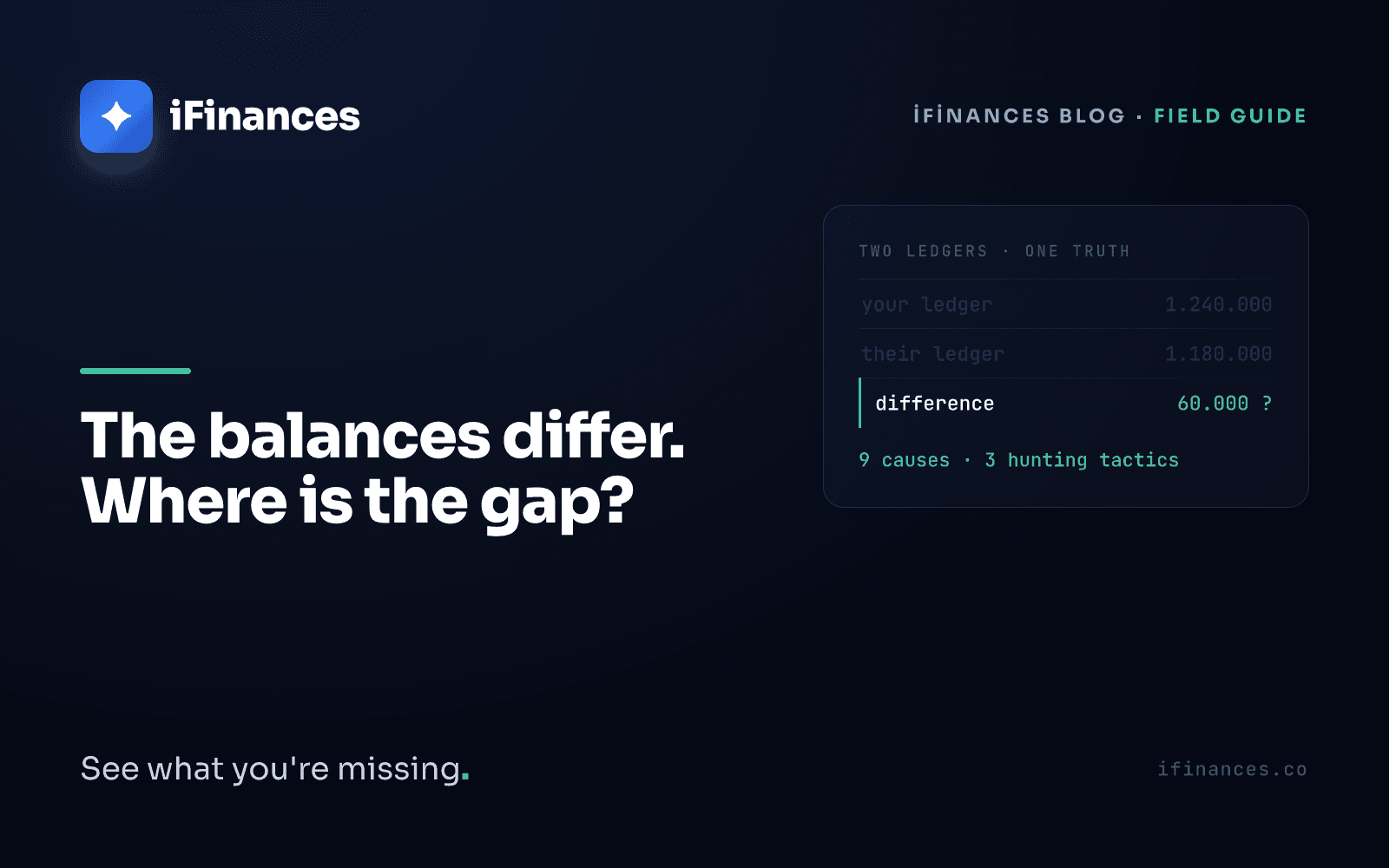
The counterparty sent over their statement, the two balances went side by side, and the numbers don't match. Few sentences are heard more often in finance teams and accounting firms at period end — and the frustrating part is that an account balance mismatch rarely comes from a single mistake you can spot at a glance. The gap between two ledgers is usually the accumulation of small drifts spread over months, and finding it takes a bit of detective work.
This guide distils the difference patterns we keep seeing in the field. First, the nine typical causes of a reconciliation difference; then four quick tests that narrow the search from hours to minutes; and finally a correction flow that closes the gap without the shortcuts that create tax exposure — a topic with specific contours in Türkiye, where commercial practice sits on the TTK (the Turkish Commercial Code) and a uniform chart of accounts.
Why an account balance mismatch happens: the mirror principle
Two companies' ledgers are mirrors of each other. The invoice you issued is a receivable in your books and a payable in theirs; in the Turkish uniform chart of accounts, your account 120 (trade receivables) for a customer should be the exact reverse of that customer's account 320 (trade payables) for you. In a healthy relationship, both ledgers record the same transactions from opposite directions and the balances agree in absolute value. If you want a refresher on statement columns and debit/credit directions, start with how to read an account statement.
A difference means the mirror is cracked somewhere, and the crack sits in one of three places: a record missing or duplicated in your ledger, a record missing or duplicated in theirs, or a transaction that exists on both sides but was booked with a different amount, date, or counterparty card. All nine causes below are variations of these three possibilities.
The 9 typical causes of a reconciliation difference
1. A missing or skipped invoice. The most common cause. The counterparty issued an invoice that never reached your records — it sat in an inbox, waited for an approval that never came, or was filed against the wrong folder. The reverse happens too: your invoice was never booked on their side. This is why catching missing invoices and duplicates as anomalies is a precondition of healthy reconciliation.
2. A duplicate entry. The same invoice booked twice — once from the e-invoice feed, once from a PDF that arrived by email. Because the amount is identical and the document number sometimes looks different, it slips through review and inflates the balance by exactly one invoice.
3. Date and period drift. An invoice issued at month-end sits in December in your books and in January in theirs, so a December 31 cut-off comparison shows a gap. The transaction isn't lost; the two ledgers simply placed it in different periods. Comparisons made without pinning the cut-off date mislead for exactly this reason.
4. FX asymmetry. On a foreign-currency invoice, one side used the invoice-date rate while the other used the payment-date rate or a different rate source, so the same transaction sits in the two ledgers at different local-currency amounts — and differing revaluation dates compound it. We unpack this pattern in FX differences in foreign-currency invoice reconciliation.
5. One-sided returns and discounts. A credit note, price adjustment, or late-payment charge processed by only one party opens the balance by exactly that document. Discounts agreed verbally — "we'll correct the invoice" promises that never materialise — are the classic of this category.
6. Wrong counterparty card; duplicated or split cards. Two legal entities of the same group, two branches of the same company, two suppliers with similar names… The transaction is right, the card is wrong. A single counterparty split across two cards in your ledger produces totals that are correct overall but wrong per card — and the other side, looking at one card, sees a mismatch.
7. A partial payment applied to the wrong invoice. The payment exists in the ledger but closed the wrong invoice; even when the total balance agrees, ageing and item-level reconciliation break. A paid invoice that still shows as open — what we call phantom debt — is usually born here. Our piece on why payment-invoice matching is hard walks through the FIFO and partial-payment mechanics in detail.
8. A reverse balance. A customer card that should carry a debit balance showing credit, or a supplier card doing the opposite, usually points to an advance, a duplicate payment, or a direction error. In Türkiye this is such a well-established period-end routine that Logo Netsis documentation defines a dedicated "reverse balance control" report for it.
9. Rounding and cent differences. VAT rounding, decimals lost in currency conversion, pennies dropped in manually keyed amounts… Individually trivial, they accumulate across hundreds of transactions into small "unexplainable" gaps. And a small difference is not always innocent: sometimes it is two large errors partially netting each other off.
How to find an account balance mismatch: four quick tests
Knowing the nine causes gives you a diagnosis list, but scanning line by line without narrowing the search is hunting a needle in a haystack. Run these four tests in order:
1. Scan forward from the last agreed date. When did both sides last agree to the penny? Everything before that date is presumed clean; the difference was born afterwards. This one question typically shrinks the search window from months to weeks — and it is the most tangible payoff of keeping a written reconciliation archive.
2. The single-document test. Take the absolute value of the difference and search both document lists for a single invoice, credit note, or payment of exactly that amount. If the gap equals one document, you are almost certainly looking at one missing or one duplicated record — most missing-invoice, duplicate, and one-sided-credit cases fall to this test.
3. The half-the-difference test. If the difference is exactly twice a document's amount, look for a direction error: something that belonged on the debit side was posted to credit. A direction error doesn't erase the amount, it doubles its effect — which is why searching the lists for half the difference works surprisingly often.
4. The round-number test. If the gap is a round figure, look at payments first. Invoices are rarely round; transfers and advances usually are. A round difference is very often a receipt or payment that was booked on one side only, or attached to the wrong counterparty card.
If none of the four fires, split the period in half and compare interim balances for each half; wherever the gap is born, split again. This binary search squeezes even the most stubborn difference into a single month within a few steps.
What not to do when closing the gap
Finding the source takes patience, and some teams reach for shortcuts. Turkish accounting literature is clear about where those shortcuts lead: a MuhasebeTR article by Koray Ateş explains that transferring a reverse-balance receivable account into account 331 (payables to shareholders), clearing that account against cash, or simply writing a cash outflow carries tax-loss risk — and that in the relevant cases the correct treatment is issuing a proper VAT invoice.
Three shortcuts to avoid in particular:
- Writing the gap off to income or expense as a "rounding difference" without explanation — a difference closed without a trail cannot be explained in an audit.
- Moving a reverse balance to another account with an undocumented transfer entry — the balance doesn't disappear, it just becomes invisible.
- Accepting the counterparty's balance unquestioned because "they're the bigger company" and bending your own ledger to match — the error may not be on your side at all.
The tax consequences of any correcting entry depend on your company's specifics; confirm the treatment with your accountant before posting.
The correct correction flow: document, entry, confirmation
A healthy close has three steps:
1. Verify against the source document. Once you have found the transaction behind the gap, go to the document before the correction: the invoice, the bank slip, the credit note. If the record disagrees with the document, the record is what gets fixed; if there is no document, the transaction itself should be questioned.
2. Post a separate correction entry. Correct with a dated, annotated entry rather than by overwriting the original, and reference the reconciliation in the description. Whoever looks at that line next year should be able to see what changed and why.
3. Request documents and get written confirmation. If the error sits in the counterparty's ledger, don't stop at asking them to fix it — request an updated statement afterwards and put the reconciliation in writing. Written balance confirmations carry real legal weight in Türkiye: under Article 94 of the TTK, a balance statement not objected to within one month can be deemed accepted in a written current-account relationship.
Catching differences before they grow: continuous reconciliation
Everything above is archaeology — work done after the gap has formed. The real win is making the dig unnecessary: when transactions are matched as they occur, a difference is caught at the first document, and none of the nine causes gets months to accumulate.
iFinances works at exactly this layer. It ingests your Excel/CSV statements and e-invoice data, matches both sides' transactions line by line, and surfaces every unmatched item with an explanation of why it looks suspicious — flagging anomaly patterns such as missing invoices, duplicates, and FX asymmetry. It does not replace your accounting software; it sits on top of it. Think of it as an assistant running the four tests above across every account, every period, at once.
If one of your accounts has refused to match for months, let's find the gap together: book a demo or write to us. For the bigger picture, continue with our complete guide to reconciliation.
Frequently Asked Questions
What should I do if the reconciliation difference cannot be found?
Narrow the window first: find the last date on which both sides agreed to the penny and only scan forward from there. Then split the period in half and test which half produces the gap, repeating until you are down to a single month. If it still hides, request an item-level statement from the counterparty and match the two lists line by line — comparing balances never reveals where a difference lives, matching lines does. Avoid writing the gap off in a single unexplained entry; work through it with your accountant.
Whose ledger is the error in?
You cannot know in advance. A difference comes from one of three places: a record missing or duplicated in your ledger, a record missing or duplicated in the counterparty's ledger, or a transaction booked on both sides with a different amount, date, or counterparty card. Until the two statements are laid side by side at line level, neither ledger can be presumed correct — assuming the bigger company must be right is a common and costly shortcut.
What is a reverse balance?
It is when a customer account that should carry a debit balance shows a credit balance, or a supplier account that should carry a credit balance shows a debit one — in the Turkish uniform chart of accounts, accounts 120 and 320 respectively. The usual causes are advances, duplicate payments, direction errors, and postings to the wrong counterparty card. Scanning for reverse balances is a standard period-end control; how to correct one depends on the specifics, so confirm the treatment with your accountant.
What is the most common cause of a balance mismatch?
In practice the patterns we see most often are missing or skipped invoices, credit notes and discounts booked on only one side, and partial payments applied to the wrong invoice. Companies trading in foreign currency add FX asymmetry to the list, and high-volume accounts add period drift. Most stubborn gaps are not one error but the accumulation of several small ones.