A credit balance in accounts receivable and a debit balance in accounts payable are the two lines that stall a reporting pack. The subsidiary sends its trial balance, the group team spots a negative debtor sitting inside receivables, and the local finance manager reaches for the fix everybody reaches for: a year-end journal that moves the balance into an advances account, and the pack goes out on time.
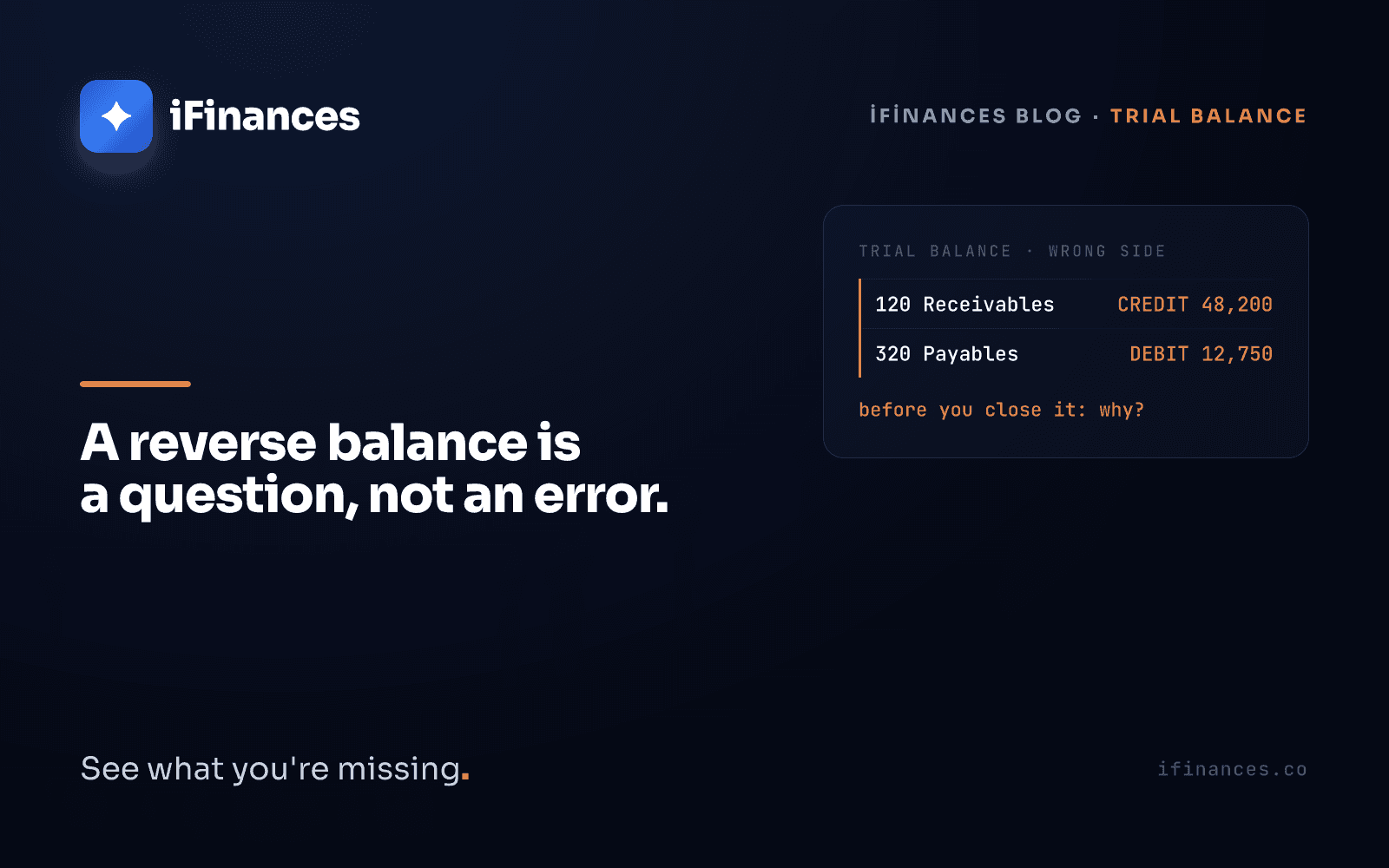
That entry is often the right entry. Posted before anyone has explained the balance, it does not correct an error — it hides one. A receivable in credit says, on paper, that you owe your customer. A payable in debit says your supplier owes you. Neither is a mistake in itself; each is a question, and it is always the same question — why is this money on the wrong side? This article sets out seven causes, the signal that separates each one from the others, and what the correct treatment is in each case.
Why AR goes into credit (and AP into debit)
Every subledger account has a normal side. In the Turkish uniform chart of accounts, account 120 (trade receivables) is debit-character: it normally shows what the customer owes you. Account 320 (trade payables) is credit-character: what you owe the supplier. An account carrying a balance against its own character is what Turkish practice calls a reverse balance, and it is the local name for something every group accountant already knows as a debit balance in AP or a credit balance in AR.
Local ERP systems treat it as routine. Logo Netsis documentation defines a reverse balance account control report as a standard period-end tool: it finds accounts such as 120 and 320 carrying a balance in the wrong direction so the amounts can be moved to advance accounts. Running the report is the easy half. Reading its output line by line is the work.
Error, meanwhile, is ordinary. In a Gartner survey from July 2023 (n=497), 18% of accountants said they make errors every day, 33% several times a week, and 59% several times a month. A reverse balance is one of the few errors that surfaces in the trial balance without anyone hunting for it. Clearing it in a hurry spends that visibility for nothing.
Seven causes, and how to tell them apart
Is it an advance?
The most common and most benign cause. The customer paid a deposit against an order, or you paid one to a supplier, and no invoice has been issued yet. The signals: a round amount, a payment reference naming an order or contract, a deposit clause in the agreement, and no invoice matching the payment on any later date. If the answer is yes, the treatment is a reclassification to advances received or advances given. But find the document first.
Is it a cut-off difference?
The payment landed on 29 December and the invoice was issued on 3 January. At a 31 December cut-off the account shows a reverse balance, although nothing is wrong and nothing is an advance. The test is quick: look at the first ten business days after the cut-off. If the balance closes against an invoice there, you have your answer and no entry is needed. For the wider framing, see supplier statement reconciliation versus bank reconciliation.
Is it a credit note booked on one side only?
Goods went back, the credit note was recorded by one party and not the other. The tell is arithmetic: the reverse balance equals a specific invoice, or a clean slice of one. Answer this from the document side rather than the ledger. According to the Turkish Revenue Administration's 2024 annual report, roughly 1 billion e-invoices and 11 billion e-archive documents were issued in 2024, so the credit note almost certainly exists electronically and can be verified independently of anyone's books.
Is it an overpayment, or a deduction?
The counterparty may have deducted bank charges, withholding, or a contractual penalty — or rounded up and sent too much. Rule of thumb: a difference that is a small percentage of the invoice is a deduction or a fee; a difference the size of a whole invoice is a different event entirely. Cent-level gaps need a written tolerance policy, or the same three cents get re-argued every cycle.
Is it a duplicate payment?
The same invoice paid twice — once by transfer, once by cheque; once from the integration, once by hand. APQC benchmarks put duplicate or erroneous payments at 0.8% of annual payments for top performers and 2% for bottom performers. The signals: identical amount, two dates close together, the same invoice reference, different payment channels. Reclassify a duplicate payment as an advance and you delete the evidence you need to claim the money back — the mirror image of the problem described in why a paid invoice still shows as open.
Did the entry land on the wrong customer or supplier record?
Group companies, the same legal entity opened twice, branch records and spelling variants of a company name are where this hides. The signature is distinctive: one record carries a reverse balance while a similarly named record carries an excess of almost exactly the same size. Checking whether one tax number appears on more than one record is the single-step test.
Is it an uncleared cheque or note?
A cheque was issued to the supplier and payables was debited, but the cheque has not been presented; or a customer cheque cleared the account and later bounced. The reverse balance is then temporary and resolves at maturity. The test: is there a matching instrument in the cheque or notes portfolio, and has its due date passed? Once it has, the balance is no longer temporary and needs a decision.
Seven causes, seven different outcomes
The consequence of each cause is genuinely different. An advance is a presentation reclassification. A cut-off gap needs nothing at all. A missing credit note is a document to be booked. An overpayment is a liability to refund or offset. A duplicate payment is a collection process, not a journal entry. A misposted entry needs a correcting journal. An uncleared cheque needs patience, then a decision.
Collapsing seven outcomes into one entry cleans the balance sheet and misleads the business: the statements look tidy while a recoverable claim quietly evaporates.
What the reclassification entry does and does not do
Reclassification is a presentation fix: it moves a balance to the right line of the balance sheet. It does not touch the content of the subledger, does not change which invoice was settled by which payment, and does not correct the counterparty's books. It should therefore be the result of a reconciliation, not a substitute for one.
Two shortcuts are actively risky. A September 2020 article by Koray Ateş on MuhasebeTR lists, among the most frequent mistakes in receivable reconciliation differences, routing a difference to a shareholder account instead of issuing an invoice — which carries VAT and income tax exposure — and clearing a reverse receivable balance with a fictitious cash payment. The correct treatment for a genuine reverse receivable, in the same article, is to issue a proper VAT invoice using the inclusive-rate method.
That last point carries a condition, and dropping the condition inverts the whole argument. Issuing an invoice is right where the credit balance is genuinely unbilled revenue or an unbilled difference. Where the balance is a customer advance, the answer is a reclassification to advances received and no invoice at all. Where it is a duplicate receipt, the answer is a refund. Without the seven questions answered first, even the correct treatment becomes another shortcut.
There is a legal side too. If you send a confirmation letter and hear nothing back, do not assume the balance is confirmed. Under Turkish Commercial Code article 94, a party receiving the closing balance statement who does not object within one month in the prescribed form is deemed to have accepted it — but that consequence operates within a written current account agreement, because article 89 treats written form as a condition of validity. Without one, silence alone may not create acceptance.
Worked example: three customer accounts in credit
Suppose three customer accounts each show a credit balance of roughly the same size in the same month-end receivables ledger. The figures are illustrative; the method of telling them apart is the point.
- A construction customer. The receipt quotes a framework contract number and matches the mobilisation percentage written into that contract. No invoice follows it. Answer: an advance. Action: reclassify to advances received, and disclose it as a liability rather than netting it inside receivables.
- A retail customer. The credit equals one specific invoice from two months earlier, to the cent. The customer's statement shows a credit note against that invoice; yours does not. Answer: a credit note booked on one side only. Action: book the document, not a reclassification.
- A customer with a sister company. The credit sits on one record while a near-identical excess sits on a similarly named record with the same tax number. Answer: a receipt posted to the wrong record. Action: a correcting journal between the two records, after which neither shows a reverse balance.
All three look identical in the trial balance and all three would disappear under the same year-end journal. Only one of them should. The difference appears when you stop looking at balances and start looking at the lines behind them.
Line-level matching beats balance-level review
The only way to explain a reverse balance is to match the underlying activity at invoice and payment level. A balance-level control tells you something is upside down; it never tells you which payment belongs to which invoice. And while each side reads only its own ledger, the answer stays out of reach: how the payment appears on the bank statement, and whether the invoice exists on the e-invoice side, are usually stronger evidence than bookkeeping. Putting ledger, bank and e-invoice data in one table makes the seven questions answerable quickly, and an anomaly detection approach flags missing invoices, duplicates and out-of-pattern amounts, raising some of these questions before you think to ask.
Where iFinances fits
iFinances does not keep your books, does not create entries, and never closes a line on its own. It makes the source of a reverse balance visible: ledger or ERP records, bank statement and e-invoice data in one table. The matching engine handles FIFO and invoice-specific settlement, splits partial payments, distributes lump-sum payments, applies a cent-level tolerance, and uses the official central bank rate across currencies.
When matching a bank statement counterparty name to a company record, it uses similarity with Turkish character folding and produces suggestions only — the decision stays with you. Every match carries a written reason: the amount agrees, the date fits, the reference points to this invoice. Missing invoices, duplicates and out-of-pattern amounts are flagged. You can invite the counterparty through a secure link to upload their own statement without software of their own, generate the confirmation letter and archive the signed copy. Data can come from Logo, SAP, Mikro, Netsis, Luca, Zirve or a plain Excel file — see the supplier statement reconciliation page.
The goal is not to clear the reverse balance, but to make the seven questions answerable in minutes.
Frequently Asked Questions
What does a credit balance in accounts receivable actually mean?
It means the account carries a balance against its normal character — on paper you owe the customer. The usual causes are a customer advance, a credit note booked on one side only, an overpayment, a receipt posted to the wrong record, and a cut-off timing gap. Each has a different correct treatment, so identify the cause before you reclassify.
Should a debit balance in accounts payable be reclassified to advances at year end?
Only if you can show the debit is genuinely a supplier advance. It can equally come from a duplicate payment, an overpayment, an invoice that has not arrived yet, or a transfer posted to the wrong supplier. Reclassifying a duplicate payment as an advance removes the evidence you need to ask for the money back.
Is it acceptable to clear a reverse balance with a cash entry?
No. A fictitious cash payment replaces one error with two: the balance is wrong and cash is wrong. A September 2020 article by Koray Ateş on MuhasebeTR lists this, along with routing the difference to a shareholder account instead of issuing an invoice, among the most common shortcuts in receivable reconciliation — the second one carries VAT and income tax exposure. The same article gives issuing a proper VAT invoice as the correct treatment, but that holds only where the credit balance is genuinely unbilled revenue or an unbilled difference; where it is a customer advance the answer is a reclassification to advances received, and where it is a duplicate receipt the answer is a refund.
How do I list every reverse balance in the trial balance at once?
Most ERP systems ship a dedicated report. Logo Netsis documentation, for example, defines a reverse balance account control report used at period end to find accounts whose balance runs against the account's character. If your system has no such report, exporting the trial balance and comparing balance direction against account character is enough. Producing the list is the easy half; explaining each line is the work.
If the counterparty never answers my confirmation letter, is the reverse balance confirmed?
Not automatically. Under Turkish Commercial Code article 94, a party who receives the closing balance statement and does not object within one month in the prescribed form is deemed to have accepted it. But that consequence operates within a written current account agreement — article 89 makes written form a condition of validity. Without one, silence alone may not amount to acceptance.
✦ iFinances — See what you're missing.