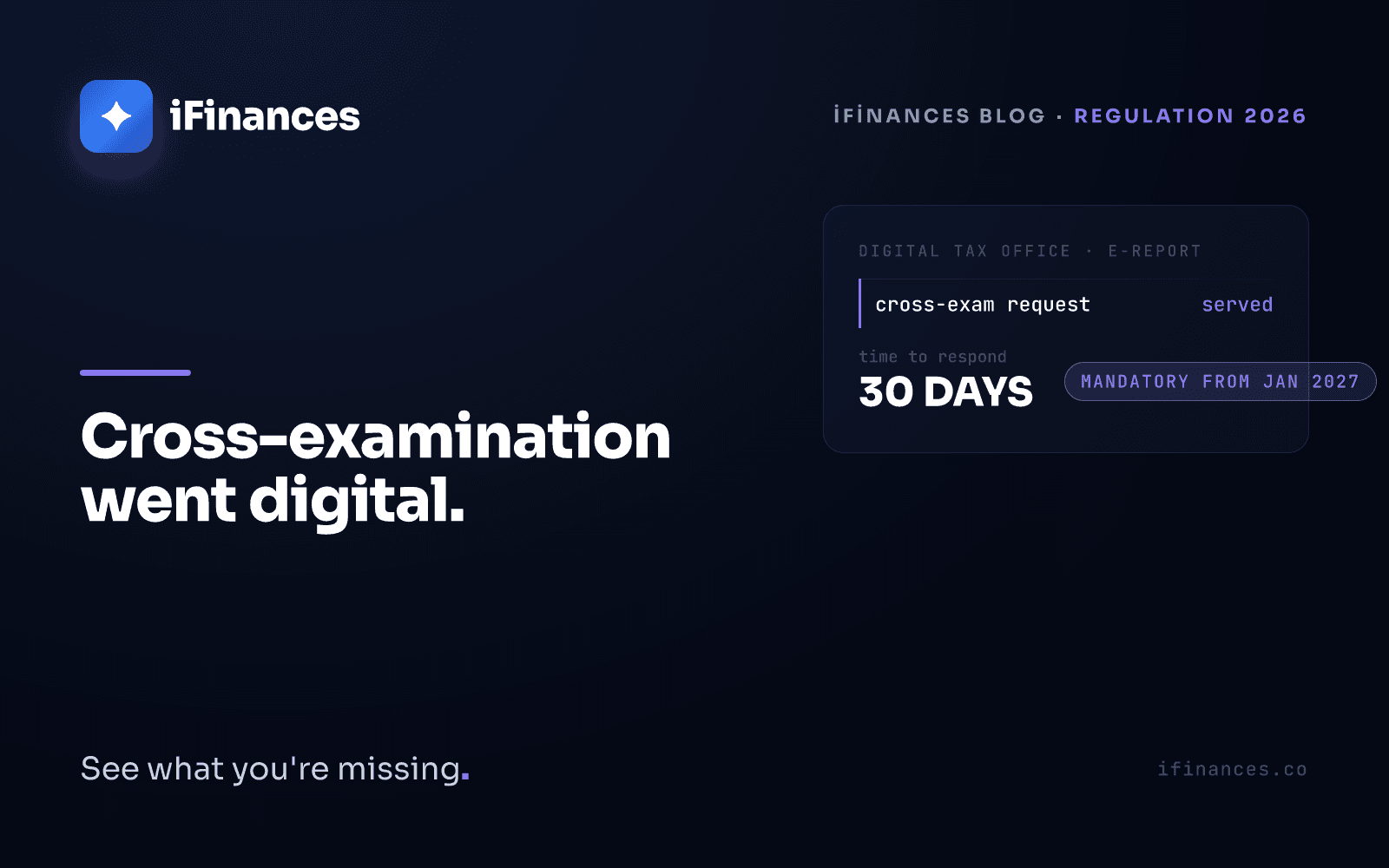
One Tuesday morning, a notification lands in your finance team's inbox: the sworn-in CPA of your largest customer is asking about the matching entries in your ledger for a VAT refund file. Increasingly the request does not arrive as a paper form to be signed and couriered back: it is drawn up electronically, and the clock starts running the moment it is served on you. You have 30 days to answer.
In 2026 this scene became routine for companies that claim VAT refunds in Türkiye — or that trade with a customer or supplier who does — because YMM cross-examination reports moved online. A quick translation for readers outside the profession: a YMM (yeminli mali müşavir, literally "sworn-in financial advisor") is the senior tier of Türkiye's accounting profession — a certified public accountant authorized to certify tax filings and refund claims. When a YMM certifies a transaction, they cross-check it against the other party's books; that check is called a cross-examination (karşıt inceleme), and its outcome is recorded in a formal report.
Almost everything written about the new regime speaks to the YMMs themselves: how to prepare the report, which screen to open in which order. Very little addresses the company on the receiving end of the question. This guide is for that side of the table: what changed, which transactions the 2026 thresholds cover, what happens if you miss the 30-day window — and why keeping your ledgers permanently answer-ready is more achievable than it sounds.
What Is a Cross-Examination, and Why Does It Involve You?
When certifying transactions — VAT (KDV) refund files are the most common case — a YMM verifies that the underlying documents are genuine, not just in their own client's ledger but in the counterparty's records too. Before the invoice you issued can support your customer's refund claim, someone confirms it sits in your books with the same amount and date.
A company enters this process through two doors. First: if you claim VAT refunds yourself, your own YMM sends questions to your suppliers and customers, and the speed of your file depends heavily on how fast they answer. Second: the YMM of a customer or supplier sends those same questions to you. Either way, what determines how smoothly things go is the same — whether your receivables and payables records can answer a document-level question at document level. For the broader picture of where reconciliation fits in, see our complete reconciliation guide.
What Changed: Reports Moved to the Digital Tax Office
A communiqué published in the Official Gazette on 24 December 2025 (Official Gazette No. 33117, Communiqué Serial No. 1) established that cross-examination reports attached to YMM certification files are now prepared electronically through the Digital Tax Office — the online portal of GİB (Gelir İdaresi Başkanlığı, Türkiye's Revenue Administration). Electronic filing became optional on 1 January 2026. The mandatory date was originally 1 July 2026, but Communiqué Serial No. 2 (Official Gazette, 21 August 2026, No. 33347) deferred it to 1 January 2027. Until 31 December 2026 reports may still be prepared with a wet signature, and electronic filing remains optional. As of this article's publication, the transition period is over: cross-examination traffic runs through the system.
In practice, paper forms, wet signatures and courier runs are being phased out: wet-signed reports remain possible throughout 2026, and electronic filing becomes mandatory on 1 January 2027. Once the transition completes, the request, the reply and the report merge into a single digital trail. The process gets faster — and more visible. The old flexibility of "the paperwork never reached us" is gone for both sides. A notified request sits in the system, the clock runs, and a late reply is on the record too.
The 2026 Thresholds: When Is a Cross-Examination Mandatory?
Two thresholds work together in 2026:
- Document-level exemption: From 1 January 2026, documents whose amount excluding VAT does not exceed 150,000 TL are exempt from mandatory cross-examination.
- Monthly aggregate rule: If goods and services purchased from a single taxpayer exceed 450,000 TL in total within one month, cross-examination is mandatory — even when each individual document stays under the threshold.
These figures were set by Communiqué Serial No. 48 under the SM-SMMM and YMM Law (Law No. 3568), published in the Official Gazette on 17 December 2025; see the 2026 certification thresholds summary for details.
The practical consequence: occasional small suppliers may stay off the radar, but the accounts you trade with regularly and at volume — the ones crossing 450,000 TL a month — are natural candidates for cross-examination. How clean those account cards are determines the workload you face when the question arrives. The thresholds are updated annually; confirm the current figures for your own file with your YMM or financial advisor.
Thirty Days: the Reply Window and the Cost of Silence
Under the electronic regime, the taxpayer receiving a cross-examination request must reply within 30 days of notification. Failing to reply on time, or providing incomplete or misleading information, triggers a special irregularity fine under repeated Article 355 of the VUK (Vergi Usul Kanunu — Türkiye's Tax Procedure Law).
Is 30 days long or short? It depends entirely on the state of your records. For a company whose accounts are reconciled monthly and whose payments are linked to invoices, this is half a day's work — pull the report, attach the documents, send. For a company with scattered records, it becomes archaeology: bank statements, email threads, binders, meetings about which payment closed which invoice three years ago. And the dig arrives without consulting your calendar — usually in the middle of a closing or refund crunch.
A cross-examination request is an unannounced exam of your ledgers: you don't pick the date, the other side writes the questions, and the law runs the clock.
The VAT Refund Side: 2026 Limits and Full Certification
If your company claims VAT refunds, cross-examination is not just a question that comes to you — it is a building block of your own file. For 2026, the announced caps for cash VAT refunds obtainable with a YMM certification report (without a full certification agreement or a tax inspection report) are 1,300,000 TL for general refund types, 2,600,000 TL for reduced-rate transactions, and 350,000 TL under Article 11/1-b of the VAT Law — see the current refund limits table. Taxpayers who signed a full certification (tam tasdik) agreement on time can have refund claims processed via YMM report regardless of amount; for 2026, the deadline for a timely agreement was announced as 31 January 2026.
What usually determines the speed of a refund file is not the legislation but data discipline: complete supporting documents, fast counterparty confirmations, consistent account balances. We walked through the most common sticking points in 7 reconciliation mistakes in the VAT refund process.
Instead of Panic Digging: Continuously Reconciled Ledgers
Faced with cross-examination, there are two kinds of companies. The first starts working when the request arrives: folders open, statements download, overtime is spent tracing a three-year-old invoice. The second keeps its accounts reconciled every month; when the request comes, the job is simply pulling an answer that already exists.
Becoming the second kind is a matter of rhythm before it is a matter of software, and it has three layers. The first is the account layer: balances are confirmed with counterparties regularly, and when a difference appears, its source is found at row level — we covered the techniques in the balances don't match. The second is the document layer: your e-invoice archive and your ledger entries agree with each other; how to track inbound and outbound invoice statuses is in our e-invoice reconciliation guide. The third is the mindset layer: being permanently ready for audits and inquiries rather than preparing for each one — the audit-side counterpart of this idea is in audit-ready reconciliation.
This is exactly where iFinances comes in — not instead of your accounting software, but on top of it. It compares your ledger, bank, and e-invoice data; matches payments to invoices while tracking partial payments and FX differences at row level; shows an explainable rationale for every match; and archives reconciliation letters with their signed copies. When a cross-examination request arrives, the answer you need is not a file to be assembled that day — it is the output of a record that was already being kept.
A Checklist That Turns 30 Days into Routine
1. Flag your high-volume accounts. Counterparties approaching or crossing the 450,000 TL monthly threshold are the natural candidates for cross-examination; start your record discipline with that list.
2. Set a monthly reconciliation rhythm. Don't wait for year-end. A company that confirms balances at each month's close never feels the 30-day window as pressure.
3. Match your e-invoice archive against the ledger. The document in question is usually an e-invoice; a gap between the archive and the ledger entry is the most common cause of late replies.
4. Keep payment-invoice links intact. When it is recorded which payment closed which invoice, and by how much, amount-and-date questions are answered in minutes.
5. Don't stockpile differences. A small unexplained gap today becomes a big question at inquiry time. Trace each difference in the month it appears and tie the correction to a document.
6. Assign an owner for official correspondence. If it is clear who on the team tracks cross-examination requests and formal notifications, the day you learn about a request is not left to chance. Confirm with your YMM which channel a request will reach you through.
The digitalization of cross-examinations is not the only 2026 change that concerns finance teams in Türkiye; we collected the year's other regulatory headlines in 5 Turkish tax changes for 2026.
One final note: the regulatory facts in this article reflect the sources available at publication; thresholds, deadlines, and procedures can change. Always make decisions about your own file together with your YMM or financial advisor.
If you want your ledgers ready to answer the 30-day question at any moment, get in touch — we'll set up the reconciliation layer on top of your existing accounting software, without replacing it. To plan the year-round rhythm, the year-end reconciliation calendar is a good place to start.
Frequently Asked Questions
What is a YMM cross-examination in Türkiye?
When a sworn-in CPA (YMM) certifies a transaction — most commonly a VAT refund claim — they verify the underlying documents not only in their client's books but also in the counterparty's records. The result is recorded in a cross-examination report attached to the certification file. Since 2026, these reports are prepared electronically through Türkiye's Digital Tax Office.
How many days do you have to reply to a cross-examination request?
Under the electronic regime, the taxpayer receiving the request must reply within 30 days of notification. Failing to reply on time, or providing incomplete or misleading information, triggers a special irregularity fine under repeated Article 355 of the Tax Procedure Law (VUK).
Above what amount is a cross-examination mandatory in 2026?
Documents up to 150,000 TL excluding VAT are exempt from mandatory cross-examination in 2026. However, if purchases from a single taxpayer exceed 450,000 TL in total within one month, cross-examination becomes mandatory even if each individual document is below the threshold. The thresholds are updated annually, so confirm current figures with your advisor.
Can cross-examination reports still be filed on paper?
Under the communiqué published on 24 December 2025, the reports are prepared through the Digital Tax Office. Electronic filing became optional on 1 January 2026. The mandatory date was originally 1 July 2026, but Communiqué Serial No. 2 (Official Gazette, 21 August 2026, No. 33347) deferred it to 1 January 2027. Until 31 December 2026 reports may still be prepared with a wet signature, and electronic filing remains optional.