What They Missed · Part 10/10
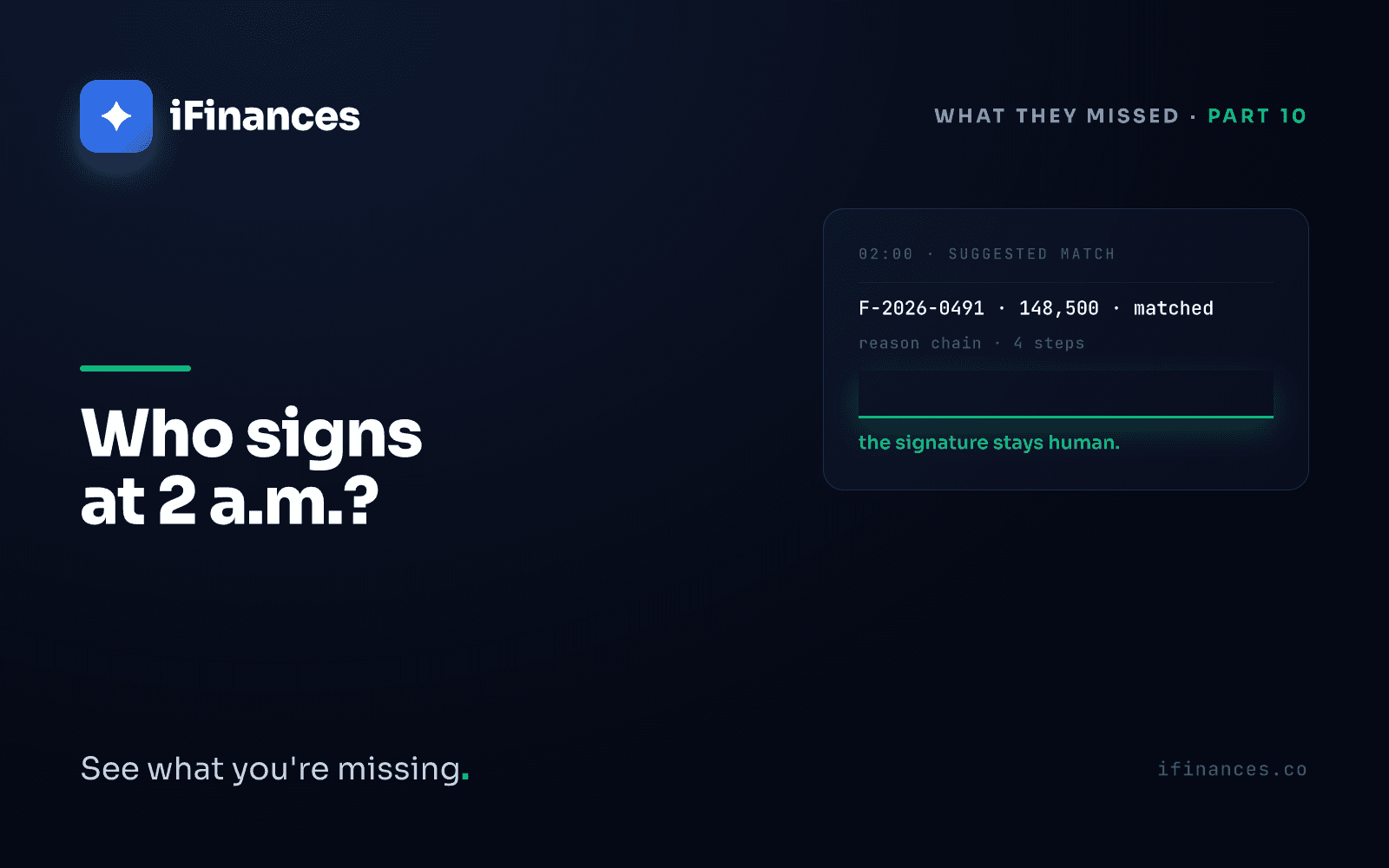
It is 2:07 a.m. and the office is empty. On the fourth floor of a mid-sized manufacturing company, a screen nobody is watching refreshes itself. A payment landed at 23:58 — six digits, a truncated description, a reference that almost matches. The software reads the line, weighs it, and finds its home: three open invoices from the same customer, oldest first. It drafts the entry. It updates the aging report. Somewhere in a queue, a new row appears in monospace type: 02:00 · MATCH SUGGESTED.
The heating is off. The cleaning crew left at eleven. The controller who owns this ledger is asleep, and her phone does not ring, because nothing is wrong. In the morning she will open the queue with her coffee and find the row waiting for her — matched, explained, flagged, holding still.
Or, in a different version of this night, she will find nothing at all. Because the entry did not wait. It posted itself at 02:00, the aging report moved on, the close absorbed the decision, and by nine there is no trace that a decision was ever made — only a ledger that is slightly different from the one she left behind.
Two versions of the same night. The difference between them is one empty line at the bottom of a card. The line where a name goes.
What actually happened
This is the tenth and final part of this series, and the only one set in the present tense. The first nine were history: an account in Singapore that nobody reconciled for years, a deployment that ran for forty-five minutes without a human gate, a wire that three people approved because the interface told them it was fine. Different decades, different instruments — and one shape repeated nine times: the calculation was never what failed. The look was.
In 2026, that shape has a new context. The current wave of agentic software proposes systems that do not merely prepare work for a person — they act. They initiate, post, approve, pay. The pitch is straightforward: the human in the loop is slow; remove the human, remove the bottleneck. Finance, with its high volumes and rule-shaped work, sits near the top of every vendor's target list, and the demo is genuinely impressive — the machine really can read a bank feed, really can draft the entries, really can run through the night.
The market is already pricing the gap between the pitch and the practice. In a press release dated 25 June 2025, Gartner predicted that over 40% of agentic AI projects will be canceled by the end of 2027, citing "escalating costs, unclear business value or inadequate risk controls." Read that third reason again. Inadequate risk controls is analyst language for something this series has met nine times under nine different names: nobody was required to look.
Nine posts of history, one press release of present. The question this series has been circling since Singapore now sits on procurement desks with a demo scheduled: when the software posts the entry at 2 a.m., whose name is on it?
The unwatched account, now by design
For nine parts, the missing look was an accident. Barings did not decide that account 88888 should go unreconciled; the control simply was not there. Knight did not choose to trade ungated for forty-five minutes; the gate had never been built. Citi's checkers looked — the interface just made looking useless. In every case, the absence of a human eye was a defect, and the story after the loss was the story of adding the eye back.
Full autonomy inverts that. An entry posted with no one required to read it is no longer a control gap — it is the specification. The unwatched account becomes a feature. And the distinction that matters here is not manual versus automated; every serious finance team automated years ago. The distinction is between automation and autonomy. Automation does the work and hands it over: it matches, drafts, sorts, prepares. Autonomy also signs.
The signature is easy to dismiss as ceremony — a click at the end of a process that was mostly machine. It is not ceremony. The signature is the point where responsibility attaches to a name, where "the system decided" becomes "I decided." Everything else in the process can be delegated. That cannot.
The machine can match, draft, flag, and explain at 2 a.m. The one thing it cannot do is take responsibility. The signature is where accountability lives — and it stays human.
The principle has two halves, and they only work together. Part 6 showed three approvals that meant nothing, because the approvers could not see what they were approving. So the machine's suggestion must arrive with its reasoning written down — the amount aligns, the date agrees, the reference points to this invoice — because an approval that cannot be read is not an approval. And the reasoning must arrive before the posting, not after. An explanation attached to a fait accompli is a press release, not a control.
Regulation is converging on the same two halves: the EU's AI framework requires that high-risk systems be designed for effective human oversight, and we have walked through what that means for finance teams. The market, meanwhile, has begun running the experiment in public — one much-discussed company replaced service staff with agents, measured what it lost, and began hiring people back. Law and market are pointing the same way: the loop keeps its human.
What this means for your close
None of this is an argument against the machine. It is an argument about where the machine stops. For a monthly close, that line can be drawn today:
- Ask of every tool you evaluate: does it do the work, or does it also approve the work? The first scales your team. The second replaces your control.
- Require written reasoning on every suggested match. A match that cannot say why cannot be reviewed — and an unreviewable suggestion is a decision in disguise.
- Keep the approval queue human, and keep it honest: the machine absorbs the routine so that people genuinely read the exceptions, instead of rubber-stamping the volume.
- Ask the 2 a.m. question of your own stack: for every entry that would post outside working hours, whose name would be on it? If the answer is "the system's," you have written Part 11.
That is the lesson of the series, moved into the present tense. Explainability plus human approval is not a compliance posture, and not a transitional phase waiting to be automated away. It is a design principle. The machine suggests, with its reasoning written down; the signature stays human.
Built to wait
This is the principle iFinances is built on, and the reason the product is a visibility layer rather than an autonomy layer. The machine reads your bank, your e-invoices, your ledger. It matches at scale, and next to every match it writes the reasoning — the amount aligns, the date agrees, the reference points here. It flags the line that breaks the pattern before you ask. And then it does the thing that separates a control from a shortcut: it waits.
Nothing closes without a name. Not because the software could not post the entry — posting is the easy part — but because a close you did not sign is not your close. The 2 a.m. row sits in the morning queue with its reasoning attached, and the decision that finishes it is made by a person with their coffee, in roughly the time it takes to read four lines. That is the trade nine chapters of history argue for: give the machine the volume, the memory, the pattern, the night shift — and keep the one thing that was missing in Singapore, in Jersey City, in that loan operations queue. A human being, required to look, and able to understand what they are looking at.
Frequently asked questions
Does human approval become a bottleneck at scale?
No — the effect runs the other way. When the machine absorbs the routine, thousands of confident matches arrive as suggestions with reasoning attached, and the human queue shrinks to the small residue that genuinely needs judgment. Review gets stronger precisely because attention is no longer spread across everything. The bottleneck was never the signature; it was making a person do the machine's share of the work.
What is the difference between automation and autonomy in finance?
Automation does the work and hands it over: it matches, drafts, sorts, and prepares, and a person approves the result. Autonomy also signs: it posts, pays, or closes with no one required to look. The dividing line is not the sophistication of the model but the signature — whether a human name attaches to the entry before it becomes final.
Doesn't regulation already require a human in the loop?
Increasingly, yes. The EU's AI framework requires high-risk systems to be designed for effective human oversight, and several finance use cases fall in scope. But regulation sets a floor, not a design. The operational argument is stronger: an entry that nobody can explain or own is a risk to your close regardless of what the law requires that year.
It is 2:07 a.m. again, and the screen refreshes. The payment finds its three invoices. The entry drafts itself; the reasoning writes itself; the row joins the queue in monospace type. And then — nothing. The building stays dark, the aging report stays put, and the empty line at the bottom of the card waits for morning, glowing faintly, holding the one thing nine chapters of history kept losing: the moment a person looks.
Nine times, someone should have looked and didn't. Design the tenth so that looking is the system.
Frequently Asked Questions
Does human approval become a bottleneck at scale?
No — the effect runs the other way. When the machine absorbs the routine, thousands of confident matches arrive as suggestions with reasoning attached, and the human queue shrinks to the small residue that genuinely needs judgment. Review gets stronger precisely because attention is no longer spread across everything. The bottleneck was never the signature; it was making a person do the machine's share of the work.
What is the difference between automation and autonomy in finance?
Automation does the work and hands it over: it matches, drafts, sorts, and prepares, and a person approves the result. Autonomy also signs: it posts, pays, or closes with no one required to look. The dividing line is not the sophistication of the model but the signature — whether a human name attaches to the entry before it becomes final.
Doesn't regulation already require a human in the loop?
Increasingly, yes. The EU's AI framework requires high-risk systems to be designed for effective human oversight, and several finance use cases fall in scope. But regulation sets a floor, not a design. The operational argument is stronger: an entry that nobody can explain or own is a risk to your close regardless of what the law requires that year.
✦ iFinances — See what you're missing.