What They Missed · Part 01/10
Singapore, 23 February 1995. The afternoon session at the Singapore International Monetary Exchange is winding down, and the general manager of Barings Futures Singapore leaves the floor early. Colleagues assume a family matter. In London, eight hours behind, the treasury desk is arranging another transfer to Singapore — margin funding for the office's futures positions, one more remittance in a series that has grown week by week. Nobody questions it closely. Singapore is the office that reports profits.
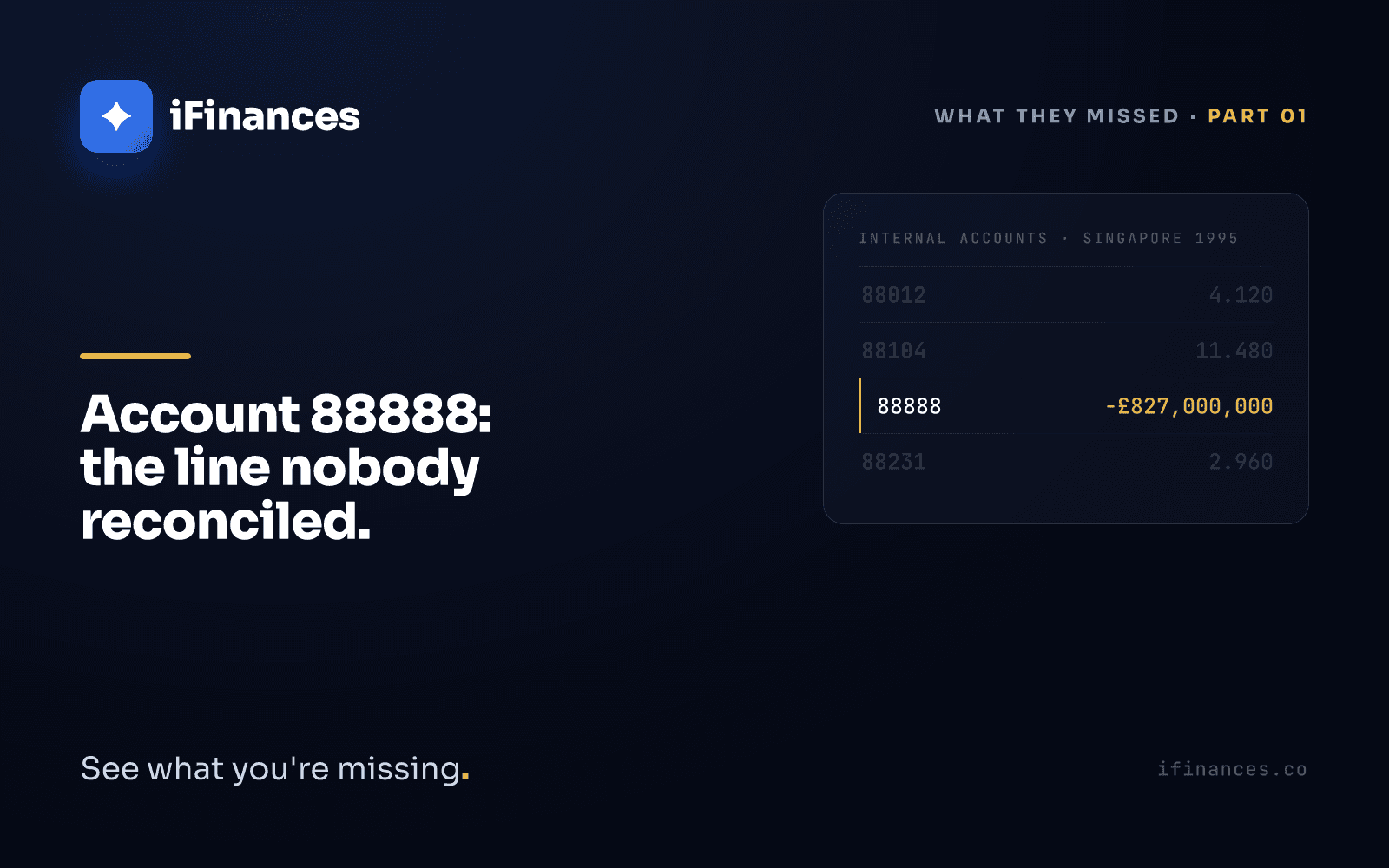
Inside the Singapore books sits an account numbered 88888 — five eights, a digit considered lucky in Chinese business culture. It was opened as an error account: a holding pen for small booking mistakes, the kind every trading operation accumulates and clears. On the reports London reads each morning, it does not appear. No one at head office is assigned to reconcile it. No one ever has been.
Tonight the general manager does not go home. By the weekend, he has left the country. Within three days, a bank founded in 1762 — 233 years of continuous business — will be in administration. The instrument of its end is not a derivative, not an offshore structure, not an exotic instrument at all. It is a single internal account, sitting in plain view in the bank's own ledger, waiting for someone to look at it.
What actually happened
Barings was founded in 1762 and had operated continuously for 233 years. In 1992 it sent a young back-office specialist, Nick Leeson, to Singapore to run settlements for its new futures operation on SIMEX. Soon he was running the trading desk as well. That dual role is the center of this story: Leeson was at once chief trader and head of settlements. He executed the trades, and he controlled the records that said what the trades were.
Account 88888 was opened in the Singapore office as an internal error account. Leeson began using it to park unauthorised positions and the losses they generated, and the account was kept out of the daily reports transmitted to London. The office's reported results showed steady profit; the concealed losses grew alongside them. By the end of 1994 the account held roughly £208 million in losses — hidden through nothing more elaborate than an account nobody examined.
Then came January 1995. The Kobe earthquake pushed the Japanese market down, and Leeson's positions — tied to the Nikkei 225 — deteriorated fast. He responded by enlarging them, betting on a recovery that did not come. Every enlargement demanded margin, and London wired the funds, booking the remittances as client-related without reconciling them against any named client obligation.
On 23 February 1995 Leeson left Singapore. When the positions were finally unwound, the losses reached £827 million — more than twice the bank's available capital. The collapse was announced on 26 February 1995. In March, ING bought the business for £1.
The Bank of England's Board of Banking Supervision investigated for months and did not conclude that Barings had been defeated by complexity. Its report found the losses went undetected because of "a failure of management and other internal controls of the most basic kind". A failure, in other words, of looking.
The line nobody owned
Every ledger has accounts like 88888. Error accounts, suspense accounts, internal transfer accounts — they exist to absorb friction, to hold the mismatches of daily business until someone resolves them. And precisely because they are expected to contain noise, they are treated as noise. Nobody's month depends on them. Nobody's name is on them.
The Barings account was not hidden in a shell company or an offshore ledger. It sat in the bank's own books, under a five-digit number, formatted like every other line. Two conditions protected it, and both were organisational, not technical.
The first: the account stood outside the reconciliation routine. It was excluded from daily reporting to London, and nobody independently confirmed its contents against the exchange's records or against the margin money flowing out of head office. Money left London for Singapore in growing volumes, and no process matched those remittances to the positions they supposedly funded.
The second: the person who booked the trades was the person who settled them. Whatever record Leeson produced was confirmed by a process Leeson controlled. Reconciliation existed at Barings — as a concept, as a department, as a word in the manual. But reconciliation is only a control when the person doing the matching is different from the person who made the records. Fold the two together and the control is not weakened; it is absent.
Reconciliation is the discipline of looking at every line — especially the ones designed to be ignored.
Any single routine check would have surfaced the problem years earlier: matching London's remittances to named client positions, confirming Singapore's balances directly with the exchange, or simply reconciling account 88888 itself. Each of these checks existed as a possibility. None of them was anyone's job.
What this means for your close
No mid-sized company runs a futures book in Singapore. But the mechanics of Barings scale down to any monthly close, because the failure was not exotic — it was the gap between "we reconcile" and "we reconcile everything". Four habits close that gap.
- Give every account two names: one person who owns the entries, and one who confirms them against an independent source — the bank, the counterparty, the ledger on the other side. Never the same person.
- Bring internal accounts — error, suspense, transfer — inside the close, with an explicit rule: cleared to zero, or every aged item listed with an explanation and an owner.
- Reconcile money against purpose. An outgoing payment should match a named obligation, not a category. Funding that cannot be tied to a specific position or invoice is a question, not a booking.
- Treat every reporting exclusion as a decision that expires. An account left off a report is a choice someone made once, under circumstances nobody remembers. Review those choices on a schedule, the way you review payments.
The lesson underneath all four is visibility. The ledger did not lie to Barings; it recorded every loss faithfully, in an account with a memorable number. What failed was the discipline of looking — and the separation that makes looking mean something. Segregation of matching from booking is not bureaucracy. It is the control.
Where a visibility layer stands
A visibility layer earns its keep in exactly the places where Barings had none. It reads every line — not the interesting ones, every one — and shows what each line connects to: which payment closed which invoice, which remittance funded which obligation, which internal account carries movements nobody has confirmed this quarter. When a line deviates from its own history, it raises the deviation as a signal rather than an error, with the reasoning attached.
What it does not do is decide. iFinances proposes matches and explains them; the approval — the signature that says this line is what we believe it is — stays with a person, and that person is not the one who made the booking. The separation is deliberate, and it is the same principle a 1995 inquiry called basic. We have written elsewhere about why reconciliation is trust infrastructure rather than a spreadsheet chore, and about the gap between what a ledger records and what is actually true. This series is the historical companion to those arguments: ten cases where the gap was real, and expensive.
Frequently asked questions
What was error account 88888 at Barings?
It was an internal error account opened at Barings Futures Singapore in 1992, originally intended to hold minor booking mistakes until they were resolved. Nick Leeson used it to conceal unauthorised positions and their losses, and it was kept out of the daily reports head office received. By the end of 1994 it held roughly £208 million in hidden losses; by the collapse in February 1995, the total reached £827 million.
Why did nobody at Barings detect the losses earlier?
Because the two functions that would have caught them sat with one person. Leeson ran both trading and settlements, so the records he produced were confirmed by a process he controlled. London funded his margin calls without matching the remittances to named client positions, and account 88888 was excluded from daily reporting. The Bank of England inquiry attributed the failure to basic internal controls, not to sophistication on the trader's part.
What does segregation of duties mean in reconciliation?
It means the person who records a transaction is never the only person who confirms it against an independent source — the bank statement, the exchange, the counterparty's ledger. Booking and matching stay in separate hands, so an error or a concealment in one is visible from the other. Software can propose the matches at scale, but a separate human approves them; the principle survives automation intact.
On the evening of 23 February 1995, account 88888 looked exactly as it had looked for nearly three years: one line among thousands, five digits, no flag, no colour. The reports it was missing from arrived in London on time, and balanced. Everything that ended the bank was already written down — faithfully, precisely, in the bank's own ledger. The ledger did its job. What was missing was a reader. Somewhere in most ledgers there is a line like that: internal, quiet, excluded from the view for reasons no one recalls. It costs nothing to look this month.
Frequently Asked Questions
What was error account 88888 at Barings?
It was an internal error account opened at Barings Futures Singapore in 1992, originally intended to hold minor booking mistakes until they were resolved. Nick Leeson used it to conceal unauthorised positions and their losses, and it was kept out of the daily reports head office received. By the end of 1994 it held roughly £208 million in hidden losses; by the collapse in February 1995, the total reached £827 million.
Why did nobody at Barings detect the losses earlier?
Because the two functions that would have caught them sat with one person. Leeson ran both trading and settlements, so the records he produced were confirmed by a process he controlled. London funded his margin calls without matching the remittances to named client positions, and account 88888 was excluded from daily reporting. The Bank of England inquiry attributed the failure to basic internal controls, not to sophistication on the trader's part.
What does segregation of duties mean in reconciliation?
It means the person who records a transaction is never the only person who confirms it against an independent source — the bank statement, the exchange, the counterparty's ledger. Booking and matching stay in separate hands, so an error or a concealment in one is visible from the other. Software can propose the matches at scale, but a separate human approves them; the principle survives automation intact.
✦ iFinances — See what you're missing.