What They Missed · Part 04/10
Jersey City, New Jersey. 1 August 2012, 9:30 a.m.
The opening bell rings across the river in Manhattan, and at Knight Capital the morning looks routine. Knight is a market maker — the firm that stands between buyers and sellers in US equities, executing order flow for retail brokers around the country. Today carries one small novelty: the New York Stock Exchange is launching its Retail Liquidity Program this morning, and Knight has spent the past weeks preparing SMARS, its high-speed order router, to take part. The new code went out to the servers in stages over the previous week. Everything is in place.
At 9:30, orders begin to arrive — 212 of them from retail customers, the kind of flow SMARS handles without ceremony every day. The router goes to work.
Then it doesn't stop.
Within minutes, people at Knight can see something wrong in the flow. Positions are building in stocks no customer asked for. The router is sending orders — not hundreds, millions — buying at the offer, selling at the bid, again and again. Engineers begin hunting for the cause. They cannot find it, so they try the step that seems safest: rolling the new code back.
The flow does not slow. It widens.
On the far side of the router sits the market, and the market keeps answering. Every order the machine sends is real.
What actually happened
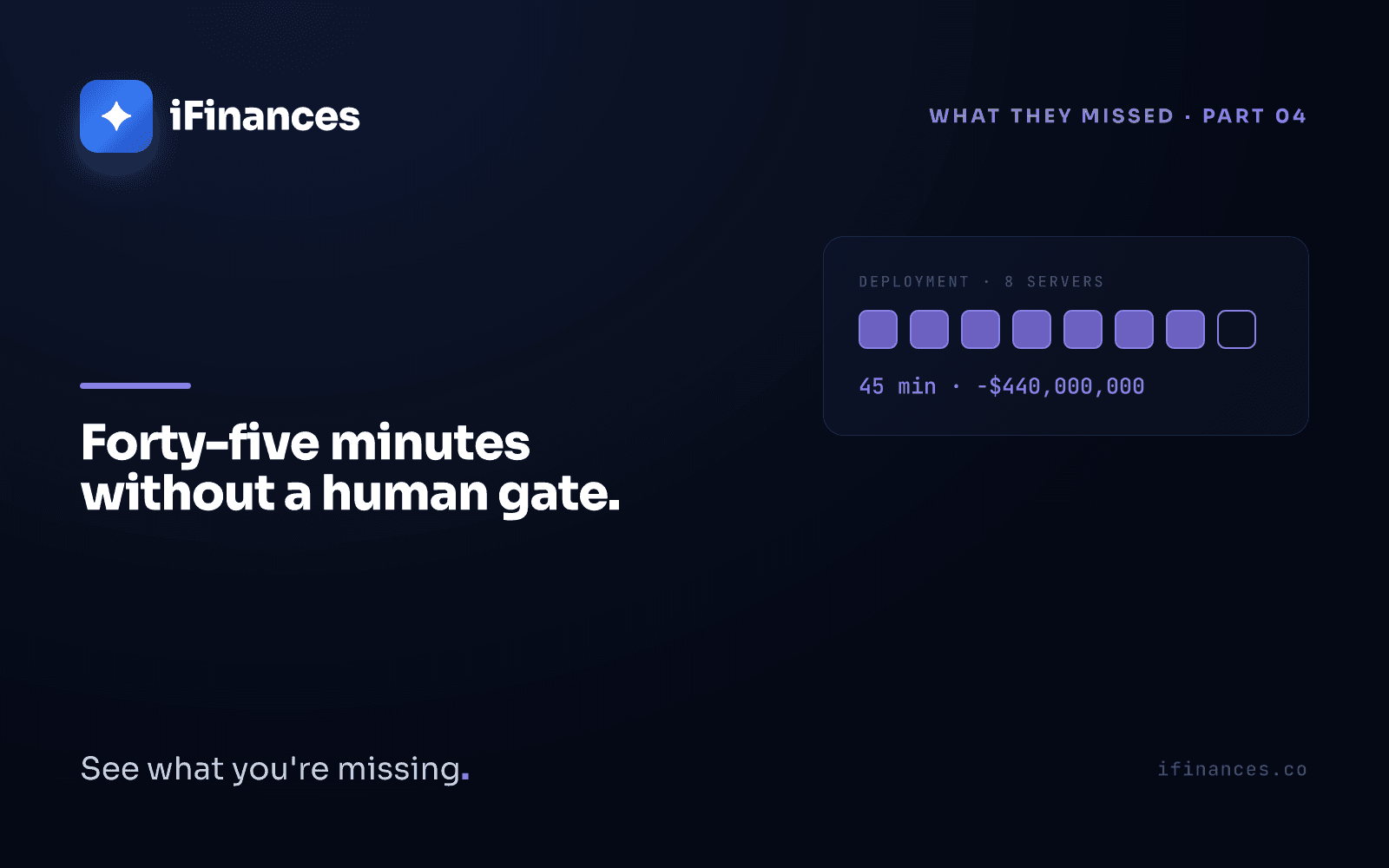
The mechanics, as reconstructed in the SEC's 2013 order, are almost mundane. To support the new NYSE program, Knight updated SMARS and deployed the code in stages beginning on 27 July 2012. The rollout covered eight servers. In the SEC's words: "one of Knight's technicians did not copy the new code to one of the eight SMARS computer servers."
That alone would have been survivable. What made it dangerous was a second, older decision. The new code reused a flag — a simple marker carried in each order — that had previously activated a function called Power Peg, a piece of routing logic Knight had stopped using in 2003 but never removed. Power Peg's job was to keep sending small child orders until a parent order was filled. And years earlier, the counter that told it a parent order was complete had been moved elsewhere in the code. On the one server still running the old logic, Power Peg woke up with no way of knowing when to stop.
On 1 August, seven servers processed the new program's orders correctly. The eighth treated the repurposed flag as a command from 2003. While working through 212 customer orders, SMARS sent millions of orders into the market over roughly 45 minutes — more than 4 million executions across 154 stocks, roughly 397 million shares. Rolling back the new code made things worse, not better: now every server carried the old logic and the live flag.
There was no automatic stop tied to capital, no threshold that forced the system to pause and ask. By the time the flow was cut, Knight faced a pre-tax loss of roughly $440 million. Within days it needed $400 million in rescue financing to keep operating.
The gate that wasn't there
It is tempting to file this as a software story: a bug, a bad deploy, an unlucky flag. But every part of the failure, taken alone, is ordinary. Codebases carry dormant logic. Flags get reused. Deployments occasionally miss a server. None of these, by itself, costs $440 million in three quarters of an hour.
What turned an ordinary defect into a catastrophic number was architecture: there was no point in the system where the machine's output had to pause and wait for a person. Not at deployment — no second technician reviewed the rollout, so the missing server stayed invisible. Not at runtime — orders flowed from SMARS straight to the exchanges, with no threshold that turned unusual volume into a mandatory stop. And not at the level of plain proportion: 212 orders went in and millions came out, a ratio that would not have survived a single human glance. No glance was scheduled.
This is the distinction that matters for anyone who automates anything: a machine that suggests at great speed is an asset; a machine that commits at great speed multiplies whatever is wrong with it. In Part 01 of this series, a line nobody reconciled stayed hidden for years because no one looked. Knight is the same missing control at a different clock speed — automation did not change the nature of the damage, only how long it took.
Speed without an approval gate is not efficiency. It is exposure. The worth of an automated system is decided at the moment its output becomes a commitment — and that moment belongs to a person.
The gate is not bureaucracy, and it is not distrust of the machine. It is designed whitespace between what the system produces and what the organization is bound by.
What this means for your close
Your close does not route equity orders. But it carries the same architecture question, repeated quietly at every automated step: where does output become commitment — a posted entry, an approved match, a released payment? Four checks are worth running:
- Map the commitment points. For every automated pipeline in your close, name the exact step where its output becomes real — posted, approved, sent. Each of those points needs either an explicit gate or an explicit, argued reason not to have one.
- Audit dormant logic. Old macros, inherited templates, repurposed columns, flags whose original meaning has drifted — logic nobody uses is not neutral. It waits.
- Verify deployment parity. When a process changes — a new template, a new matching rule, a new ERP configuration — confirm that every instance changed. One unchanged branch behaves exactly like Knight's eighth server.
- Keep the signature human. Let machines read, match, and propose at any speed. The lesson of the 45 minutes is that posting is a decision, and decisions need an owner.
The whitespace between suggestion and ledger
A visibility layer should be fast in exactly one direction. Reading bank statements, e-invoices, and ledger lines; matching payments to invoices; noticing that a pattern deviates — all of that benefits from machine speed, and none of it commits you to anything. The step that binds you is the last one, and that is where speed stops being a virtue.
This is how iFinances is built. The matching engine proposes; it does not post. Every proposal carries its own reasoning — a visible chain of why this payment belongs to this invoice — so the person at the gate approves something they can inspect, not something they must take on faith. When a line deviates from its pattern, it arrives as a signal to examine, not an error already corrected. The certain is marked certain, the uncertain is marked uncertain, and nothing becomes your ledger without a person saying yes.
The gate is not a concession to caution. It is the design — deliberate whitespace between what the machine found and what your books say. The machine's speed serves the person's judgment, never the other way around.
Frequently asked questions
What caused the Knight Capital loss on 1 August 2012?
A staged deployment left one of eight order-routing servers on old code, and a repurposed flag in the new logic activated a dormant function called Power Peg on that server. The router sent millions of unintended orders in roughly 45 minutes — more than 4 million executions across 154 stocks, roughly 397 million shares. The SEC's order, however, centered on controls: no second review of the deployment, and no checkpoint between the system's output and the market.
What is a human approval gate in financial automation?
A designed checkpoint where automated output pauses until a person confirms it — the point where a suggestion becomes a commitment. In reconciliation, it is the difference between an engine that posts matches on its own and one that proposes them with visible reasons and waits for approval. The gate concentrates human attention on the few moments that bind the company, instead of spreading it thin across thousands of routine steps.
Did Knight Capital survive the loss?
Narrowly. The firm reported a pre-tax loss of roughly $440 million and secured $400 million in rescue financing within days, at the price of severe dilution for existing shareholders. Within a year it had agreed to merge with a competitor. The company continued — but not as an independent firm, and not on its own terms.
By roughly 10:15 that morning, the flow is finally cut. Forty-five minutes have passed since the opening bell. 212 orders went in; more than 4 million trades came out; and between those two numbers there was no confirmation screen, no review step, no signature — not one moment when a person had to say yes. Every automated process eventually meets its own 9:30 a.m. The question worth settling beforehand is structural, and it is quiet: at the point where your machine's output becomes your money, who says yes — and would they have time to say no?
Frequently Asked Questions
What caused the Knight Capital loss on 1 August 2012?
A staged deployment left one of eight order-routing servers on old code, and a repurposed flag in the new logic activated a dormant function called Power Peg on that server. The router sent millions of unintended orders in roughly 45 minutes — more than 4 million executions across 154 stocks, roughly 397 million shares. The SEC's order, however, centered on controls: no second review of the deployment, and no checkpoint between the system's output and the market.
What is a human approval gate in financial automation?
A designed checkpoint where automated output pauses until a person confirms it — the point where a suggestion becomes a commitment. In reconciliation, it is the difference between an engine that posts matches on its own and one that proposes them with visible reasons and waits for approval. The gate concentrates human attention on the few moments that bind the company, instead of spreading it thin across thousands of routine steps.
Did Knight Capital survive the loss?
Narrowly. The firm reported a pre-tax loss of roughly $440 million and secured $400 million in rescue financing within days, at the price of severe dilution for existing shareholders. Within a year it had agreed to merge with a competitor. The company continued — but not as an independent firm, and not on its own terms.
✦ iFinances — See what you're missing.