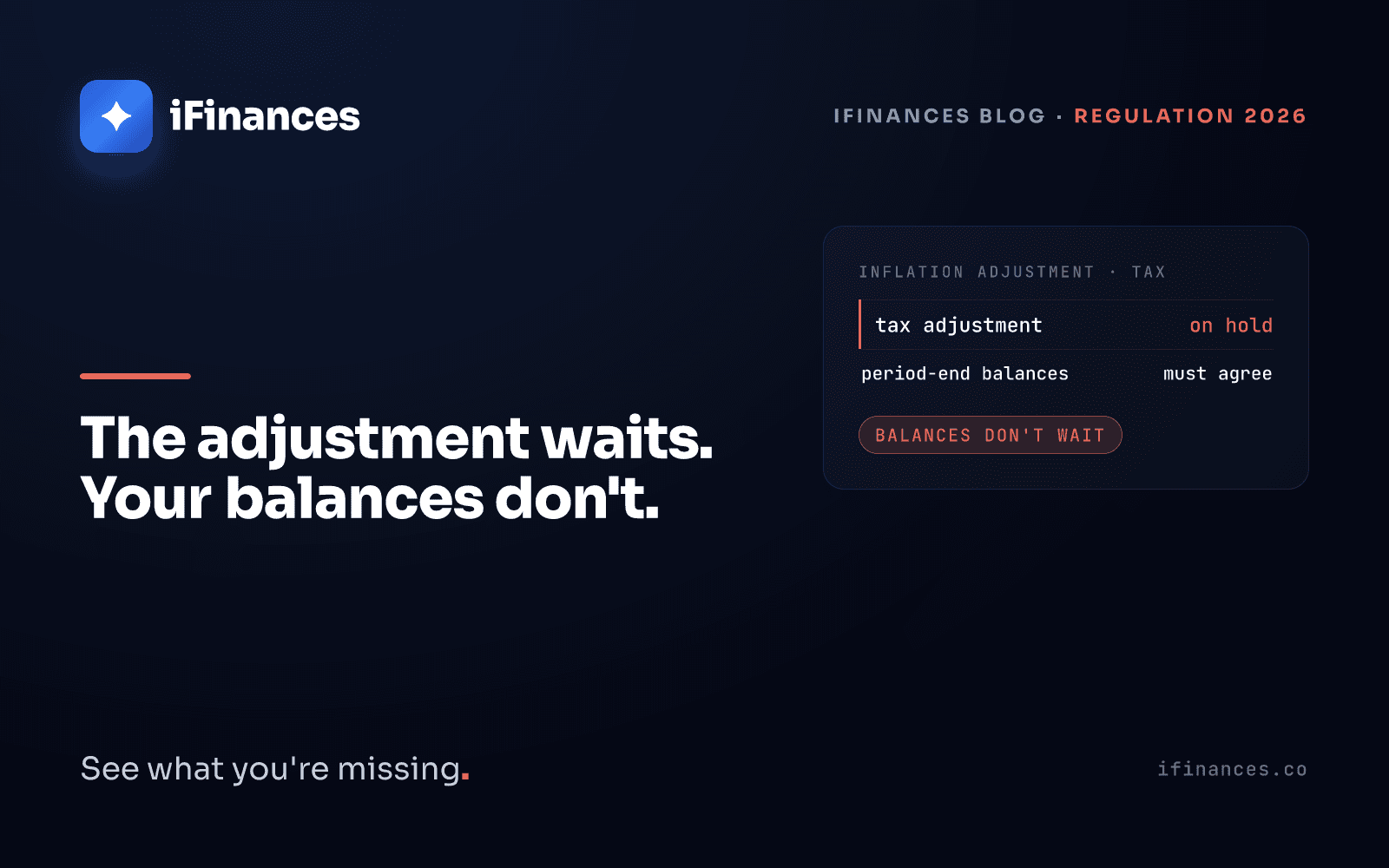
Is inflation accounting required in Turkey in 2026? For tax purposes, no. As of September 2026, the Tax Procedure Law (VUK) does not apply it for 2026. Provisional Article 37, added to the VUK by Law No. 7571, provides that financial statements are not adjusted for inflation for the 2025 fiscal year and for the 2026 and 2027 fiscal years, advance tax periods included, regardless of whether the statutory triggers in Repeated Article 298 are met. The only exception is taxpayers exclusively and continuously engaged in trading and manufacturing processed gold and silver.
For group CFOs and IFRS reporters, the second point matters more. This is a tax suspension. Financial reporting under IAS 29, published in Türkiye as TMS 29, rests on a different legal basis, and Law No. 7571 does not switch it off.
Below: what the provision says, the 2023 to 2027 timeline, who is in scope, the TMS 29 side, and why period-end balances still carry the weight. This is general information, not tax advice; for your entity, work with your local tax adviser (a YMM or SMMM in Türkiye).
Is inflation accounting required in Turkey in 2026? What the law says
As a reminder, under Repeated Article 298 the tax inflation adjustment restates non-monetary items in the financial statements using a price index; monetary items, including foreign currency, are not restated.
Provisional Article 37 was added to the VUK by Article 34 of Law No. 7571, adopted on 24 December 2025 and published in the Official Gazette of 25 December 2025 (issue 33118), entering into force on publication. Its core is a single sentence: financial statements are not subject to inflation adjustment, whether or not the conditions for one have arisen.
Three details matter. First: the suspension covers advance tax periods. Second: for taxpayers with a special fiscal year, it applies to fiscal periods ending in 2026, 2027 and 2028. Third: "whether or not the conditions have arisen" is deliberate. Under the normal regime, Repeated Article 298/A makes the adjustment mandatory for balance-sheet-basis taxpayers when the producer price index has risen by more than 100% over the last three fiscal periods and by more than 10% in the current one. Provisional Article 37 disables that test for the suspended periods.
The President may extend these periods, advance tax periods included, by up to three fiscal periods, and the Ministry of Treasury and Finance sets the implementing procedures. Nobody can speak with certainty about the years after 2027; follow changes in the Official Gazette and the consolidated text of the VUK. For another 2026 regulatory timeline, see how YMM cross-examinations are moving online.
2023 to 2027: which periods were adjusted for tax, and which were not
The answer sits in the timeline. Under the VUK, the adjustment has worked like a door opening and closing over three years:
- Balance sheet at 31 December 2023: adjusted. Mandatory under Provisional Article 33 regardless of the triggers. The difference went to retained earnings or accumulated losses; a resulting profit was not taxed and a resulting loss was not treated as a tax loss.
- First advance tax period of 2024: not adjusted. General Communiqué No. 560 (Official Gazette 30 April 2024, issue 32532).
- Second and third advance tax periods of 2024: partly. Communiqué No. 563 (Official Gazette 31 August 2024, issue 32648) exempted taxpayers whose gross sales in the 31 December 2023 income statement were below TRY 50,000,000.
- Balance sheet at 31 December 2024: adjusted. Communiqué No. 582 (Official Gazette 15 February 2025, issue 32814) required it from all in-scope taxpayers, including those who skipped the 2024 interim adjustments.
- First, second and third advance tax periods of 2025: not adjusted. Also under Communiqué No. 582.
- Fourth advance tax period of 2025: not adjusted. Under Communiqué No. 587 (Official Gazette 24 December 2025, issue 33117).
- Year-end 2025, 2026 and 2027: no adjustment. Under Provisional Article 37, advance tax periods included.
In practice, for calendar-year taxpayers the last inflation-adjusted year-end tax balance sheet is dated 31 December 2024; for special fiscal years it is the balance sheet for the period ending in 2025. Gold and silver taxpayers under the exception keep adjusting.
Who is covered, who is exempt, and are banks included?
Provisional Article 37 has one exception: taxpayers under Repeated Article 298/A-9, exclusively and continuously engaged in trading and manufacturing processed gold and silver. They keep adjusting.
This is also where a common error appears: the claim that banks, insurers and capital markets institutions sit outside the tax suspension. The statute says the opposite. Provisional Article 37 also applies to the taxpayers listed in Provisional Article 33(4), which include banks; leasing, factoring and financing companies; payment and electronic money institutions; asset management companies; capital markets institutions; and insurance, reinsurance and pension companies. The confusion comes from the fact that some of these entities are subject to a separate regulatory decision on the reporting side.
Revaluation during the suspension: Repeated Article 298(Ç)
The suspended periods also count, for Repeated Article 298(Ç), as periods in which the adjustment conditions were not met. That lets full taxpayers keeping books on a balance-sheet basis, with certain exceptions (gold and silver taxpayers under the exception and taxpayers permitted to keep their records in a currency other than Turkish lira), optionally revalue their depreciable fixed assets and the related depreciation. Some amounts, such as exchange differences and loan interest added to cost, are also out of scope. The rate and tax effects need their own calculation, so decide with your tax adviser.
Two inflation accounting regimes in Türkiye: does the tax suspension switch off IAS 29?
Not by itself. Law No. 7571 amended the VUK; its text makes no reference to TMS, TFRS, financial reporting or the Public Oversight, Accounting and Auditing Standards Authority (KGK).
The reporting side rests on the KGK announcement of 23 November 2023: entities applying TFRS (Turkish IFRS), BOBİ FRS (the framework for large and medium-sized entities) or KÜMİ FRS (the framework for small and micro entities) present annual financial statements for periods ending on or after 31 December 2023 adjusted for inflation under TMS 29 and BOBİ FRS Section 25. The KGK implementation guide on financial reporting in hyperinflationary economies adds that KÜMİ FRS reporters also adopt the Section 25 principles. The announcement let authorities with their own regulatory remit set different transition dates:
- SPK (Capital Markets Board): under decision 81/1820 of 28 December 2023, issuers subject to its financial reporting rules and capital markets institutions apply TMS 29 starting with annual reports for periods ending 31 December 2023.
- BDDK (Banking Regulation and Supervision Agency): banks and leasing, factoring, financing, savings-finance and asset management companies did not restate their 31 December 2023 statements under TMS 29 (decision 10744 of 12 December 2023). The transition date was then set at 1 January 2025 (decision 10825 of 11 January 2024), but decision 11021 of 5 December 2024 provided that they would not apply inflation accounting in 2025 either. Decision 11340 of 18 December 2025 repealed 10825 and provides that they do not apply inflation accounting, without stating an end date; check BDDK for later decisions.
So banks not applying TMS 29 is a sector regulator's decision; on the tax side, the same institutions are within Provisional Article 37. The criteria show the two regimes are distinct:
- Trigger: the VUK uses a mechanical threshold (100% and 10%). TMS 29 sets no precise rate, treats hyperinflation as a matter of judgement, and lists among its indicators three-year cumulative inflation approaching or exceeding 100%.
- Index: the tax adjustment is based on the producer price index; according to the KGK guide, TMS 29 restatement uses TÜİK's consumer price index (CPI).
In practice, audited 2025 year-end financial statements published on KAP, Türkiye's public disclosure platform, still show TMS 29 restatement, and an international audit-profession tracker published in late 2025 still listed Türkiye among economies with three-year cumulative inflation above 100%. Whether that holds at your 2026 year-end is a judgement to confirm with your auditor.
If your Turkish entity reports under TFRS or BOBİ FRS, the tax suspension does not by itself remove the reporting obligation; check your sector regulator's current decisions as well. How to keep evidence for customer, supplier and bank balances ready for the audit all year is covered in our article on staying audit-ready for KGK reviews.
The inflation adjustment is suspended; your balances are not
The inflation adjustment debate usually revolves around inventory, fixed assets and equity. Yet the busiest lines on a balance sheet are the ones neither regime restates.
The VUK adjustment applies only to non-monetary items, and foreign currencies count as monetary. Under TMS 29, monetary items such as cash, receivables, bank loans and trade payables are not restated either, because they are already expressed in the measuring unit current at period-end. Your customer, supplier and bank balances are not indexed; their period-end valuation starts from what the ledger says, with foreign currency balances additionally valued at the period-end rate. That ties valuation directly to their accuracy:
- Foreign currency receivables and payables: under VUK Article 280 they are valued at the exchange rate, independently of the suspension. What goes wrong when your valuation rate and your counterparty's rate diverge is covered in our FX difference reconciliation article; the term is defined in the glossary.
- Turkish lira receivables and payables: under VUK Articles 281 and 285 they are valued at recorded value, meaning the value in the ledger. If the ledger balance is wrong, so is the valuation.
- Net monetary position for TMS 29 reporters: the gain or loss goes to profit or loss. Under a KGK Board decision of 26 October 2024, entities applying TFRS or BOBİ FRS must disclose which financial statement items it arises from, for periods ending on or after 31 December 2024. If monetary items are wrong, that note rests on the wrong base.
In short, even with no tax inflation adjustment in 2026, the customer, supplier, bank and FX lines of your trial balance remain the foundation of period-end decisions.
No adjustment, same scrutiny: 6 balance checks for the 2026 year-end
This is not a tax procedure; it is a sequence for establishing what your balances rest on before the period-end close. A dated version is in our year-end reconciliation calendar and checklist.
1. Confirm customer and supplier balances with the counterparty. Compare against their statement, currency by currency; even when the balance agrees, check the lines.
2. Match bank balances to the ledger. Every difference needs an explanation: payments in transit, bank charges, unrecorded transactions.
3. Clean up foreign currency accounts before valuation. Article 280 valuation is built on the foreign currency balance in the ledger; an invoice booked with the wrong currency amount produces a wrong FX difference even at the right rate.
4. Clear stale open items. Paid invoices still showing as open, unmatched partial payments and contra balances (credit balances in receivables, debit balances in payables) should not roll into the new year; the usual causes are in our article on credit balances in receivables. Doubtful receivables defined in VUK Article 323, such as those in litigation or enforcement, can carry a provision; review the conditions with your adviser.
5. Book differences to the right account, with a reason. Find the root cause before expensing an unexplained difference; the sequence is in our article on where reconciliation differences go.
6. Do not treat an unanswered letter as agreement. The one-month objection period in Article 94 of the Turkish Commercial Code applies in the context of a written current-account agreement (Article 89); silence does not automatically mean acceptance of every reconciliation letter. Details in our article on unanswered reconciliation letters.
Bottom line: the suspension is a calendar, the balance is a fact
As of September 2026, the picture under the VUK is clear: on a calendar-year basis, the balance sheets at 31 December 2023 and 31 December 2024 were adjusted; 2025, 2026 and 2027, advance tax periods included, are not. Because the suspension can be extended, keep watching the Official Gazette, and answer the TMS 29 question separately, based on KGK rules and your sector regulator's decisions.
What both regimes share is the need for correct balances, and that is where iFinances works. It is not accounting software; it is a reconciliation and financial intelligence layer that sits on top of your ERP. It matches ledger and ERP records, bank statements and e-invoice data in one table, uses the official CBRT rate when matching across currencies, shows a written reason next to every match, and routes unexplained differences to an exception list. Fuzzy matches are only suggestions; your team makes the decision and the entry. iFinances does not post to the ledger, does not calculate inflation adjustments or Article 298(Ç) fixed-asset revaluations, does not book Article 280 valuation entries, does not file returns and does not give tax advice. See how matching runs as data arrives, without waiting for period-end, on our continuous reconciliation page.
If you want to see how your 2026 year-end balances match line by line ahead of time, contact us.
Frequently Asked Questions
Is inflation accounting required in Turkey in 2026?
Not for tax purposes. As of September 2026, Provisional Article 37 of Türkiye's Tax Procedure Law provides that financial statements are not adjusted for inflation in the 2026 fiscal year or its advance tax periods, even if the statutory triggers are met; the suspension also covers the 2025 and 2027 fiscal years. For taxpayers with a special fiscal year, periods ending in 2026, 2027 and 2028 apply; the only exception is taxpayers exclusively and continuously engaged in trading and manufacturing processed gold and silver. For entities reporting under TFRS or BOBİ FRS, the TMS 29 / Section 25 obligation does not fall away because of this suspension.
Has inflation accounting been abolished in Turkey?
No. The underlying provision, Repeated Article 298 of the Tax Procedure Law, remains in force; Provisional Article 37, added by Law No. 7571, suspends its application for the 2025, 2026 and 2027 fiscal years. The President is authorised to extend those periods, advance tax periods included, by up to three fiscal periods.
Are banks and financial companies covered by the suspension?
On the tax side, yes: by cross-reference to Provisional Article 33(4), Provisional Article 37 also applies to banks, leasing, factoring and financing companies, insurance and pension companies, capital markets institutions and the other taxpayers listed there. On the financial reporting side, the banking regulator (BDDK) has separately decided that banks and certain finance companies do not apply inflation accounting. The two decisions are independent of each other.
Does the tax suspension affect IAS 29 (TMS 29) reporting?
Not by itself. Law No. 7571 amended only the Tax Procedure Law and makes no reference to TMS or TFRS. Under the KGK announcement, entities applying TFRS, BOBİ FRS or KÜMİ FRS restate annual financial statements for periods ending on or after 31 December 2023 under TMS 29 or Section 25, and sector regulators' decisions must be checked separately. Confirm your own obligation with your auditor.
What can companies do during the suspended periods?
Full taxpayers keeping books on a balance-sheet basis (other than gold and silver taxpayers under the exception and those permitted to keep records in a currency other than Turkish lira) may, under Repeated Article 298(Ç), optionally revalue their depreciable fixed assets and the related depreciation. Year-end valuation of foreign currency receivables and payables under Article 280, and verification of customer, supplier and bank balances, are not affected by the suspension. Take the revaluation decision with your local tax adviser.
✦ iFinances — See what you're missing.