What They Missed · Part 08/10
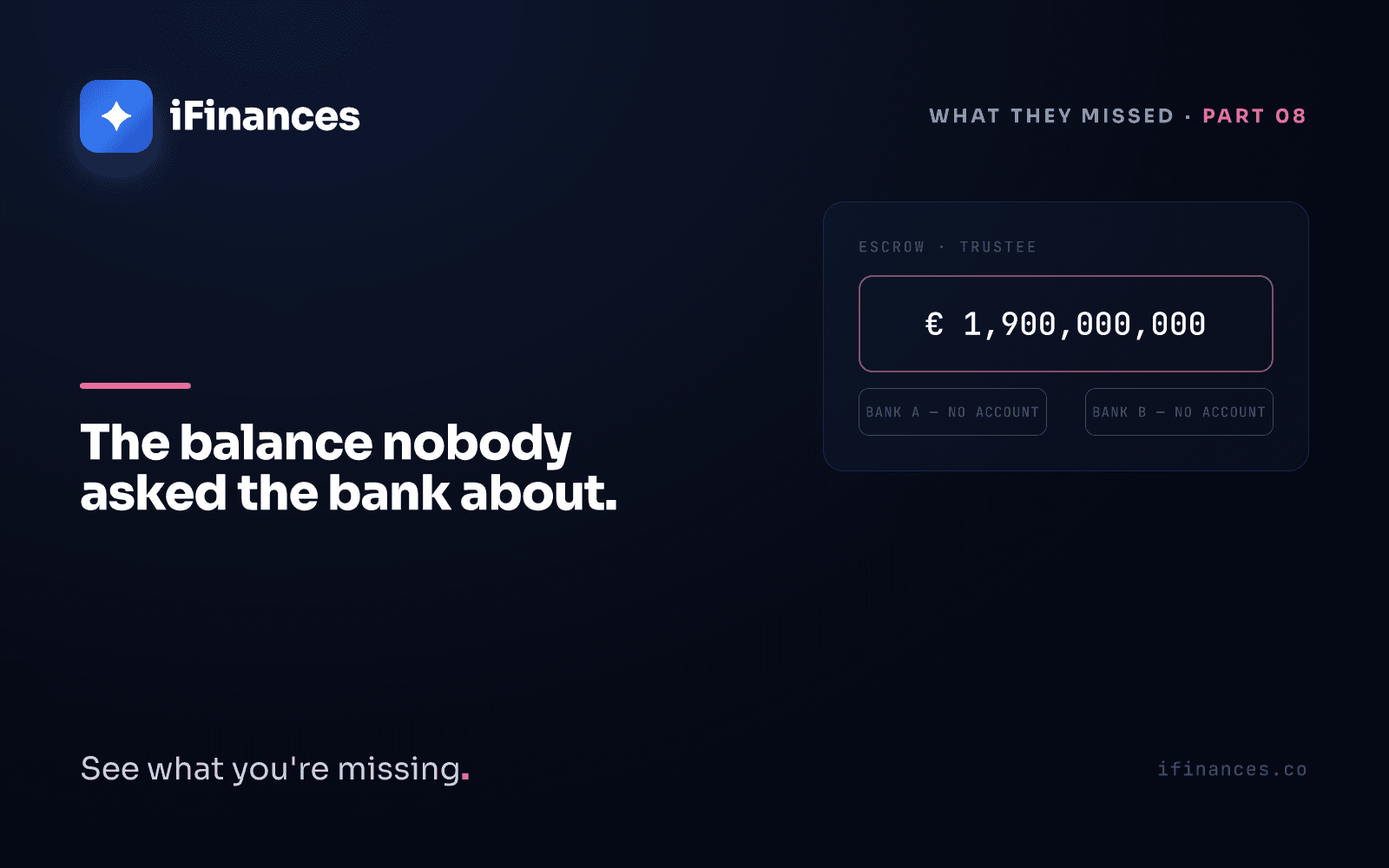
Aschheim, on the eastern edge of Munich. 18 June 2020, early morning. Wirecard AG is due to publish its audited annual report today. The date has slipped several times already; this time, the company has promised, the numbers will come. Wirecard is a payment processor and a member of the DAX 30, Germany's blue-chip index. It moves card transactions for merchants around the world, and on its balance sheet, €1.9 billion — roughly a quarter of its total assets — sits in escrow accounts at two banks in the Philippines, held in trust by a third party.
The report does not come. Instead, a statement: EY, the auditor, cannot confirm that the €1.9 billion exists, and will not sign the accounts. That evening the chief executive records a video message and suggests that Wirecard itself may be the victim of a fraud of considerable scale.
Some ten thousand kilometers away, in Manila, two banks are reading documents that carry their letterheads, their formatting, and the names of their own officers. Certificates stating that the accounts are real and the money is there. For months, these papers have stood in for the balance itself.
Before the day is out, both banks will have said, in public, what they see when they look at those certificates.
What actually happened
The €1.9 billion had a story attached. In markets where Wirecard held no payment license, third-party partners were said to process transactions on its behalf, and the cash those partners generated was reported to sit in escrow accounts at two Philippine banks — BDO Unibank and the Bank of the Philippine Islands — administered by a trustee. The balances did not arrive in the audit file as answers from the banks. They arrived as documents: confirmations and certificates that traveled through the trustee, the same channel that asserted the balances in the first place.
In June 2020, EY asked for something the file had never contained: verification it could trust, independent of that channel. The rest took one week.
On 18 June, the annual report was postponed again and EY declined to sign. Within hours, both Philippine banks stated publicly that the documents were fabricated. BDO said the papers used the bank's name and carried forged signatures of its officers; BPI said Wirecard had never been a client and had never placed money with the bank. On 19 June, the chief executive resigned. On 21 June, the governor of the Philippine central bank went further: the €1.9 billion had never entered the country's financial system at all. On 22 June came the company's own disclosure — "there is a prevailing likelihood that the bank trust account balances … do not exist". On 25 June, one week after the missing signature, Wirecard filed for insolvency in Munich.
Note the tense of that concession. Not "the money has been lost". Not "the money was stolen". Do not exist. The balance was not misplaced in June 2020; it had been absent all along. What existed was paper about it.
The gap between a document and a balance
Every line on a balance sheet is, in the end, a claim that someone can check. Cash is supposed to be the simple one — you ask the bank that holds it. Inventory has to be counted; receivables have to be aged and argued over; cash either answers or it doesn't.
Wirecard's €1.9 billion survived for years inside a narrow, specific gap: the question "what does the bank say?" was being answered by documents, and the documents came from the same side that asserted the balance. The trustee said the money was there; the trustee supplied the evidence that the money was there. Every confirmation cycle closed the loop without ever leaving it. The one voice that could not be manufactured — the bank's own, answering a direct question — was never in the file.
Readers of this series have seen the shape before. In 1963, inspectors in Bayonne verified warehouse receipts while the tanks beneath them held seawater. The medium changes — paper about oil, certificates about euros — but the gap does not: a document about an asset was allowed to stand in for the asset.
Your ledger says. The counterparty says. The bank says. A number is real only where all three voices meet — anything less is a document about a balance, not a balance.
What is striking about June 2020 is not how elaborate the collapse was, but how fast. Once the question finally traveled the independent path — auditor to bank, directly — the answer took hours. Seven days after that, the company was insolvent. A control that would have cost one confirmation letter per quarter was skipped, and its absence held up a quarter of a balance sheet.
What this means for your close
Your close does not contain a €1.9 billion escrow account in Manila. It contains the same gap at smaller scale: balances supported by a document rather than by a source. A statement PDF someone forwarded. A confirmation the counterparty produced about itself. A cash line nobody has tied to a bank feed since the account was opened. Four disciplines follow from Wirecard's June:
- Give every material balance three voices — what your ledger says, what the counterparty says, what the bank says — and treat the number as real only on the lines where all three meet.
- Never let the evidence for a balance travel through the party that benefits from the balance. A confirmation is worth exactly as much as the independence of its path.
- Be suspicious of balances that are always confirmed and never move. Cash that never pays anything behaves like paper, whatever the certificate says.
- Cross-check at line level, in one table — three sources side by side — not as three totals reconciled in three separate places.
None of this doctrine is new; auditors have carried it for generations. What is new is that at modern transaction volume, it can only be practiced systematically.
Three sources, one table
In a monthly close, the doctrine has a concrete shape: the bank statement, the e-invoice flow, and the ledger, side by side, matched line against line. Not three reconciliations in three files, but one cross-reconciliation across all three sources — because a gap is precisely the thing that only becomes visible where the sources meet. A balance that lives in your ledger but stays silent in the bank feed is not an error message; it is an open question, and it should look like one.
This is where a visibility layer stands. It does not certify anything, and it does not sign anything. It shows which lines all three sources agree on, suggests what a silent line might mean, and explains why — so that the person closing the books spends attention on the handful of lines where a voice is missing, instead of re-confirming the thousands where all three already speak. That layer is what iFinances is built to be; the record it works against is what we have called the invisible balance sheet — the layer of relationships between records that no single source displays. The signature at the bottom of the close stays where it always was: with you.
Frequently asked questions
Why didn't the auditors simply ask the banks directly?
For years, the evidence for the escrow balances arrived as documents routed through the trustee — the same side that asserted the balances. When direct, independent verification was finally demanded in June 2020, the two banks answered within hours: the documents were fabricated, the signatures forged, and no such accounts had ever been opened. The structure collapsed at exactly the speed of one direct question.
What is three-source cross-reconciliation?
It is the practice of confirming a number against three independent voices: your own ledger, the counterparty's records, and the bank. A balance is treated as real only on the lines where all three meet; where a source is silent or disagrees, the line stays visibly open until it is resolved. The point is that each source alone can be incomplete or wrong — the fact lives where they intersect.
Our counterparties confirm balances every period. Isn't that enough?
A counterparty confirmation is one voice of three — and it usually confirms a total, not the lines beneath it. Wirecard's balances were confirmed every period too, by paper that came from the side that benefited from the number. A confirmation carries weight when it travels an independent path and can be cross-checked, line by line, against the bank and against your own ledger.
A week after the morning the report didn't come, Wirecard is in the insolvency court in Munich. Out of everything in that June, the detail worth keeping is a small one: the reconciliation that ended the story took hours, not years. Two banks, asked directly for the first time, needed only that long to say what the file had never contained — no account, no balance, no client. The question was available all along. It was simply never routed to the only party that could not answer with a document about the money instead of the money.
Frequently Asked Questions
Why didn't the auditors simply ask the banks directly?
For years, the evidence for the escrow balances arrived as documents routed through the trustee — the same side that asserted the balances. When direct, independent verification was finally demanded in June 2020, the two banks answered within hours: the documents were fabricated, the signatures forged, and no such accounts had ever been opened. The structure collapsed at exactly the speed of one direct question.
What is three-source cross-reconciliation?
It is the practice of confirming a number against three independent voices: your own ledger, the counterparty's records, and the bank. A balance is treated as real only on the lines where all three meet; where a source is silent or disagrees, the line stays visibly open until it is resolved. The point is that each source alone can be incomplete or wrong — the fact lives where they intersect.
Our counterparties confirm balances every period. Isn't that enough?
A counterparty confirmation is one voice of three — and it usually confirms a total, not the lines beneath it. Wirecard's balances were confirmed every period too, by paper that came from the side that benefited from the number. A confirmation carries weight when it travels an independent path and can be cross-checked, line by line, against the bank and against your own ledger.
✦ iFinances — See what you're missing.