What They Missed · Part 02/10
Bayonne, New Jersey. A tank farm at the edge of the harbor, autumn 1963. An inspector climbs the steel ladder bolted to the side of a storage tank, lifts the hatch, and lowers a sampling tube into the dark. It comes up glistening: soybean oil, golden, unmistakable. He records the level, closes the hatch, climbs down. In an office nearby, his measurement becomes a warehouse receipt — a signed document stating that this tank holds a specific quantity of vegetable oil, kept in custody for its owner.
The receipt travels. At a bank in Manhattan, a lending officer examines it and finds nothing to question. The paper is genuine, issued by a field-warehousing subsidiary of American Express — a name that settles doubts rather than raising them. The loan is approved. The receipt goes into a vault as collateral, and money flows the other way, toward a company called Allied Crude Vegetable Oil Refining Corporation.
Fifty-one institutions will eventually hold paper like this. Banks, brokers, trading houses. Each of them checks the document. The signature is real, the format is correct, the issuer is reputable. What no one checks is the tank — against anything other than the paper describing it.
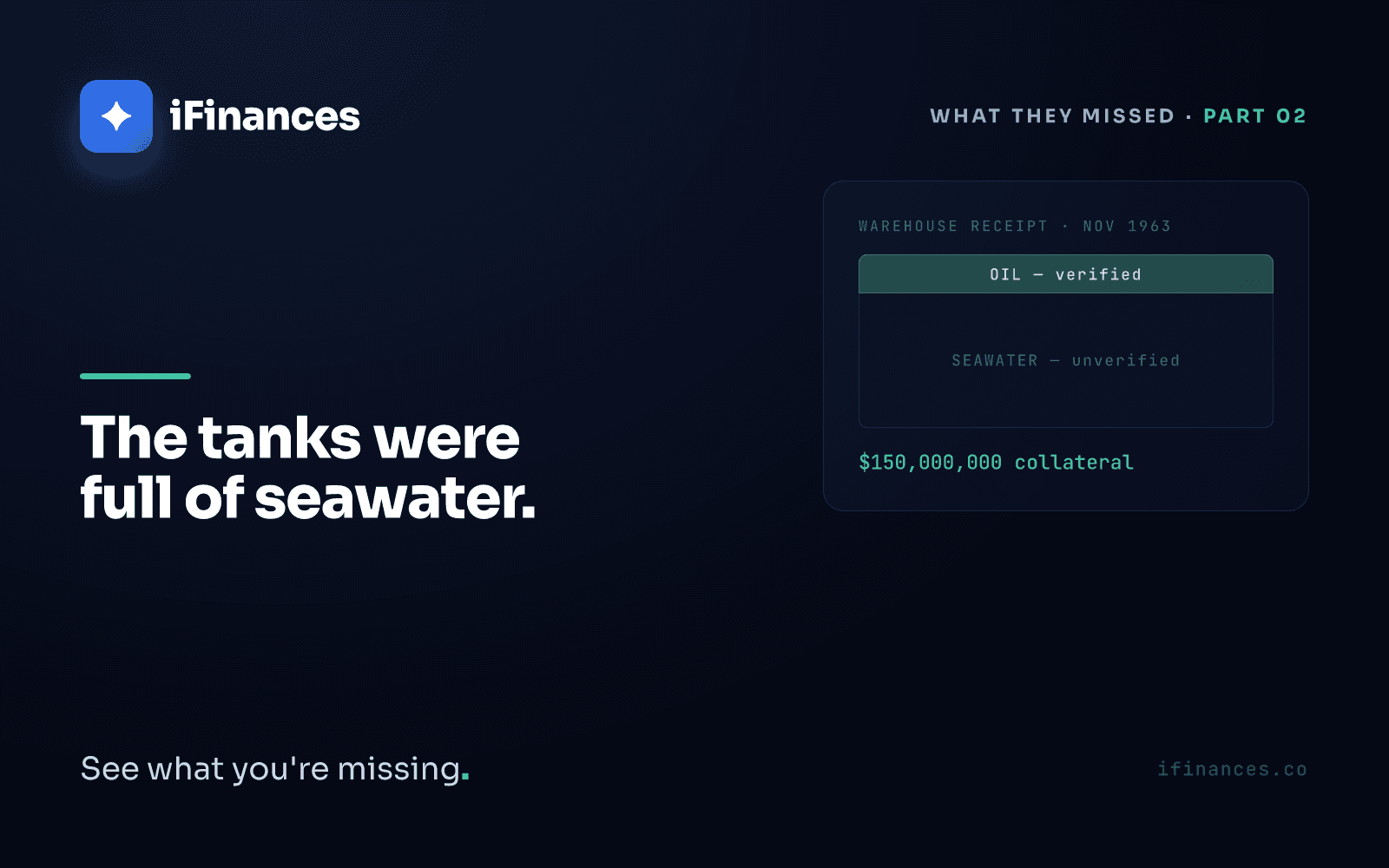
The oil the inspector touched was real. It was a few feet deep. Beneath it, all the way down to the floor of the tank, was seawater.
What actually happened
Allied Crude Vegetable Oil, run by a Bronx-born commodities dealer named Anthony "Tino" De Angelis, financed itself through a mechanism that was ordinary practice at the time. A warehousing firm certifies the inventory sitting in your tanks; the certificate — a warehouse receipt — becomes collateral; lenders advance cash against it. The certifying firm in Bayonne was a subsidiary of American Express, and its inspectors did come to measure. They climbed the tanks and sampled from the top.
Vegetable oil floats on water. That single physical fact carried the entire fraud. The tanks were filled mostly with seawater, with a layer of oil on top deep enough to meet a sampling tube. When inspections moved from tank to tank, oil could move too, through connecting pipes, so the same oil was counted more than once. Some tanks held hidden compartments. Eventually De Angelis stopped bothering with the physics and simply forged receipts outright.
The paper grew on its own logic. By 1963, Allied's certified inventory had reached many times the oil actually sitting in Bayonne — by some contemporary accounts, more than the country's visible supply of soybean oil, a comparison no lender ever made, although national stock figures were public.
In mid-November 1963, a leveraged position in soybean oil futures turned against De Angelis, margin calls arrived, and Allied filed for bankruptcy. Investigators returned to the tanks and, this time, checked the bottom. Seawater. More than $150 million had been borrowed against the receipts; total losses climbed past $175 million. Two brokerage houses were suspended on the New York Stock Exchange. American Express, whose subsidiary had signed the receipts, watched its stock lose more than half its value. De Angelis pleaded guilty and was sentenced in 1965. The collapse ran through the same week the country stopped for the assassination of President Kennedy, and the financial story nearly disappeared beneath the national one.
A receipt is not a second source
The uncomfortable part is that almost everyone in this story did their job. The inspectors sampled the tanks the way tanks were sampled. The lending officers verified the receipts the way receipts were verified. The documents were internally consistent — signature, format, issuer, all in order. Fifty-one institutions ran the same control and got the same clean result.
The control they ran was authenticity: is this paper real? The control nobody ran was correspondence: does this paper match the world? Those are different questions, and the second one cannot be answered from inside the document. A receipt, however genuine, is testimony from a single witness. Examining the signature more closely does not add a second witness.
A number you have seen in only one place is not a fact. It is a claim. Verification begins where the second source begins.
Every route to a second source stood open. A physical audit that sampled below the surface would have found the water. A comparison against published national stocks would have shown how implausibly large the certified figure had grown. A confirmation routed past the borrower to an independent party would have broken the loop in which Allied's paper vouched for Allied's oil. None of this required suspicion or genius. It was simply nobody's step, because the paper looked like enough.
Modern ledgers keep the same shape. A balance confirmed only by the system that produced it is the paper describing the tank. Your ERP says a receivable is open; the bank statement is the tank. Until the two are read against each other, line by line, what you hold is a well-formatted claim.
What this means for your close
The mechanics of 1963 translate into month-end mechanics with very little adjustment:
- Treat any figure that exists in only one source as unconfirmed, however clean the document carrying it. One source is a claim; two independent sources are the beginning of evidence.
- Count sources by origin, not by document. Ten reports generated from the same ledger are one source. A receipt, an invoice copy, and a statement all issued by the same counterparty are one source.
- Sample below the surface. Totals are the top of the tank; agreement at the total can float on disagreement underneath. Confirmation that means something happens at the line level.
- Cross-check before a number enters the close, not after someone asks. In 1963, every hard question was asked after the bankruptcy filing.
Auditors have a name for this doctrine — independent confirmation — and it is the founding logic of reconciliation itself: the ledger against the bank, the ledger against the counterparty, each source allowed to contradict the others. We have written about what accumulates when the gap between record and reality goes unexamined in the invisible balance sheet, and this series opened with a single account that stayed outside every cross-check until it was the whole story.
The second source, as a habit
What failed in 1963 was not intelligence but architecture: the second source existed, and no process required anyone to consult it. That is the gap a visibility layer is built to close — not by trusting any one record more, but by refusing to let any record answer for itself.
Three-way reconciliation is that refusal made routine: the bank statement, the e-invoice, and the ledger read side by side, so every material figure is confronted with an account of itself from a source it does not control. Where the three agree, the agreement is evidence. Where a figure appears in one source and not the others, the absence surfaces as a signal instead of staying quiet — the discipline we described in treating anomalies as signals rather than errors. This is how iFinances is built: the system shows where sources diverge, suggests the match it believes in, and explains its reasons — and the decision to accept remains a human signature. The machine checks the bottom of the tank. A person still says what the tank means.
Frequently asked questions
What was the salad oil swindle of 1963?
Allied Crude Vegetable Oil, led by Anthony "Tino" De Angelis, borrowed more than $150 million from 51 lenders against warehouse receipts certifying soybean oil that largely did not exist; the storage tanks in Bayonne, New Jersey held seawater beneath a shallow layer of oil. The company collapsed in November 1963, and total losses passed $175 million. American Express, whose subsidiary had issued the receipts, saw its stock lose more than half its value. De Angelis pleaded guilty and was sentenced in 1965.
Why is a single source never enough to confirm a financial figure?
Because a single source can only be tested for authenticity, not for correspondence with reality. A document can be perfectly genuine and still describe something that is not there — every receipt in 1963 passed inspection. Independent sources fail independently, so a figure confirmed by two of them is qualitatively different from a figure seen twice in one of them.
How does three-way reconciliation apply this lesson?
It reads the bank statement, the e-invoice, and the ledger side by side, so that no figure is confirmed solely by the system that produced it. Agreement across independent sources becomes evidence; a figure present in one source and absent in another surfaces as a signal to investigate. The matching is suggested and explained by the system, and the final approval stays with a person.
The inspector climbs down the ladder, and nothing he did was false. The tube touched real oil; the level he recorded was the level he saw. Every fact he gathered was true, and the receipt built on those facts was fiction, because the truth of a tank does not live at its surface. Somewhere in this month's close there is a number you have seen in only one place. It is probably right. In Bayonne, for years, it probably was too. The difference between probably and confirmed is one more source — and its price is set on the day nobody checks.
Frequently Asked Questions
What was the salad oil swindle of 1963?
Allied Crude Vegetable Oil, led by Anthony "Tino" De Angelis, borrowed more than $150 million from 51 lenders against warehouse receipts certifying soybean oil that largely did not exist; the storage tanks in Bayonne, New Jersey held seawater beneath a shallow layer of oil. The company collapsed in November 1963, and total losses passed $175 million. American Express, whose subsidiary had issued the receipts, saw its stock lose more than half its value. De Angelis pleaded guilty and was sentenced in 1965.
Why is a single source never enough to confirm a financial figure?
Because a single source can only be tested for authenticity, not for correspondence with reality. A document can be perfectly genuine and still describe something that is not there — every receipt in 1963 passed inspection. Independent sources fail independently, so a figure confirmed by two of them is qualitatively different from a figure seen twice in one of them.
How does three-way reconciliation apply this lesson?
It reads the bank statement, the e-invoice, and the ledger side by side, so that no figure is confirmed solely by the system that produced it. Agreement across independent sources becomes evidence; a figure present in one source and absent in another surfaces as a signal to investigate. The matching is suggested and explained by the system, and the final approval stays with a person.
✦ iFinances — See what you're missing.