What They Missed · Part 09/10
It is mid-November 2022, and a restructuring team is doing what restructuring teams do on day one: making lists. A list of the legal entities. A list of the bank accounts each entity holds. A list of who is authorized to sign on each of those accounts. A list of what is owed, and to whom. None of this is analysis yet. The lists are the floor that every later judgment will stand on.
The man directing the work has spent roughly forty years walking into failed companies. He helped unwind Enron. He has seen fraud, leverage, negligence, and every combination of the three, and in each case the first week looked broadly the same: secure the records, assemble the lists, then begin. The lists were often battered — out of date, scattered across systems, arguing with each other. But they existed, because in every company he had entered, somebody had been keeping books.
This time the lists do not come together. The team asks for a register of the group's bank accounts and cannot find one it trusts. It asks who can sign on which account, and no reliable answer comes back. The company at the center of the work is FTX, a crypto exchange through which customers around the world held their balances. What unsettles the professionals is not the scale of the collapse. It is the silence where the lists should be.
What actually happened
On 11 November 2022, FTX Trading Ltd. and more than one hundred affiliated companies filed for Chapter 11 protection in Delaware. Sam Bankman-Fried resigned as CEO, and John J. Ray III — the restructuring specialist who had overseen the long unwinding of Enron — was appointed in his place.
Six days later, on 17 November, Ray filed his first-day declaration with the bankruptcy court. One sentence in it traveled around the world: "Never in my career have I seen such a complete failure of corporate controls and such a complete absence of trustworthy financial information as occurred here."
The sentence was strong. The details beneath it carried more weight. The declaration reported that the group did not have an accurate list of its own bank accounts, nor of the people authorized to sign on them. It reported that appropriate books and records had not been kept. Accounting for parts of a group that spanned more than one hundred entities ran on QuickBooks, a package designed for small businesses. A month later, testifying before the United States House Financial Services Committee, Ray described an "utter failure of corporate controls at every level of an organization."
Read those findings in order and notice what kind of failure they describe. Not a wrong number — an absent one. Not a ledger that lied, but a ledger that, in the sense that matters, was never fully there. Every collapse Ray had handled before contained defects in controls. This one contained an absence of the thing the controls exist to protect.
Before the match, the list
Everything this series has examined rests on one quiet precondition. Matching a payment to an invoice assumes both are recorded. Cross-checking bank against ledger assumes you know which bank accounts exist. Flagging an anomaly assumes there is a population to deviate from. Each technique begins from an enumeration — and an enumeration is exactly what FTX's new management could not obtain.
Part 08 of this series told the story of a balance that lived in the ledger for years while nobody asked the bank. FTX is that story inverted. At Wirecard there was a precise claim and no verification. At FTX there was no stable set of claims to verify — before anyone could ask a bank to confirm a balance, someone had to establish which banks to ask.
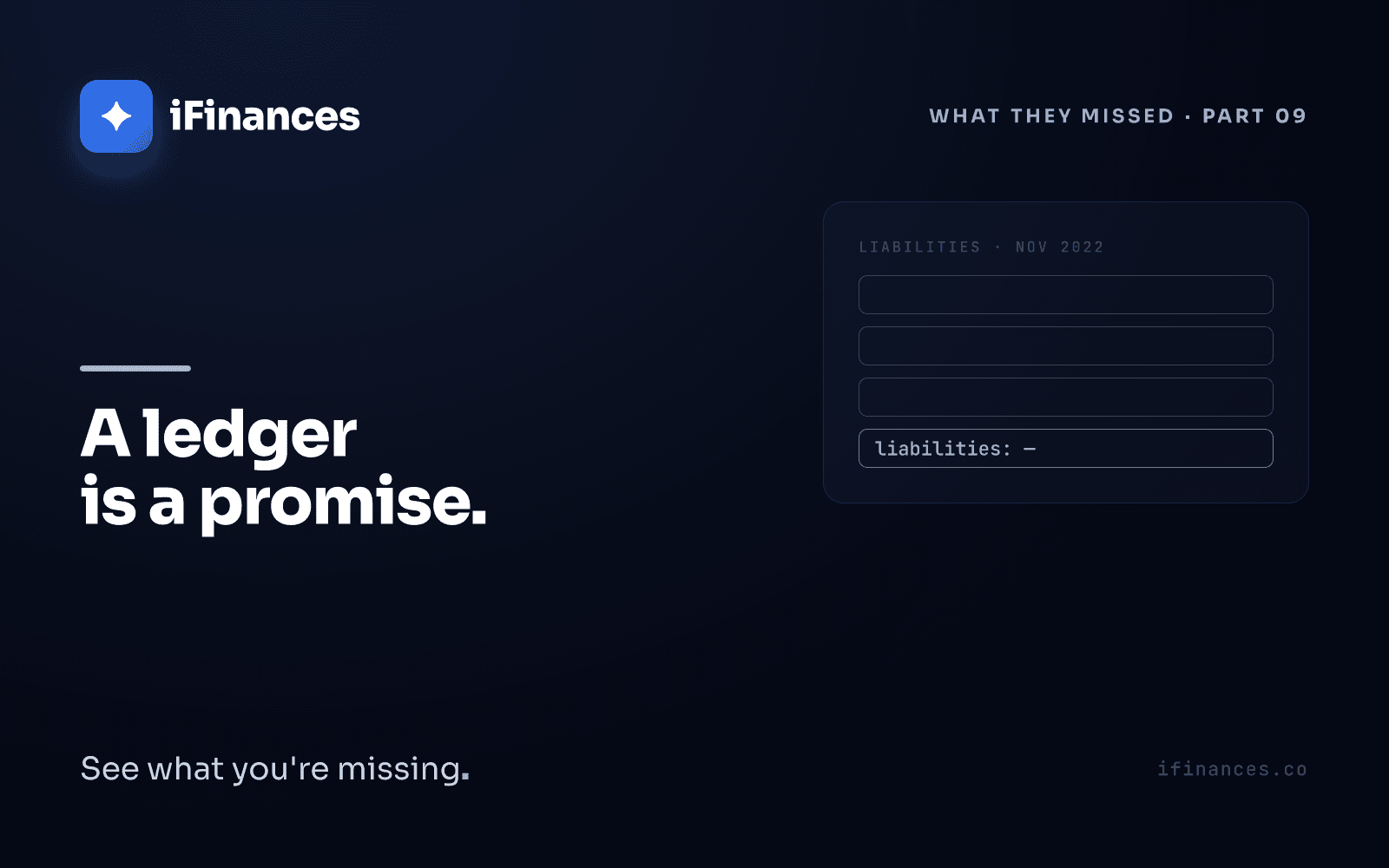
A ledger is usually described as a record. That undersells it. A record captures events; a ledger promises coverage. It says: everything that exists is in here, once. The promise has two halves. Accuracy — what is listed is right. Completeness — what is right is listed. Most controls guard the first half, because errors in listed items create variances, and variances make noise. Completeness fails in silence. A missing account produces no wrong number, only no number, and no report highlights a row that was never written.
A ledger is a promise: that somewhere, a complete and honest list is being kept. Reconciliation is how that promise is checked against the outside world — and a promise nobody checks is, over time, just a hope.
This is why we argue that reconciliation is trust infrastructure rather than a month-end chore. The monthly ritual, at its root, is the periodic testing of the list against witnesses that do not depend on you: the bank's own statement, the counterparty's own ledger. Before software, before automation, before any dashboard, a finance function's first deliverable is a trustworthy list. FTX built and ran its own trading platform. It did not have the list.
What this means for your close
No reader of this series runs a company without books. But completeness fails in ordinary companies too — a currency account opened for one project and forgotten, a subsidiary ledger that never joins the consolidation, a payment channel that lives outside the close. The FTX lesson scales down cleanly.
- Begin the close with enumeration, not matching. Before asking whether the numbers agree, ask whether every account, ledger, and payment channel is on the list at all. A close that starts from last month's list inherits last month's blind spots.
- Treat the bank as a witness, not a mirror. Completeness can only be tested from outside your own records — against statements the bank produces, not exports your own system produces.
- Watch for silence, not only variance. A difference between two numbers is a loud problem that demands attention. An account that appears in no comparison is a quiet one, and quiet problems age badly.
- Keep signatories on the list. Who can move money out of each account is part of the ledger's promise, not an administrative footnote. Ray's declaration cited the missing signatory lists for a reason.
The lesson beneath all four is the same: the ledger is trust infrastructure, and visibility begins with the humble, complete list. Matching, forecasting, audit — everything else a finance function does is built on top of that list, and holds only as long as it does.
Where a visibility layer stands
There is a reason serious reconciliation work starts with an inventory rather than an algorithm. When bank, e-invoice, and ledger are cross-checked against one another, the first thing the exercise produces is not matches — it is a census. Which accounts exist. Which sources feed them. Which source has gone quiet since last month. Only then does line-level matching begin, because matching inside an incomplete universe verifies nothing.
That census is where a visibility layer earns its keep. iFinances holds the enumeration in one place — the accounts, the invoice sources, the ledger slices — and shows when something drops out of it: a source that stopped arriving, a balance with no outside witness, a line that belongs to no known account. The engine suggests which payment closed which invoice and shows the reasons for each suggestion; a person approves or rejects it. The signature stays human, deliberately — because the system's job is to make the list and its gaps visible, not to promise the gaps away.
None of this requires a collapse to be worth doing. It requires only the recognition that a list, like a bridge, is infrastructure: unnoticed while it holds, decisive when it fails. If the vocabulary here is new, the complete guide to reconciliation walks through it from the beginning.
Frequently asked questions
What did the FTX restructuring team actually find in November 2022?
On 11 November 2022, FTX and more than one hundred affiliated companies filed for Chapter 11 in Delaware. In his first-day declaration of 17 November, new CEO John J. Ray III reported that the group had no accurate list of its bank accounts or account signatories, had not kept appropriate books and records, and ran parts of its accounting on QuickBooks. In December he told the US Congress the case represented an "utter failure of corporate controls at every level of an organization."
Why is a complete list of accounts a financial control?
Because completeness fails silently. An error in a recorded item produces a variance that someone eventually notices; an account missing from the list produces no variance, no exception, and no red cell anywhere. Enumerating accounts, payment channels, and ledger sources — and re-verifying that enumeration against outside statements — is therefore the control on which every other control depends.
Where should a finance team start if it doubts its own list?
Start outside your own records. Collect statements directly from each bank and payment provider, and compare that external inventory against what your ledger believes exists. Anything present on one side and absent on the other is the finding. Then move to line-level reconciliation — with a person reviewing and approving what the comparison suggests.
The lists did get made, in the end. Assembling them fell to outsiders — restructuring professionals rebuilding, under court supervision and at professional rates, what an ordinary finance function keeps as a matter of course: which accounts exist, who signs, what is owed and to whom.
That is the quiet dignity of a well-kept ledger. No board slide celebrates it. It is a promise kept daily and invisibly — visible only in a borrowed conference room where, one November, a team of veterans asked for the everyday documents any company owns and, for the first time in a long career, found nothing to rely on.
Frequently Asked Questions
What did the FTX restructuring team actually find in November 2022?
On 11 November 2022, FTX and more than one hundred affiliated companies filed for Chapter 11 in Delaware. In his first-day declaration of 17 November, new CEO John J. Ray III reported that the group had no accurate list of its bank accounts or account signatories, had not kept appropriate books and records, and ran parts of its accounting on QuickBooks. In December he told the US Congress the case represented an "utter failure of corporate controls at every level of an organization."
Why is a complete list of accounts a financial control?
Because completeness fails silently. An error in a recorded item produces a variance that someone eventually notices; an account missing from the list produces no variance, no exception, and no red cell anywhere. Enumerating accounts, payment channels, and ledger sources — and re-verifying that enumeration against outside statements — is therefore the control on which every other control depends.
Where should a finance team start if it doubts its own list?
Start outside your own records. Collect statements directly from each bank and payment provider, and compare that external inventory against what your ledger believes exists. Anything present on one side and absent on the other is the finding. Then move to line-level reconciliation — with a person reviewing and approving what the comparison suggests.
✦ iFinances — See what you're missing.